
Dendera Temple Complex and the celestial stone of Qena
Published on 09/09/2026 at 12:13 | Editorial responsibility: Rafael Müller, Editor-in-Chief AD HOC NEWS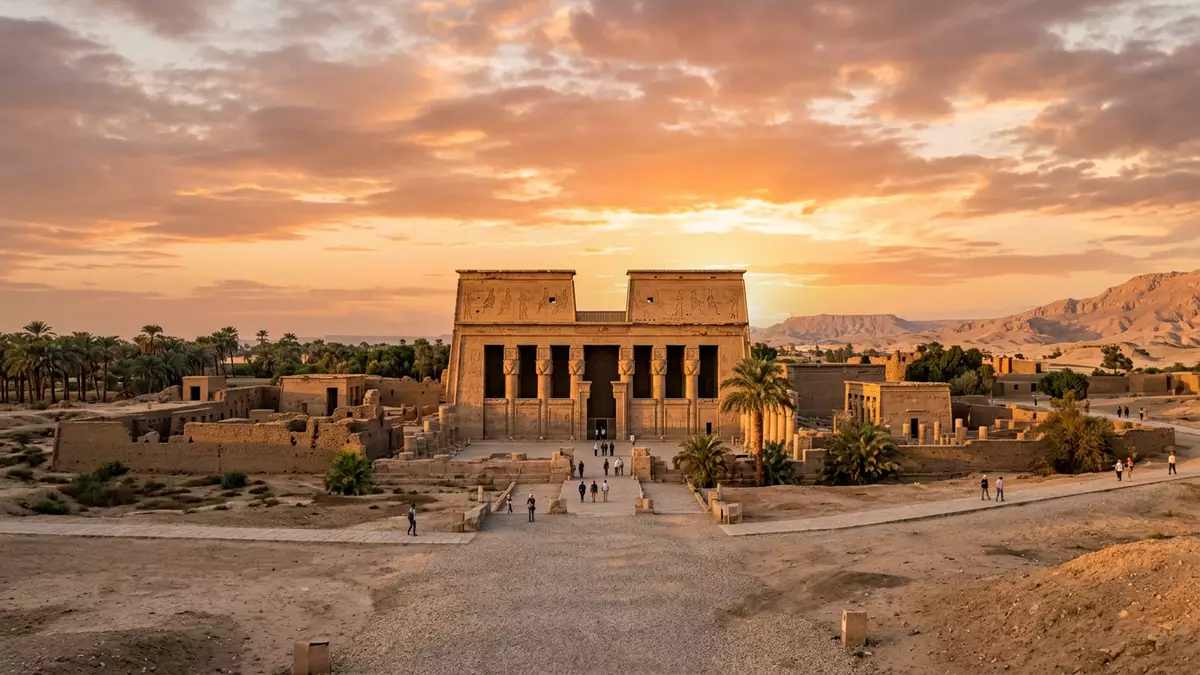
Dendera Temple Complex near Qena in Egypt gathers centuries of stone into a single enclosure, with the Temple of Hathor at its core and the sky carved into its ceilings.
The Temple of Hathor: late Ptolemaic stone under a Roman sky
The dominant monument within Dendera Temple Complex is the Temple of Hathor, dedicated to the goddess associated with music, joy and protection.Temple of Hathor The present temple belongs to the late Ptolemaic period, with construction linked to the reign of Ptolemy XII and continued under Cleopatra VII, and its decoration and architectural completion extending into the Roman era under emperors such as Augustus, Tiberius and Trajan.late Ptolemaic and Roman periods
The temple stands within a large walled enclosure of mudbrick that defines the broader Dendera Temple Complex and separates its ritual spaces from the surrounding landscape.mudbrick enclosed wall Within the stone mass of the main building, visitors encounter columned halls covered in reliefs, chapels lining the sanctuary axis and stairways that climb towards the roof. The hypostyle hall at the temple’s front belongs to the Roman period and carries dense carved scenes and inscriptions, while side chapels and upper chambers extend the route of procession, taking the cult of Hathor towards the light and the open air.
A compact city of shrines, birth houses and a sacred lake
Dendera Temple Complex is more than a single temple: it is a compact city of cult structures framed by its enclosure. Within the walls lie a basilica, birth houses, subsidiary temples and shrines arranged around the main Hathor sanctuary.basilica and birth houses A sacred lake occupies part of the compound, providing a water surface that formed part of ritual practice and offers a reflective counterpart to the surrounding stone.
The earliest surviving building in the complex is a birth house, or mammisi, associated with Nectanebo II of the thirtieth dynasty in the fourth century BC.mammisi of Nectanebo II Nearby, gateways from the Roman period punctuate the enclosure on the north and east, marking formal routes into the sacred precinct.Roman portals Within this framework, the inner courts and side chapels create a layered experience of space, moving from broad open areas with views to the enclosure walls into narrower corridors and rooms where reliefs sit close to the viewer and traces of colour remain on carved figures and hieroglyphs.
The Dendera Zodiac and the temple’s carved sky
Among the most discussed works associated with Dendera Temple Complex is the Dendera Zodiac, a carved sandstone bas-relief that once formed part of the ceiling of a chapel dedicated to Osiris on the roof of the Temple of Hathor.Dendera Zodiac ceiling relief The zodiac dates to the late Ptolemaic period, around the mid-first century BC, and brings together figures for the twelve zodiac signs, Egyptian decans and constellations arranged around a circular composition.late Ptolemaic circular bas-relief
The original circular zodiac was removed from Dendera in the nineteenth century and is now displayed at the Louvre in Paris, while rectangular astronomical reliefs remain on the temple ceilings at the site.zodiac now in the Louvre These carved skies connect the architecture of Dendera Temple Complex with ancient understandings of the heavens, turning the ceilings into stone planispheres where celestial bodies, deities and time cycles are rendered in hieroglyphic and figural form. The combination of liturgical rooms below and astronomical iconography above gives the complex a distinctive place in the study of Egyptian religion and archaeoastronomy.
Visiting Dendera Temple Complex: what travellers from Western Europe should know
- Dendera Temple Complex lies near the town of Dendera on the west bank of the Nile, a short distance south of Qena in Upper Egypt.location near Qena
- Within the enclosure, movement involves crossing uneven stone surfaces, climbing stairways inside the Temple of Hathor and navigating roof passages to reach the chapels where astronomical reliefs were carved.
- The official language is Arabic and the currency is the Egyptian pound.
- Entry requirements depend on your nationality; UK travellers can check the FCDO travel advice at gov.uk/foreign-travel-advice, Irish travellers the Department of Foreign Affairs at ireland.ie.
Searching for Dendera Temple Complex on social platforms
These links open searches for Dendera Temple Complex on each platform.
Frequently asked questions about Dendera Temple Complex
Where is Dendera Temple Complex and what does it include?
Dendera Temple Complex stands near Dendera, south of Qena in Upper Egypt, and includes the Temple of Hathor, birth houses, a basilica, a sacred lake and various shrines within an enclosure.
What can visitors expect inside the Temple of Hathor?
Visitors encounter carved columns, relief-covered halls, side chapels and roof stairways, with astronomical ceilings and cult rooms forming a dense sequence of ritual spaces.
What makes Dendera Temple Complex distinctive among Egyptian temple sites?
The combination of a well-preserved late Ptolemaic and Roman temple of Hathor, its surrounding birth houses and the famous Dendera Zodiac relief linked to celestial imagery gives the complex particular importance.


