

Dendera Temple Complex and its celestial stone world
Published on 09/16/2026 at 16:38 | Editorial responsibility: Rafael Müller, Editor-in-Chief AD HOC NEWS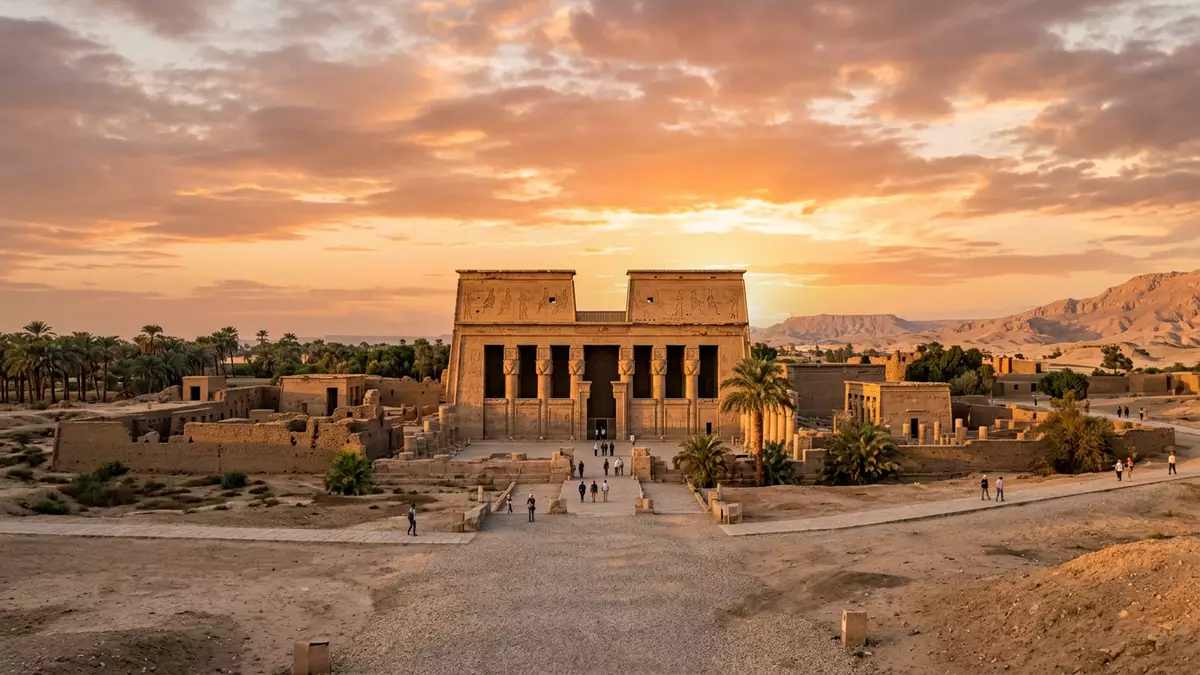
On the west bank of the Nile opposite Qena, Dendera Temple Complex preserves a stone world where the goddess Hathor, processional routes and carved skies meet in one enclosed sacred landscape.Dendera Temple complex dominates a walled precinct above the river, its main temple rising from ground that has carried cult buildings for Hathor since the pharaonic period.
Hathor’s sanctuary in stone
The heart of Dendera Temple Complex is the great Temple of Hathor, a sandstone monument whose present form belongs to the late Ptolemaic and early Roman periods.Temple of Hathor at Dendera Construction of the current temple began around 54 BC under Ptolemy XII Auletes, continued under Cleopatra VII and carried into the reigns of Roman emperors, including Tiberius.construction beginning around 54 BC Hathor, associated with love, music and joy, is present throughout in reliefs, shrines and columns that carry her likeness.
The temple’s plan follows the familiar Egyptian sequence of forecourt, hypostyle hall and progressively darker inner chambers, yet the density of carving at Dendera gives each space particular character.Dendera temple complex Massive columned halls are covered with hieroglyphic texts and images, while subsidiary chapels and crypts are cut into the thickness of the walls and floors, creating a layered interior dedicated to ritual and myth. The complex sits within a substantial mud-brick enclosure, separating the sacred architecture from the surrounding agricultural land along the Nile.
Ceilings of stars and the Dendera Zodiac
Dendera Temple Complex is closely associated with carved images of the sky, most famously the Dendera Zodiac, a circular astronomical relief originally set into the ceiling of a chapel dedicated to Osiris on the temple roof.sculptured Dendera zodiac The zodiac shows constellations, including Taurus and Libra, arranged around the central sky, and was once removed from Dendera and installed at the Musée du Louvre in Paris, where it remains on display.Dendera Zodiac astronomical relief
Within the temple itself, other ceilings carry extensive astronomical decoration, including a large rectangular composition in the pronaos that sets rows of deities against coloured bands representing the heavens.beautifully decorated ceiling These carved skies situate Dendera Temple Complex within both religious and observational traditions, linking the goddess Hathor with the cyclical movements of stars and planets. The survival of pigments on parts of the ceiling and columns makes the celestial theme more legible, suggesting how vivid the imagery would have appeared when newly painted.
A walled complex on the Nile
Dendera Temple Complex occupies a position beside the Nile that connects it to both riverine and desert landscapes of Upper Egypt. The enclosure stands near the modern town of Dendera, across the river from Qena, with the precinct extending over an area of about 40,000 square metres within a mud-brick wall.covers some 40,000 square meters The site lies a short distance inland from the riverbank, reached by roads that cross the cultivated floodplain and rise gently towards the temples.
Within the walls, visitors encounter not only the Temple of Hathor but also other structures, including ruined temples, birth houses and sacred lakes that formed part of the wider ritual landscape.west bank of the Nile about 2.5 km from Dendera The complex’s preservation has drawn attention from heritage organisations, and its reliefs, crypts and ceilings make it a key site for understanding religious architecture in the Graeco-Roman period of Egypt.one of the best-preserved temple complexes
Visiting Dendera Temple Complex: what travellers from Western Europe should know
- Dendera Temple Complex stands near the town of Dendera on the west bank of the Nile, opposite Qena in Upper Egypt, reached by road from the regional centres.
- Within the complex, movement involves walking along stone-paved routes, climbing staircases to roof chapels and passing through halls lined with columns and reliefs.
- The wider landscape around Dendera is largely level agricultural ground beside the Nile, so approaches to the enclosure involve only modest gradients on compact surfaces.
- The official language is Arabic and the currency is the Egyptian pound. Entry requirements depend on your nationality; UK travellers can check the FCDO travel advice at gov.uk/foreign-travel-advice, Irish travellers the Department of Foreign Affairs at ireland.ie.
Searching for Dendera Temple Complex on social platforms
These links open searches for Dendera Temple Complex on each platform.Frequently asked questions about Dendera Temple Complex
Where is Dendera Temple Complex located?
Dendera Temple Complex stands near the town of Dendera on the west bank of the Nile in Upper Egypt, across the river from the city of Qena.across the river from Qena
What can visitors expect when exploring the complex?
Visitors encounter the large sandstone Temple of Hathor with columned halls, decorated ceilings, chapels, crypts and other structures enclosed by a substantial mud-brick wall.enclosed by a hefty mud brick wall
What makes Dendera Temple Complex distinctive among Egyptian temple sites?
The complex is known for the preservation of its Graeco-Roman temple architecture and for its carved astronomical ceilings, including the Dendera Zodiac now displayed at the Musée du Louvre.now on display at the Musée du Louvre


