
Den Lille Havfrue sits small on Copenhagen’s harbour
Published on 09/22/2026 at 21:37 | Editorial responsibility: Rafael Müller, Editor-in-Chief AD HOC NEWS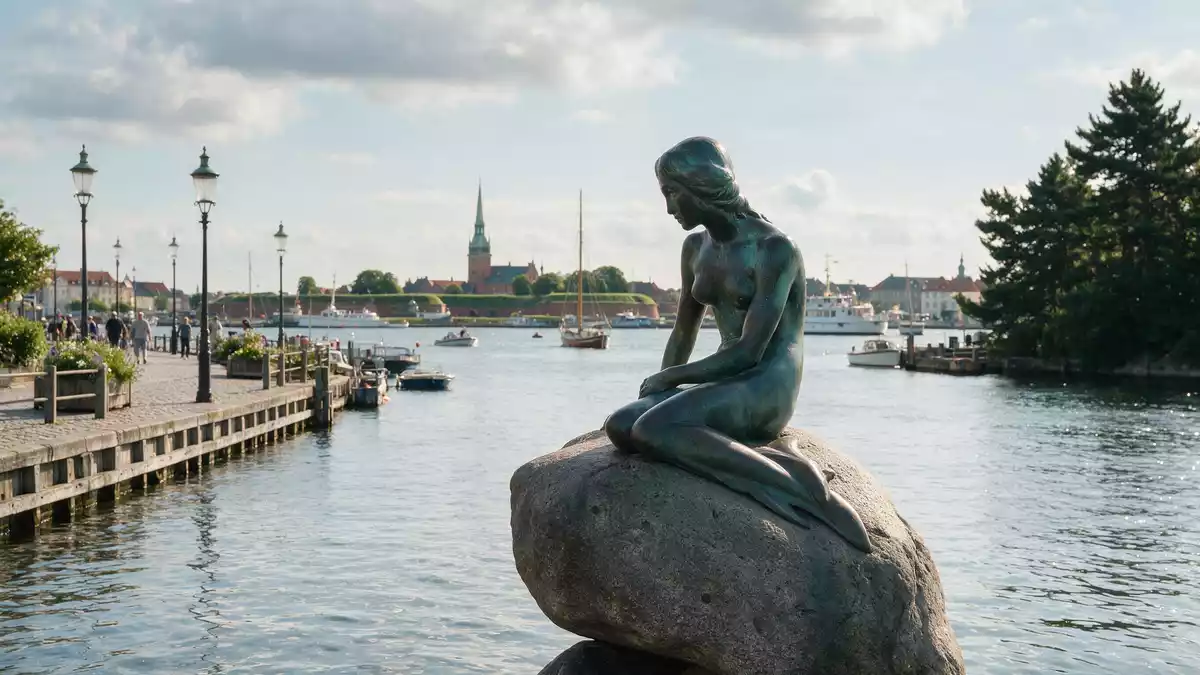
Den Lille Havfrue is a small bronze figure seated on a granite boulder beside Kopenhagen’s harbour. The sculpture brings together the sea creature from Hans Christian Andersen’s nineteenth-century fairy tale, the work of Edvard Eriksen and the shoreline of Langelinie.
Den Lille Havfrue on a granite harbour boulder
The statue stands at Langelinie, a waterfront promenade on the Østerbro side of Kopenhagen Harbour. Its setting is direct and physical: bronze rests on granite, with the water immediately beyond the quay and the harbour entrance opening towards the sea.
The figure is compact, measuring 1.25 metres in height. Her human upper body joins a fish tail, and she sits with her gaze turned towards the water. The contrast between the small sculpture and the open harbour forms the central visual fact of the site. the bronze figure’s height is recorded as 1.25 metres.
From Andersen’s tale to Edvard Eriksen’s bronze
Hans Christian Andersen published The Little Mermaid in 1837. The story supplied the literary figure that entered Danish theatre, ballet and public art during the nineteenth and early twentieth centuries.
Carl Jacobsen commissioned Edvard Eriksen to create the sculpture in 1909. Eriksen produced the seated mermaid in bronze, and the work was unveiled on 23 August 1913. Jacobsen gave the statue to the City of Copenhagen, connecting a private commission with a public waterfront. the 23 August 1913 unveiling remains part of the statue’s recorded identity.
Langelinie, water and the city’s literary figure
Den Lille Havfrue occupies a narrow meeting point between sculpture, promenade and harbour. The boulder gives the figure a low base, while the shoreline places the tale within a working maritime landscape rather than inside a gallery.
Ships, harbour structures and the opposite shore form the surrounding view. The statue’s material records its setting: bronze carries the figure, and granite carries the weight of the sculpture at the water’s edge. Its literary origin is equally visible in its name, which refers to Andersen’s mermaid.
The work belongs to Danish public art of the early twentieth century. It is neither a large architectural monument nor a building with an interior. Its scale, pose and position make it a sculpture encountered along the promenade, with the harbour forming the space behind it.
Visiting Den Lille Havfrue: what travellers from Western Europe should know
- Den Lille Havfrue stands on Langelinie promenade beside Kopenhagen Harbour, on the Østerbro side of the city. Østerport station is the named rail and Metro reference point for the waterfront.
- The sculpture is placed at the water’s edge on a granite boulder. The approach follows a public promenade, with the harbour and quay beside the route.
- The figure is only 1.25 metres tall, so the boulder and the open harbour setting form part of the visual scene.
- The nearby Kastellet is a historic fortified site beside the Langelinie waterfront. Its earthworks and paths create a separate landmark close to the statue.
- The official language is Danish and the currency is the Danish krone.
Searching for Den Lille Havfrue on social platforms
These links open searches for Den Lille Havfrue on each platform.
Frequently asked questions about Den Lille Havfrue
Where is Den Lille Havfrue?
Den Lille Havfrue stands on Langelinie promenade beside Kopenhagen Harbour, on the Østerbro side of the city. The statue is near the harbour entrance and Østerport station.
What can visitors expect at the statue?
The site is an outdoor waterfront setting with a bronze figure on a granite boulder. The approach follows the Langelinie promenade beside the quay and harbour.
What makes Den Lille Havfrue distinctive?
Its compact bronze form combines a human upper body with a fish tail and connects Andersen’s 1837 fairy tale with Kopenhagen’s harbour. Edvard Eriksen’s sculpture was unveiled on 23 August 1913.


