
Den Lille Havfrue on Copenhagen’s harbour boulder
Published on 09/10/2026 at 21:42 | Editorial responsibility: Rafael Müller, Editor-in-Chief AD HOC NEWS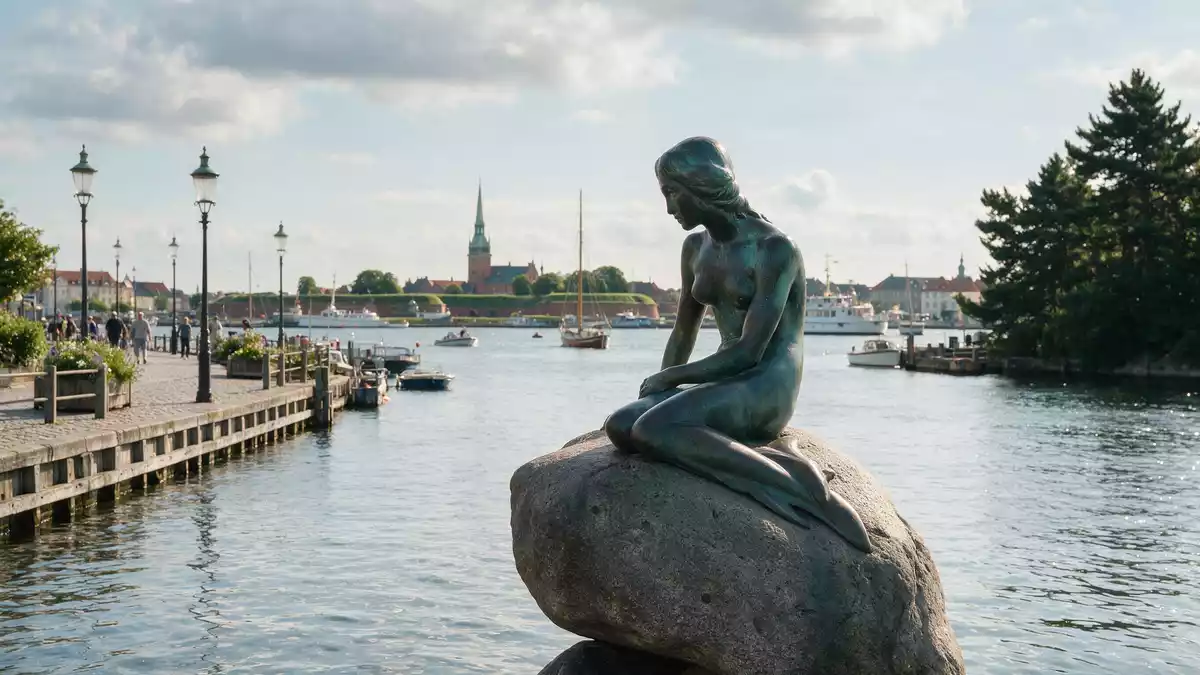
Den Lille Havfrue, known in English as the Little Mermaid, is a small bronze figure poised on a harbour boulder along the Langelinie waterfront in Kopenhagen, a sculpture that links Denmark’s capital directly to Hans Christian Andersen’s nineteenth-century mermaid tale. Cast by sculptor Edvard Eriksen and unveiled in 1913, the statue has become a fixed point on the edge of the city’s harbour, more a quiet marker on the water than a grand column or triumphal arch inland.
A bronze mermaid shaped by Andersen’s story
The figure of Den Lille Havfrue is a bronze sculpture by Danish artist Edvard Eriksen, created after a commission from brewer Carl Jacobsen, heir to the Carlsberg brewery fortune.Bronze sculpture by Edvard Eriksen The statue depicts a mermaid in the moment of transition between sea and land, with the upper body in human form and the lower body retaining the fluid lines of a sea creature. The composition is compact, with the figure arranged close to the boulder rather than stretched out, and the sculpture is significantly smaller than many visitors expect from its reputation, with a height of about 1.25 m (4.1 ft).Height of about 1.25 m
Hans Christian Andersen published “The Little Mermaid” in 1837, and that story provides the narrative background for the harbour statue devoted to his character.Andersen’s 1837 fairy tale Decades later, in 1909, a ballet adaptation of the tale at the Royal Danish Theatre prompted Carl Jacobsen to commission a permanent sculpture for Copenhagen, drawing directly on Andersen’s description of the mermaid who longs for life among humans.Commission after a theatre ballet Eriksen’s work takes that literary figure and renders her in metal, giving Kopenhagen a tangible emblem for a story that had already entered the country’s cultural memory.
From commission to harbourside unveiling
The path from Andersen’s written tale to Den Lille Havfrue on her harbour boulder ran through Copenhagen’s early twentieth-century cultural life. In 1909, Carl Jacobsen saw the ballet “Den lille Havfrue” at the Royal Danish Theatre and resolved to create a mermaid statue for the harbour entrance, turning to Edvard Eriksen to realise the idea.Carl Jacobsen’s commission Eriksen worked on the piece in bronze, using a granite boulder as the base, and the finished sculpture was installed along the Langelinie waterfront.
The statue was unveiled on 23 August 1913, and Jacobsen gifted it to the City of Copenhagen; from that point the municipality became the owner while the Eriksen family retained control of image rights.Unveiled on 23 August 1913 The unveiling did not take the form of a monumental ceremony but marked the quiet placement of a mermaid at the harbour edge. Since 1913 the statue has stood at Langelinie, with one notable exception when it travelled to the Shanghai World Expo in 2010 as a temporary loan; otherwise the bronze has remained on its harbour rock facing the water.Continuous presence at Langelinie
On the harbourfront at Langelinie
Den Lille Havfrue occupies a specific, modest position along Copenhagen’s waterfront. The statue sits on a single granite boulder at the water’s edge on the Langelinie promenade in the Østerbro district, with harbour water lapping against the rock and the quay stretching away on either side.Location on Langelinie promenade Unlike many civic monuments placed on squares or in front of public buildings, this sculpture is aligned with the line of the shore, and its base is part of the harbour’s edge rather than an elevated plinth in stone.
The wider setting is a public harbour area that has evolved from a defensive waterfront into an open promenade, and Den Lille Havfrue forms one of its focal points, set against a backdrop of harbour traffic and quayside structures.Harbourfront setting at Langelinie Nearby paths and low walls give visitors clear sightlines towards the mermaid and across the water. The sculpture’s small scale means that its presence relies on this intimate relationship with the rock and the harbour rather than on height or mass; the piece is accessible at close quarters, and the bronze surface can be seen from short range without barriers.
Visiting Den Lille Havfrue: what travellers from Western Europe should know
- Den Lille Havfrue stands on the harbourfront at Langelinie on the Østerbro side of Kopenhagen, along the waterside promenade north-east of the historic centre.
- The statue is reached on foot along relatively level harbour paths, with low walls and steps down to the water’s edge near the boulder.
- Østerport railway station lies within walking distance inland from Langelinie, and local harbour tours by boat pass the statue as part of their routes.
- The official language is Danish and the currency is the Danish krone.
Searching for Den Lille Havfrue on social platforms
These links open searches for Den Lille Havfrue on each platform.
Frequently asked questions about Den Lille Havfrue
Where is Den Lille Havfrue located in Kopenhagen?
Den Lille Havfrue stands on a granite boulder at the water’s edge along the Langelinie promenade in the Østerbro district of Kopenhagen’s harbour.
What should visitors expect when they reach the statue?
Visitors find a compact bronze mermaid sculpture close to the harbour water, set at low level on a single rock with open public access from nearby paths.
What makes Den Lille Havfrue distinctive among Copenhagen’s landmarks?
The statue’s distinction lies in its modest scale, literary origin in Andersen’s 1837 “The Little Mermaid” and enduring position on the harbourfront since 1913.


