
Den Lille Havfrue, Copenhagen’s small mermaid on the harbour edge
Published on 08/27/2026 at 20:57 | Editorial responsibility: Rafael Müller, Editor-in-Chief AD HOC NEWS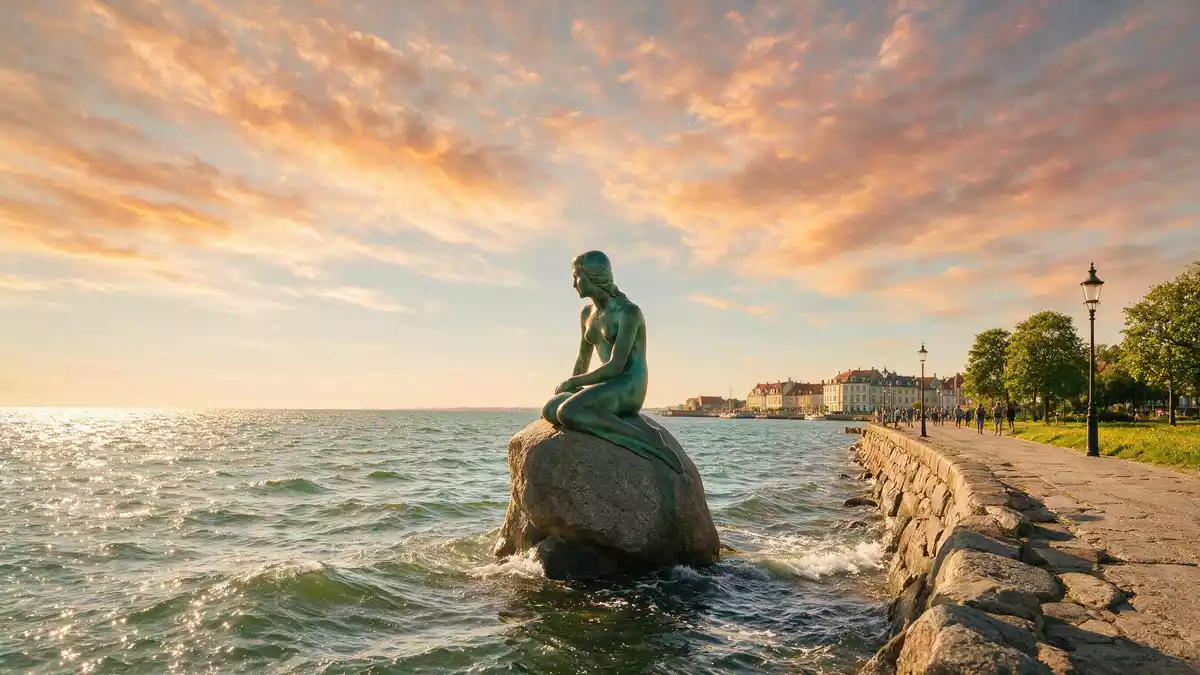
Den Lille Havfrue is a small bronze mermaid on a waterside boulder at Langelinie in Kopenhagen, a figure that has become closely tied to the city’s harbour landscape. Cast in bronze and set on granite, the sculpture links Hans Christian Andersen’s nineteenth-century fairy tale to the everyday traffic of the Østerbro waterfront, bringing a literary character into the open air at the edge of the Baltic.
A mermaid from page to harbour
The story behind Den Lille Havfrue starts with Hans Christian Andersen’s fairy tale “The Little Mermaid”, first published in 1837 and later adapted for ballet at the Royal Danish Theatre in Kopenhagen.Hans Christian Andersen’s 1837 fairy tale provided the figure and mood that the sculpture translates into metal and stone, echoing the mermaid’s transformation between sea and land. The statue itself was commissioned by Carl Jacobsen, a patron linked to the Carlsberg brewery, after he attended a ballet performance inspired by Andersen’s story in 1909 and wanted a permanent mermaid figure for his home city.commissioned by Carl Jacobsen
Danish sculptor Edvard Eriksen created the work and oversaw its casting in bronze, designing a mermaid whose upper body takes human form while the tail curves down towards the stone.bronze statue by Edvard Eriksen The finished sculpture was unveiled on 23 August 1913 and gifted to the City of Copenhagen, establishing Den Lille Havfrue as a permanent feature of the harbour.unveiled on 23 August 1913 Set on a granite boulder at the water’s edge, she looks out over the harbour entrance, with ships and ferries passing behind her and the long promenade stretching away along the shoreline.
Scale, material and setting on Langelinie
One of the most striking aspects of Den Lille Havfrue is her modest scale compared with the attention she attracts. The statue stands around 1.25 m (about 4 ft) high and weighs in the region of 175 kg, a compact figure rather than a towering monument.1.25 m tall and 175 kg Visitors encounter a figure close to their own height, perched on a boulder that rises only a short distance above the water, so the mermaid appears almost at eye level when viewed from the quay.around 1.25 m in height
The materials are simple and robust: cast bronze for the figure and granite for the stone, a combination that withstands salt water and harbour weather while ageing with a characteristic patina.bronze and granite Den Lille Havfrue sits on the Langelinie promenade on the Østerbro side of Kopenhagen Harbour, a waterfront strip that has served as a public promenade since the late nineteenth century and remains a place where harbour infrastructure, walking paths and moored ships meet.Langelinie promenade in København Ø The statue’s position near the harbour entrance means that from the boulder there are views across the water towards the opposite shore and along the line of the quay, with the city’s mix of historic fortifications and later harbour structures within sight.
From fairy tale figure to city landmark
Since her unveiling in 1913, Den Lille Havfrue has stood on Langelinie as a public sculpture embedded in Kopenhagen’s identity, closely associated with the city’s image and with Denmark’s literary heritage.gift from Carl Jacobsen to Copenhagen The statue is accessible from the quay, with visitors able to walk along the waterside path and approach the boulder from the promenade, bringing them into close proximity with the bronze figure. The mermaid’s pose is quiet rather than dramatic: she rests on the stone with her tail wrapped around the rock, her head turned slightly, giving the impression of a character caught between the sea behind her and the land ahead.
Over more than a century, Den Lille Havfrue has weathered salt spray, harbour traffic and the attention that comes with being a recognised city symbol, yet her basic form and position remain as they were at the time of her unveiling.unveiled in 1913 The statue’s modest height and direct placement on the harbour edge tie it closely to everyday movement around Kopenhagen, so that a figure born in a nineteenth-century story has become a fixed point on a working waterfront.
Visiting Den Lille Havfrue: what travellers from Western Europe should know
- Den Lille Havfrue stands on the Langelinie promenade on the Østerbro side of Kopenhagen Harbour, within walking distance of Østerport station on the city’s rail network.
- The statue is reached along a paved waterside path, with low harbour steps and uneven stones near the boulder that may require care when approaching close to the water.
- Nearby, the harbourfront includes the Langelinie quay, moored vessels and views towards the historic Kastellet fortress, making the mermaid part of a wider stretch of waterfront sights.
- The official language is Danish and the currency is the Danish krone.
- Entry requirements depend on your nationality; UK travellers can check the FCDO travel advice at gov.uk/foreign-travel-advice, Irish travellers the Department of Foreign Affairs at ireland.ie.
Searching for Den Lille Havfrue on social platforms
These links open searches for Den Lille Havfrue on each platform.
Frequently asked questions about Den Lille Havfrue
Where exactly is Den Lille Havfrue in Kopenhagen?
Den Lille Havfrue stands on a granite boulder by the water at Langelinie promenade in the København Ø district, near the harbour entrance and Østerport station.
What should visitors expect when seeing the statue?
Visitors encounter a relatively small bronze mermaid close to the quay, set on a waterfront boulder with harbour views and a paved promenade that allows people to approach on foot.
What makes Den Lille Havfrue distinctive among city landmarks?
The statue’s compact height, simple bronze-and-granite construction and direct placement on a working harbourfront give a literary mermaid figure a permanent, everyday presence in Kopenhagen’s waterfront scenery.


