
Delfoi and the terraced sanctuary of Apollo on Mount Parnassus
Published on 09/15/2026 at 13:51 | Editorial responsibility: Rafael Müller, Editor-in-Chief AD HOC NEWS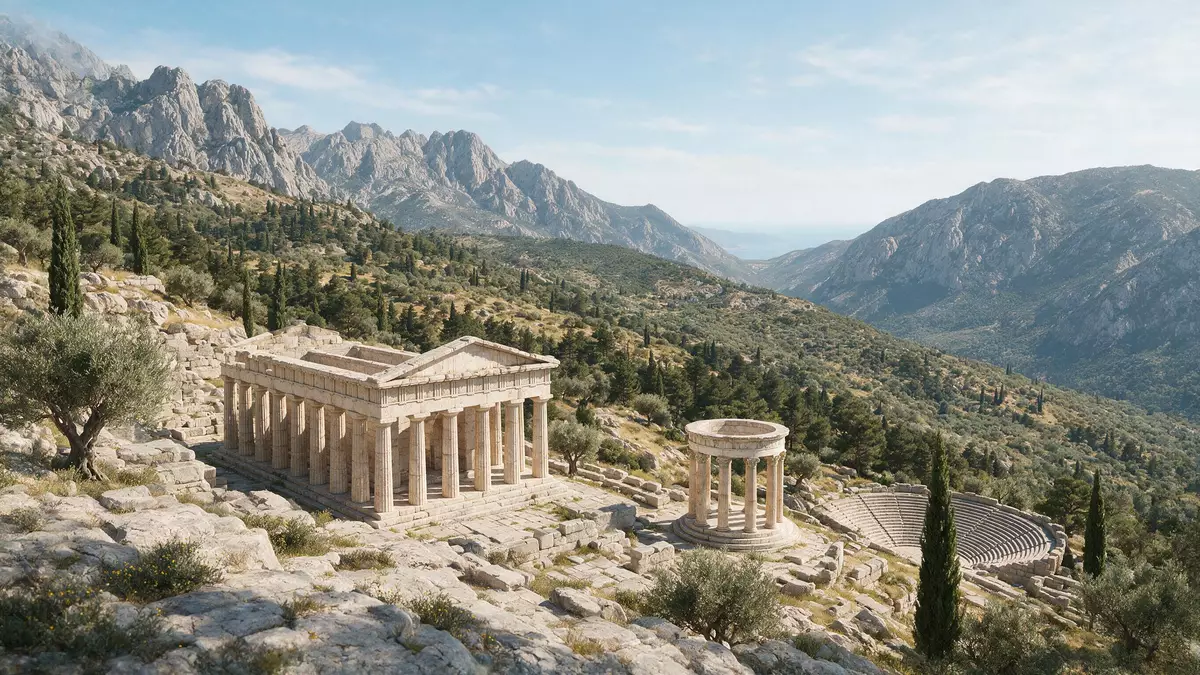
Delfoi is the ancient sanctuary and town on the southern slopes of Mount Parnassus in Greece, where the oracle of Apollo once drew pilgrims from across the Greek world.Archaeological Site of Delphi The terraced site lies within Phocis, above the valley of the Pleistos River, framed by limestone cliffs known as the Phaidriades.
The mountain setting of Delfoi
Delfoi occupies a natural amphitheatre on the southwestern slopes of Mount Parnassus, with the sanctuary stepping down towards the valley and views stretching towards the Gulf of Corinth.ancient town and oracle of Apollo Twin cliffs, known as the Phaidriades or “Shining” Rocks, rise above the archaeological area and give the landscape a distinctive profile.
The terrain is rocky and steep, and the structures of Delfoi follow its contours in terraces linked by stone paths and stairways.southern slopes of Mount Parnassus The sacred precinct sits within Parnassos National Park, and the ruins stand above the modern village that shares the same name.
The sanctuary of Apollo and the Sacred Way
The heart of Delfoi is the sanctuary of Apollo, a defined precinct where monuments line a processional route known as the Sacred Way.sanctuary of Apollo and Sacred Way This path climbs past a series of treasuries built by different Greek city-states, each designed to house offerings and display sculpted decoration.
Near the upper part of the sanctuary, the Temple of Apollo occupies a terrace above the Sacred Way, and behind it a stone theatre is cut into the slope.temple, theatre, stadium and Athena sanctuary Higher still, a stadium lies on the uppermost terrace of the archaeological site, reached along a rising path from the main cult area.
Athena Pronaia and the wider site of Delfoi
South of the main sanctuary stands the sanctuary of Athena Pronaia, separated from the Apollo precinct by the modern road that crosses the hillside.sanctuary of Athena Pronaia and Tholos This area includes temples of Athena, treasuries and the circular Tholos building that has become one of the most recognisable forms at Delfoi.
Close to the sanctuaries, the Kastalia spring emerges from the rock, marking an important water source at the edge of the ancient precinct.Kastalia spring and treasuries The wider archaeological zone also includes public structures such as a gymnasium and portico, set outside the main sacred spaces but connected by paths along the hillside.
Visiting Delfoi: what travellers from Western Europe should know
- Delfoi lies in Phocis in central Greece, on the slopes of Mount Parnassus above the valley of the Pleistos River, close to the modern village called Delphi.
- The approach from the village to the archaeological site follows an uphill road, and within the sanctuary the routes between the monuments run along stone paths and stairways on a steep hillside.
- The archaeological site of Delfoi is in Greece, where the official language is Greek and the currency is the euro.
- Delfoi can be reached by road from Athens in mainland Greece, with the route crossing central regions before climbing towards Mount Parnassus.
Searching for Delfoi on social platforms
These links open searches for Delfoi on each platform.
Frequently asked questions about Delfoi
Where is Delfoi in Greece?
Delfoi is in the region of Phocis in central Greece, on the southern slopes of Mount Parnassus above the Pleistos valley and near the modern village called Delphi.
What should visitors expect on a visit to Delfoi?
Visitors encounter extensive ruins arranged on terraces, including the sanctuary of Apollo, the sanctuary of Athena Pronaia, a theatre, a stadium and an archaeological museum beside the site.
What makes Delfoi distinctive among ancient sites?
Delfoi combines a terraced mountain setting with dense clusters of sanctuaries, treasuries and sporting structures, and it is recognised as a UNESCO World Heritage archaeological site focused on the oracle of Apollo.


