
Deir el-Bahari and the terraces of Hatshepsut in Luxor
Published on 09/09/2026 at 19:34 | Editorial responsibility: Rafael Müller, Editor-in-Chief AD HOC NEWS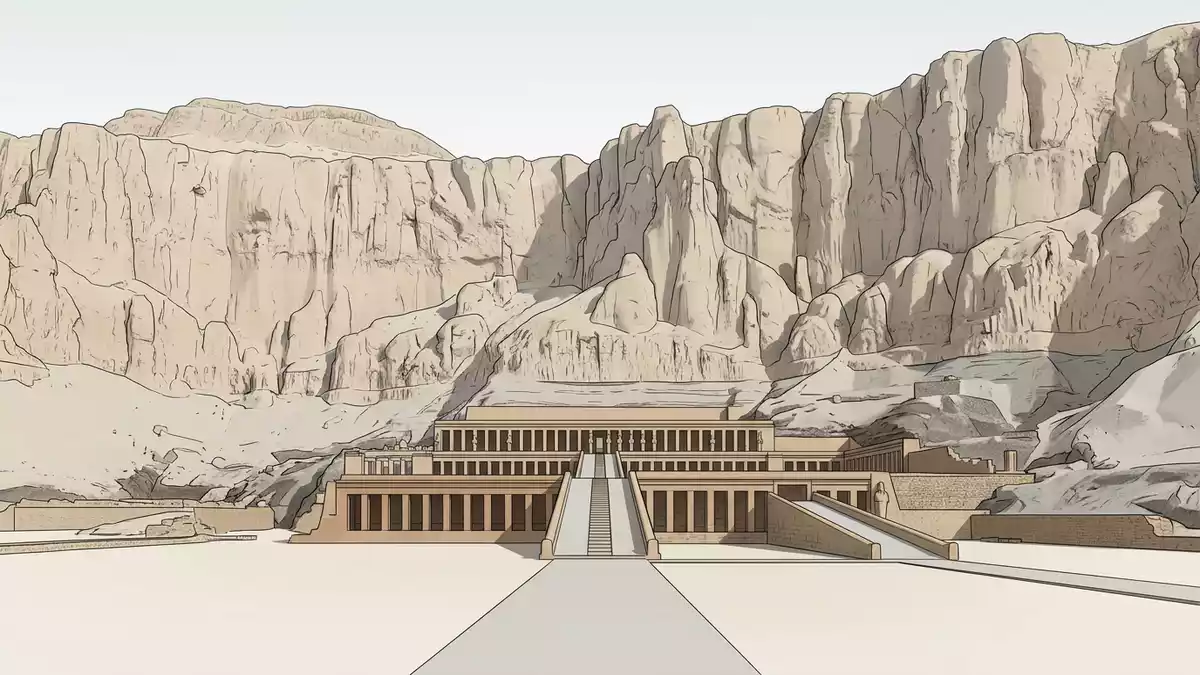
On the west bank of the Nile at Luxor, Deir el-Bahari forms a vast amphitheatre of rock and stone where mortuary temples step out from the cliffs in precise terraces. Here, in the Theban Necropolis of ancient Egypt, Queen Hatshepsut’s colonnaded sanctuary rises against the limestone, sharing the bay with earlier and later royal monuments from different dynasties.
Terraced temples against a cliff of the Theban Necropolis
Deir el-Bahari occupies a deep bay in the cliffs of the Theban Necropolis, part of the funerary landscape west of the Nile opposite Luxor and the temple precincts of Karnak. The site lies in the Qurnah district of the Luxor Governorate, with the peak of el-Qurn separating it from the neighbouring valleys where the kings and nobles of the New Kingdom were buried.Qurnah district west of the Nile The bay concentrates several mortuary temples and tombs from the Middle Kingdom and New Kingdom, making it one of the densest ensembles of royal cult architecture in Egypt.mortuary temples and tombs
Approached from the cultivated floodplain, the cliffs form a sheer wall of pale rock, with human intervention visible in bands of masonry, ramps and courtyards that extend the natural ledges into formal terraces. The main axis of Hatshepsut’s sanctuary aligns with the bay, leading the eye from the broad entrance terrace through successive levels towards the cliff face. Elsewhere in the bay, remains of other temples cluster against the rock, their masonry integrated into the same geological setting so that the whole complex reads as a single, stepped façade of stone and desert.
Hatshepsut’s Djeser-Djeseru: “Holy of Holies” on three levels
The focal monument at Deir el-Bahari is the mortuary temple of Hatshepsut, known by its ancient Egyptian name Djeser-Djeseru, “Holy of Holies”. Built in the fifteenth century BC for the sixth pharaoh of the Eighteenth Dynasty, it stands as one of the clearest surviving statements of royal cult architecture from that period.mortuary temple of Hatshepsut The design is attributed to Senenmut, the royal steward and architect who oversaw Hatshepsut’s building projects; his conception of terraces and colonnades has become a touchstone for later interpretations of the site.designed by Senenmut
Hatshepsut’s temple rises in three principal levels, each formed by a wide open court backed by a colonnade, and connected by a central ramp that runs straight towards the cliff. The lowest terrace spreads out from the temple’s entrance, with rows of square pillars defining its edge; above it, higher terraces repeat the pattern, their colonnades enclosing chapels and sanctuaries dedicated to deities including Amun, Anubis and Hathor.chapels for Amun and Hathor Reliefs on the walls record episodes from Hatshepsut’s reign, among them an expedition to Punt on the Red Sea and a “Birth Colonnade” that sets out her divine origins in carefully carved scenes.expedition to Punt
Layers of dynasties: Mentuhotep II to Thutmose III
Although Hatshepsut’s temple dominates the view, Deir el-Bahari belongs to a longer sequence of royal building that began in the Middle Kingdom. The earliest major monument in the bay is the mortuary temple of Mentuhotep II of the Eleventh Dynasty, traditionally dated to the twenty-first century BC and raised on several levels at the base of the cliff.Mentuhotep II mortuary temple Its arrangement of terraces inspired Hatshepsut’s later design, and the two monuments stand adjacent within the same natural bay, allowing their different architectural languages to be read side by side.adjacent Middle and New Kingdom temples
In the Eighteenth Dynasty, construction continued with a mortuary temple for Thutmose III, built close to Hatshepsut’s sanctuary and forming another element in the complex New Kingdom use of the bay.mortuary temple of Thutmose III Across the centuries, the area accumulated royal and private tombs alongside these temples, including burials associated with the Middle Kingdom and New Kingdom courts.royal and non-royal tombs Much later, in the Christian period, parts of Hatshepsut’s temple were reused as a monastery, giving the whole site its Arabic name Deir el-Bahari, often translated as “Northern Monastery”.used as a monastery
Visiting Deir el-Bahari: what travellers from Western Europe should know
- Deir el-Bahari stands on the west bank of the Nile opposite Luxor, within the Theban Necropolis and near the Valley of the Kings; it is reached from Luxor by road across the river to the Qurnah district.
- The approach from the parking area to the terraces involves walking across an open forecourt and then ascending ramps between levels, with steps and broad stone surfaces exposed to the desert sun.
- The surrounding cliffs rise steeply above the complex and there is little natural shade, so the site feels strongly shaped by its desert environment and the contrast between built stone and bare rock.
- The official language is Arabic and the currency is the Egyptian pound; entry requirements depend on your nationality, UK travellers can check the FCDO travel advice at gov.uk/foreign-travel-advice, Irish travellers the Department of Foreign Affairs at ireland.ie.
Searching for Deir el-Bahari on social platforms
These links open searches for Deir el-Bahari on each platform.
Frequently asked questions about Deir el-Bahari
Where is Deir el-Bahari and what kind of site is it?
Deir el-Bahari is a complex of mortuary temples and tombs in the Theban Necropolis on the west bank of the Nile opposite Luxor in Egypt.
What should visitors expect when exploring the complex?
Visitors encounter terraced stone temples built against high cliffs, broad open courts, ramps between levels, and carved reliefs depicting scenes from royal ceremonies and expeditions.
What makes Hatshepsut’s temple at Deir el-Bahari distinctive?
Hatshepsut’s temple, Djeser-Djeseru, is distinctive for its three colonnaded terraces, its alignment with the cliff bay, and reliefs combining royal cult, deities and narratives from her reign.


