
Deir el-Bahari and the terraced temples beneath Luxor’s cliffs
Published on 09/18/2026 at 15:59 | Editorial responsibility: Rafael Müller, Editor-in-Chief AD HOC NEWS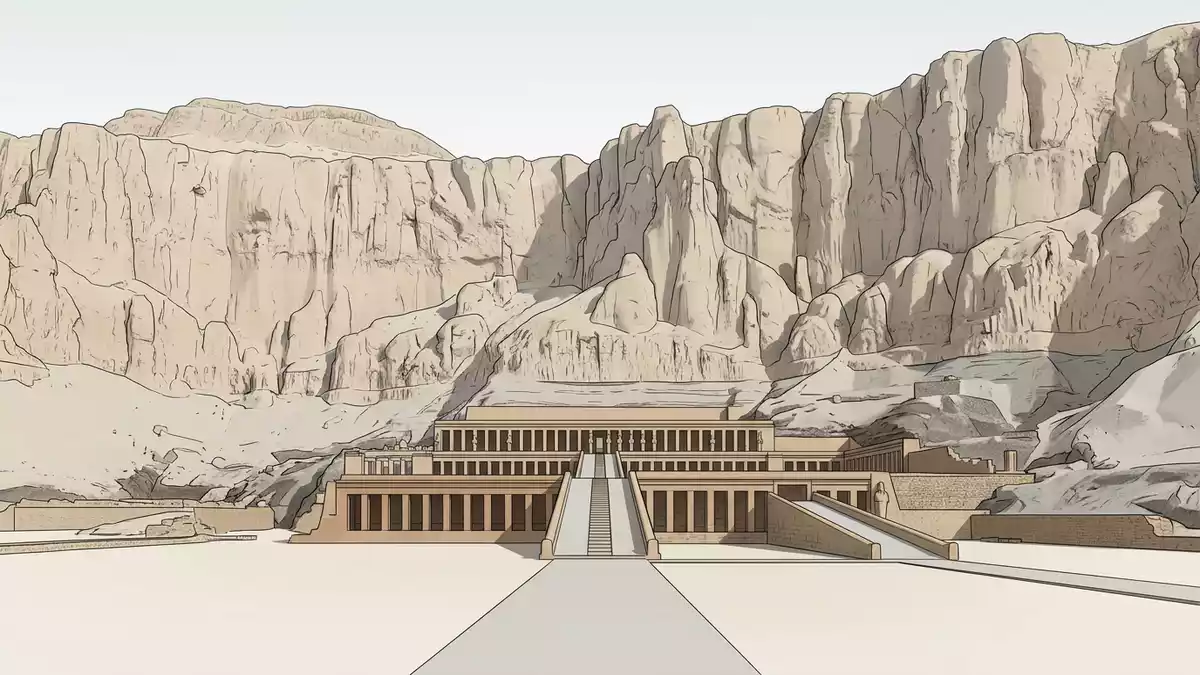
On the west bank of the Nile opposite Luxor, Deir el-Bahari forms a shallow bay in the cliffs where ancient Egyptian mortuary temples rise in terraces from the desert floor. This archaeological complex in Egypt brings together Middle Kingdom and New Kingdom monuments in the wider Theban Necropolis, with the celebrated mortuary temple of the pharaoh Hatshepsut set against the rock face as the most prominent structure in view.complex of mortuary temples
Cliff bay and stone terraces on Luxor’s west bank
Deir el-Bahari occupies a natural amphitheatre in the limestone cliffs backing the Theban west bank, separated from the Valley of the Kings by the peak of el-Qurn. The complex lies within the Luxor Governorate, across the river from the temple districts of Karnak and Luxor, and forms part of the extensive burial landscape known as the Theban Necropolis.Theban Necropolis west bank
The bay itself is framed by steep cliffs, and stone terraces step up towards the rock, creating long horizontal lines that contrast with the vertical faces of the mountain. The Mortuary Temple of Hatshepsut, known in ancient Egyptian as Djeser-Djeseru, occupies the centre of this setting, with colonnaded platforms aligned towards the Nile and carved chambers extending into the bedrock behind.bay in the cliffs
Hatshepsut’s Djeser-Djeseru and its neighbours
The focal monument at Deir el-Bahari is the mortuary temple of Hatshepsut, built during the reign of this Eighteenth Dynasty pharaoh in the fifteenth century BC.temple of Hatshepsut The temple takes the form of a sequence of broad terraces connected by axial ramps, fronted by rows of square pillars and backed by the cliff into which chapels and halls are cut. Its ancient name, Djeser-Djeseru, is usually translated as “Holy of Holies”, a title that reflects its status within the complex.Djeser-Djeseru Holy of Holies
Hatshepsut’s temple does not stand alone. To one side lie the remains of the earlier mortuary temple of Mentuhotep II from the Middle Kingdom, which combined a royal tomb and a temple for the deified ruler and associated gods.Temple of Mentuhotep II Nearby are traces of a temple of Thutmose III and other structures, so the site presents successive phases of royal building within a confined hollow in the cliffs, all connected to the wider funerary landscape centred on Thebes.
Architecture, alignment and the wider funerary landscape
Architecturally, Deir el-Bahari is marked by long straight terraces, repeated lines of columns and a strong axis running from the valley towards the cliff. At Hatshepsut’s temple the design extends outwards in a causeway connecting the valley temple near the water’s edge with the main terraces, continuing an arrangement seen earlier in Memphite pyramid complexes and adapted here to the cliff setting.valley temple and causeway The result is a sequence of open courts and colonnades that gradually approach the cliff face, where internal chapels are cut into the rock.
The wider landscape ties Deir el-Bahari to other Theban sites. The cliffs rise behind the terraces towards the high desert, with paths and tracks leading towards the Valley of the Kings, while the river plain stretches away towards the temples at Karnak and Luxor on the opposite bank.across from Karnak and Luxor Within this setting, Deir el-Bahari forms a distinct bay of ritual architecture, where royal mortuary temples share one cliff-backed hollow and present ancient stonework directly against the rock.
Visiting Deir el-Bahari: what travellers from Western Europe should know
- Deir el-Bahari lies on the west bank of the Nile opposite Luxor within the Luxor Governorate of Egypt, reached by road across the river into the Theban Necropolis.
- The temple area stands at the foot of steep limestone cliffs, and a visit involves walking over firm desert ground and ascending ramps and stairways between the terraces.
- The surrounding landscape includes the Valley of the Kings and other Theban necropolis sites, so Deir el-Bahari often forms part of a wider circuit on the west bank.
- The official language is Arabic and the currency is the Egyptian pound.
- Entry requirements depend on your nationality; UK travellers can check the FCDO travel advice at gov.uk/foreign-travel-advice, Irish travellers the Department of Foreign Affairs at ireland.ie.
Searching for Deir el-Bahari on social platforms
These links open searches for Deir el-Bahari on each platform.
Frequently asked questions about Deir el-Bahari
Where is Deir el-Bahari located?
Deir el-Bahari stands on the west bank of the Nile opposite Luxor in the Luxor Governorate of Egypt, within the wider Theban Necropolis.
What should visitors expect at the site?
Visitors encounter an open archaeological complex of stone terraces, ramps and colonnades set directly against high limestone cliffs, with several mortuary temples sharing the same bay.
What makes Deir el-Bahari distinctive among Egyptian sites?
Deir el-Bahari is distinctive for its combination of cliff-backed terraces and royal mortuary temples from different dynasties concentrated in one natural amphitheatre on Luxor’s west bank.


