
Death Valley National Park’s extremes around Furnace Creek
Published on 09/09/2026 at 17:43 | Editorial responsibility: Rafael Müller, Editor-in-Chief AD HOC NEWS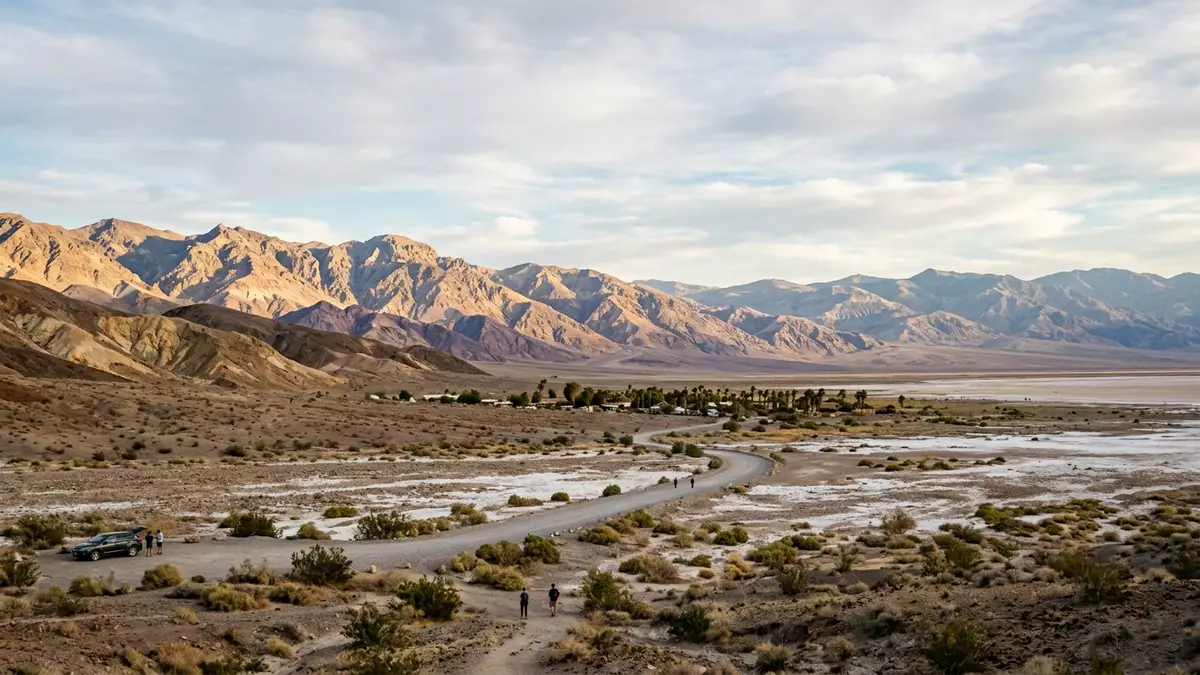
Death Valley National Park in the USA stretches across an arid basin framed by mountain ranges, with Furnace Creek sitting near its central valley floor. The park is known for its below-sea-level salt flats at Badwater Basin and for the high ridges of the Panamint Range, creating a dramatic contrast in elevation within a single protected landscape.Badwater Basin rests below sea level
Land of heat, height and depth
Death Valley National Park covers part of eastern California along the border with Nevada, and Furnace Creek lies within this desert valley as a developed area on the basin floor.The National Park Service describes the area as a land of extremes The valley floor at Badwater Basin lies around 86 m (282 ft) below sea level, while Telescope Peak in the Panamint Range rises to 3,368 m (11,049 ft), giving the park an elevation range that is unusual even by desert standards.Badwater and Telescope Peak mark this contrast
Furnace Creek itself has become a focal point for understanding the park’s climate and geography, partly because air temperature records were measured here in the early twentieth century. In July 1913 a figure of 56.7 °C (134 °F) was recorded at Furnace Creek Ranch, a value recognised as one of the highest reliably reported air temperatures on Earth.The 1913 temperature at Furnace Creek Ranch The combination of low elevation, surrounding mountains and arid conditions contributes to extreme heat, while the clear desert air exposes the basin and ranges to strong sunlight.
Desert geology shaped over millions of years
The geology of the Death Valley area, including the surroundings of Furnace Creek, spans hundreds of millions of years and records several distinct environments. Limestones and sandstones in nearby ranges such as the Funeral and Panamint Mountains indicate that parts of this region formed as a warm, shallow sea during the Paleozoic Era, between about 542 and 251 million years ago.The Paleozoic shallow sea environment Later, during the Tertiary Period, extensive volcanic activity affected the area, with ash and cinders blanketing the region and volcanic centres shifting westward from Nevada towards Furnace Creek and Shoshone.
As the crust stretched and fault systems developed, basins such as the Furnace Creek Basin opened and subsided, filling with thick sequences of lakebed sediments, muds, gravels and volcanic material.The Furnace Creek Formation records this subsidence The Furnace Creek Formation, a Pliocene unit, consists of cemented gravel and saline deposits more than 1,500 m (5,000 ft) thick in places, including layers rich in borate minerals that were later of economic interest.Descriptions of the Furnace Creek Formation Colourful badlands near Furnace Creek, such as those visible along Artist Drive, owe their reds, yellows, greens and purples to mixes of iron-bearing minerals like hematite, limonite and chlorite in these weathered volcanic and sedimentary rocks.Mineral pigments in the Furnace Creek badlands
Human traces at Furnace Creek and across the valley
Beyond its geology, Death Valley National Park carries human stories, particularly around Furnace Creek where springs and groundwater made settlement and industry possible on the desert floor. Furnace Creek took its name from small furnaces used to smelt silver-rich ores, reflecting early mining activity in the surrounding hills.The naming of Furnace Creek Borate minerals such as colemanite and ulexite occur in Pliocene lake deposits of the Furnace Creek Formation and supported later mining, while other metallic deposits were worked in canyons around the valley.Borate and metallic deposits near Furnace Creek
Tourism began to expand in the twentieth century, with resort developments at places including Stovepipe Wells and Furnace Creek as interest in the desert landscape grew.Resorts around Stovepipe Wells and Furnace Creek The National Park Service manages visitor centres and ranger stations in several locations across the valley, including facilities at Furnace Creek that help interpret the park’s geology and history for travellers.Ranger stations and visitor services Standing on the basin floor, visitors can see the surrounding Black Mountains and Funeral Mountains rise from the valley, while badlands, alluvial fans and salt flats trace the long interaction between water, sediment and desert climate.
Visiting Death Valley National Park: what travellers from Western Europe should know
- Death Valley National Park lies in eastern California near the border with Nevada, with Furnace Creek situated on the valley floor along California Highway 190.
- The terrain around Furnace Creek includes salt flats, badlands and alluvial fans, and approaches to viewpoints and trails may involve walking over loose gravel and exposed desert surfaces.
- The park’s elevation range extends from below sea level at Badwater Basin to alpine heights on Telescope Peak, so conditions vary significantly between the valley floor and surrounding ranges.
- The official language is English and the currency is the US dollar.
- Entry requirements depend on your nationality; UK travellers can check the FCDO travel advice at gov.uk/foreign-travel-advice, Irish travellers the Department of Foreign Affairs at ireland.ie.
Searching for Death Valley National Park on social platforms
These links open searches for Death Valley National Park on each platform.
Frequently asked questions about Death Valley National Park
Where is Death Valley National Park and Furnace Creek located?
Death Valley National Park lies in eastern California in the USA near the Nevada state line, with Furnace Creek on the valley floor along a main park road.
What can visitors expect when they explore the area around Furnace Creek?
Visitors encounter desert landscapes including salt flats, badlands and alluvial fans, with surrounding mountains rising steeply from the basin and marked elevation differences within short driving distances.
What makes Death Valley National Park distinctive among desert parks?
The combination of below-sea-level basins, high peaks such as Telescope Peak, long geological history and documented extreme temperatures at Furnace Creek gives Death Valley National Park a particular character.


