
Death Valley National Park and the landscape of extremes
Published on 09/23/2026 at 03:26 | Editorial responsibility: Rafael Müller, Editor-in-Chief AD HOC NEWS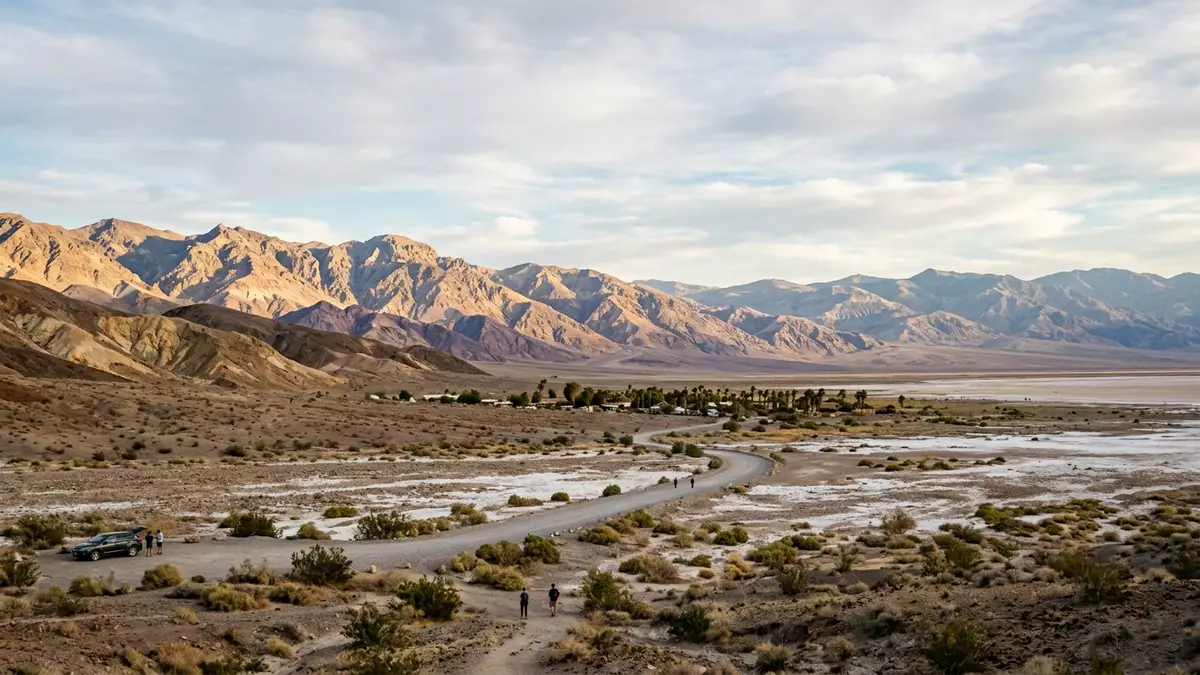
Death Valley National Park is a landscape measured in extremes. Badwater Basin lies 86 m (282 ft) below sea level, while Telescope Peak rises to 3,368 m (11,049 ft), with Furnace Creek between these sharply contrasting elevations.
Badwater Basin: a salt floor below sea level
Badwater Basin forms the visual centre of Death Valley National Park. A broad salt flat occupies the valley floor, where pale mineral patterns spread across ground that lies below sea level. The basin is the lowest point in North America at 86 m (282 ft) below sea level. Badwater Basin’s elevation gives the landscape its stark horizontal scale.
The basin belongs to a 156-mile-long north-south trough between the Amargosa Range and the Panamint Range. Salt, mud and distant mountain walls form distinct bands across the view. The surface is not an isolated geological curiosity, but part of a larger basin-and-range landscape shaped by faulting and erosion.
From desert basin to mountain summit
Death Valley National Park rises dramatically from the salt flat to Telescope Peak in the Panamint Mountains. The summit reaches 3,368 m (11,049 ft), and lies only about 24 km (15 miles) from Badwater Basin. Telescope Peak and Badwater occupy opposite ends of the park’s vertical profile.
Mountain ranges define the valley on both sides. The Panamint Range forms the western wall, while the Amargosa Range borders the east. Across these elevations, the park contains salt flats, alluvial fans, rocky canyons, dunes, springs and higher mountain habitats.
A national park with a twentieth-century history
Death Valley National Park was proclaimed a national monument on 11 February 1933. Congress re-designated it as a national park on 31 October 1994. The park extends across California and Nevada, with most of its land in California.
The name Death Valley is linked with emigrants travelling through the region during the winter of 1849–1850. Furnace Creek became the principal named settlement and reference point within the valley. The park’s formal history therefore sits alongside a landscape that preserves much older geological processes. The park’s changing designation marks its transition from national monument to national park.
Visiting Death Valley National Park: what travellers from Western Europe should know
- Death Valley National Park lies in eastern California and extends into Nevada. Furnace Creek is the main developed community in the central valley, reached by roads crossing the Mojave Desert.
- Badwater Basin is a broad salt flat below sea level, while Telescope Peak rises into the Panamint Mountains. Routes through the park cross exposed desert, mountain passes, gravel surfaces and narrow canyons.
- The official language is English and the currency is the United States dollar.
- Entry requirements depend on your nationality; UK travellers can check the FCDO travel advice at gov.uk/foreign-travel-advice, Irish travellers the Department of Foreign Affairs at ireland.ie.
Searching for Death Valley National Park on social platforms
These links open searches for Death Valley National Park on each platform.Frequently asked questions about Death Valley National Park
Where is Death Valley National Park?
Death Valley National Park lies in eastern California and reaches into Nevada. Furnace Creek sits in the central valley and serves as the principal named settlement.
What can visitors expect in the landscape?
The park contains salt flats, mountain ranges, dunes, canyons, alluvial fans and higher-elevation habitats. Routes pass through exposed desert and varied terrain.
What makes Death Valley National Park distinctive?
Its defining contrast is the short horizontal relationship between Badwater Basin, below sea level, and Telescope Peak, rising more than 3,000 m above it.


