Deadvlei’s white clay pan and black trees in Namib-Naukluft
Published on 09/04/2026 at 18:08 | Editorial responsibility: Rafael Müller, Editor-in-Chief AD HOC NEWS
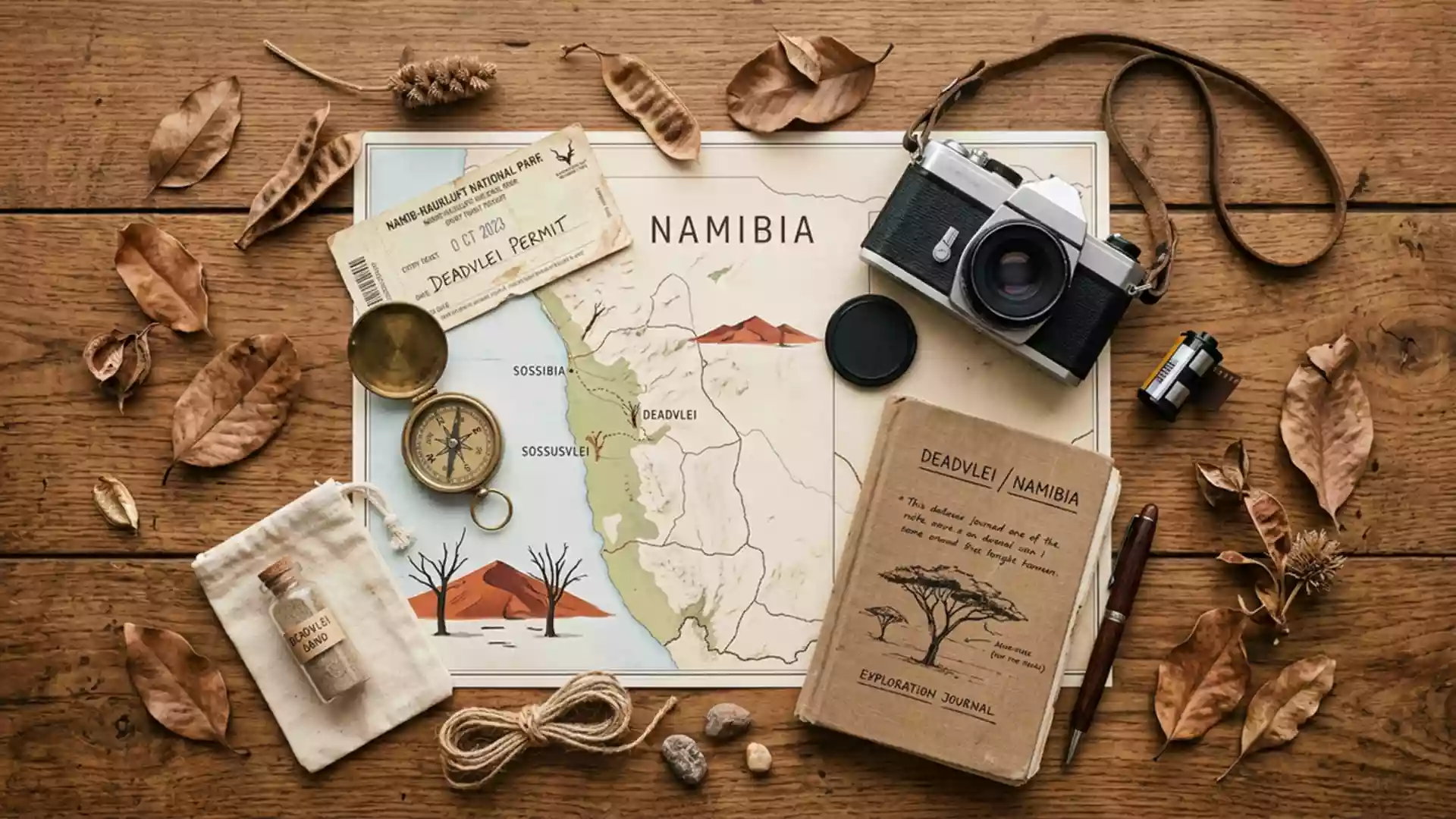
In the Namib Desert of Namibia, Deadvlei presents a stark desert tableau: a white clay pan ringed by towering red-orange dunes and studded with dark, dead camel thorn trees that have stood for centuries without rotting. Set within Namib-Naukluft National Park near the better-known basin of Sossusvlei, this dry pan has become a concise image of the Namib itself, where extreme aridity preserves wood in place and sand rises in steep walls above the flat clay floor.
A clay pan in the dunes of Namib-Naukluft
Deadvlei lies in a valley between high dunes in the southern part of Namib-Naukluft National Park, within the Namib Desert of south-western Namibia. It forms part of the Sossusvlei area, a cluster of basins where sand dunes surround hollows that gather silt and, in some cases, water. The basin of Deadvlei is a shallow depression floored by compacted clay, its pale surface contrasting sharply with the surrounding sand and the dark tree trunks that punctuate it.white clay pan located The name itself is descriptive: “vlei” is an Afrikaans word for marsh or shallow pan, so Deadvlei is literally a dead marsh, a basin where water once gathered and no longer does.
Geographically, Deadvlei lies close to the terminal basin of Sossusvlei inside the national park, reached along the same desert corridor that leads visitors into the dune belt. The wider Namib-Naukluft area is characterised by intensely dry conditions, sparse desert vegetation and dune fields whose forms shift gradually as sand accumulates and moves. Within that landscape, Deadvlei stands out as a clay hollow enclosed by dunes rather than an expanse of bare sand, its flat floor sitting below inclines that rise hundreds of metres to sharp ridges.white clay pan within Namib-Naukluft National Park
Centuries-dead camel thorn trees on a dry pan
The most striking feature of Deadvlei is the group of dead camel thorn trees that rise from its clay floor, their trunks and branches blackened and leafless. These trees, identified as camel thorn acacias, grew when floodwaters from the Tsauchab River reached the basin and supported a pocket of vegetation. As the river’s course shifted and dunes blocked the flow, water stopped reaching the pan. The trees then died, yet the extraordinary dryness of the Namib Desert prevented their wood from decomposing, leaving their skeletons upright on the clay for centuries.camel thorn trees contrasted against the white pan floor Estimates for their age converge in a range around 700 to 900 years, giving Deadvlei a living connection to environmental changes in the desert during the last millennium.trees preserved for centuries
The appearance of these trees is distinctive: their trunks are dark and dry, their branches reach up in angular forms and there is no foliage to soften their silhouettes. They stand on a clay surface that has dried and cracked into polygonal patterns, each fissure marking where moisture once shrank away. Around them, the clay’s pale tone amplifies the contrast with both the blackened wood and the orange-red dunes beyond. Many descriptions of Deadvlei emphasise this visual interplay between elements: dead trees of great age, a bleached clay floor and dunes that rise to heights in the region of 300 m (984 ft).centuries-dead camel thorn trees Together, they create a landscape where every major component is a product of long-term climatic and geological processes.
Sand dunes, desert light and a landscape of contrast
Deadvlei sits in a pocket between towering dunes whose sand takes on deep shades of orange and red, especially in low-angle light. One prominent dune above the pan is known as Big Daddy, a dune described as reaching a height of around 325 m (1,066 ft) and often used as a reference point for the basin below.Big Daddy reaching 325 meters high From the clay floor, the dunes form steep, curving walls of sand, their ridges marking lines against the sky. The flatness of the pan accentuates the scale of these surrounding hills, while the absence of living trees on the clay makes the dead camel thorn trunks more prominent.
Light plays an important role in how Deadvlei is perceived. As the sun moves, shadows of the tree skeletons stretch and rotate on the clay, while the dunes shift through tones from apricot to deep rust. The sharp contrasts between dark trunks, pale ground and coloured sand mean that Deadvlei often appears in high-contrast images of the Namib, where the composition is almost graphic: vertical tree forms, a level foreground and an inclined wall of sand behind. The basin is enclosed enough that the surrounding dunes define most of the horizon, turning the pan into a kind of stage on which these few elements interact.
Visiting Deadvlei: what travellers from Western Europe should know
- Deadvlei lies within Namib-Naukluft National Park in south-western Namibia, in the Sossusvlei area reached by the desert road corridor from Sesriem.
- Access within the park runs along a tarred road through dune country; the final approach to Deadvlei is on foot across sandy terrain from a designated parking area.
- The pan itself has a flat but firm clay floor punctuated by dead tree trunks, while approaches and surrounding dunes involve walking on loose sand and, on dune slopes, steep gradients.
- The official language is English and the currency is the Namibian dollar.
- Entry requirements depend on your nationality; UK travellers can check the FCDO travel advice at gov.uk/foreign-travel-advice, Irish travellers the Department of Foreign Affairs at ireland.ie.
Searching for Deadvlei on social platforms
These links open searches for Deadvlei on each platform.Frequently asked questions about Deadvlei
Where is Deadvlei?
Deadvlei is a white clay pan in the Namib Desert inside Namib-Naukluft National Park in south-western Namibia, near the terminal basin of Sossusvlei.
What should visitors expect on a visit to Deadvlei?
Visitors encounter a flat clay basin dotted with centuries-old dead camel thorn trees, enclosed by high red-orange sand dunes and reached on foot from the nearest parking area.
What makes Deadvlei distinctive among desert landscapes?
Deadvlei is distinctive for its combination of pale clay pan, blackened dead trees and surrounding dunes rising to heights in the region of 300 m, creating a high-contrast desert scene.