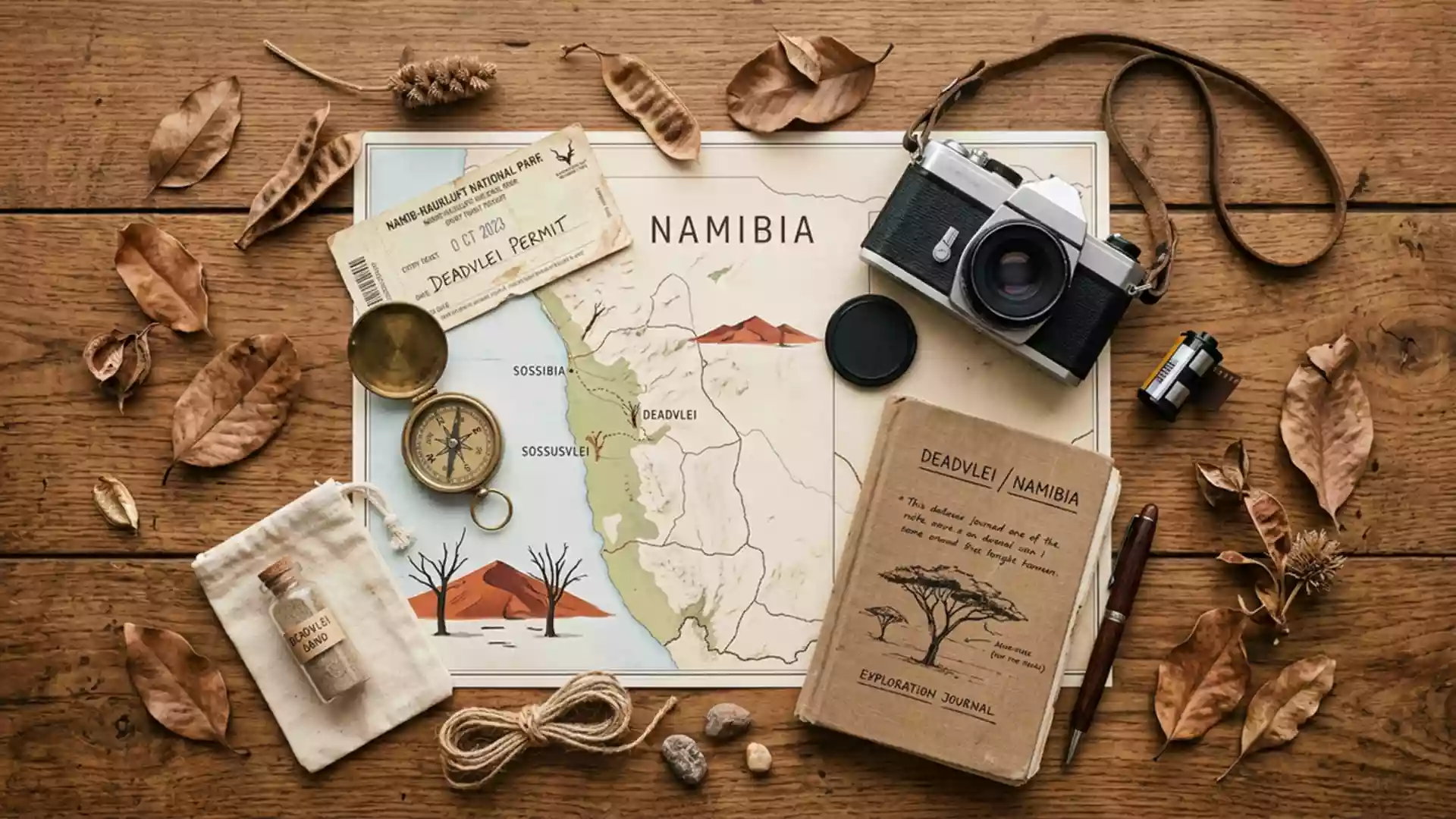
Deadvlei’s clay pan and fossil trees in Namib-Naukluft
Published on 08/21/2026 at 18:54 | Editorial responsibility: Rafael Müller, Editor-in-Chief AD HOC NEWS
In the southern part of Namibia’s Namib-Naukluft National Park, Deadvlei presents an almost abstract composition of desert forms: a pale clay pan under long-dead trees, boxed in by high red dunes of the Namib Desert. The name combines “dead” with the Afrikaans word “vlei”, meaning a shallow lake or pan, and marks a basin that once held water but has been dry for centuries.
A fossil clay pan inside the Namib Desert
Deadvlei is a white clay pan within Namib-Naukluft National Park, in the Namib Desert of southern Namibia. It lies close to the better-known basin of Sossusvlei, where the Tsauchab River reaches its inland terminus among the dunes.Deadvlei is described as a white clay pan near Sossusvlei The pan occupies a hollow between dunes that rise several hundred metres, their surfaces marked by slipfaces and wind-rippled ridges.sand dunes around the pan reach heights of roughly 300 to 400 m
The clay underfoot in Deadvlei formed when the Tsauchab River flooded into this basin and pooled long enough for fine sediments to settle. The pan’s surface has dried and cracked into irregular polygons, a pattern clearly visible in aerial views and ground-level photographs.accounts describe Deadvlei as a clay pan formed by river flooding in the Namib The surrounding dunes frame the basin on all sides, their red-orange sands contrasting sharply with the pan’s light surface and the dark trunks of the trees.
Ancient camel thorn trees preserved by arid air
The most striking feature of Deadvlei is the stand of dead camel thorn trees that rise from the clay. These are thought to have grown when the pan still received seasonal floodwater from the Tsauchab River, which briefly turned it into an oasis.the clay pan once supported camel thorn trees when water reached it When the climate became drier and sand dunes shifted, the river’s course was blocked before reaching Deadvlei, cutting off the water that sustained the trees.accounts date the blocking of the Tsauchab River and death of the trees to around 900 years ago
The trunks and branches remain standing because the surrounding climate is extremely arid, with so little moisture that decay is slowed dramatically. Estimates place their age at around 900 years, and their surfaces have darkened under sun exposure, giving the trees a black, skeletal appearance against the clay.travel and photographic sources describe dead camel thorn trees around 900 years old preserved in the pan The contrast between the fossilised trees, the pale ground and the surrounding dunes gives Deadvlei a scene that is frequently compared to a painted backdrop, with no living vegetation in the pan itself.
Deadvlei within the Sossusvlei dune landscape
Deadvlei lies in the Sossusvlei area of Namib-Naukluft, a cluster of basins where the Tsauchab River meets some of the highest dunes in the world.Deadvlei is described as a clay pan reached via the Sossusvlei route inside Namib-Naukluft National Park The main Sossusvlei basin remains an occasional gathering point for water, while Deadvlei sits slightly apart, enclosed by dunes and cut off from the river’s present course.Deadvlei lies a short distance from the principal Sossusvlei pan inside the dune field
Several dunes near Deadvlei have become landmarks in their own right, with nicknames such as “Big Daddy” attached to some of the higher ridges.sources note that the dunes surrounding Deadvlei include prominent high ridges locally named Big Daddy The lines of these dunes define the horizon from the pan, rising steeply above the clay. From the surrounding high points, the pan appears as a bright patch set into the vast dune sea of the Namib, outlining the former reach of the river against the current desert.
Visiting Deadvlei: what travellers from Western Europe should know
- Deadvlei lies in the southern part of Namib-Naukluft National Park, reached via the Sesriem gate and the Sossusvlei road; the clay pan itself is accessed from a parking area followed by a stretch on foot through sand.
- The final approach to the pan crosses soft desert sand and low dune terrain, requiring a walk that can feel longer than its map length because of the footing underfoot.
- The clay pan sits within a desert basin surrounded by dunes, with no shade from trees or buildings; exposure to sun and reflective clay is a constant feature of the visit.
- In Namibia the official language is English and the currency is the Namibian dollar.
- Entry requirements depend on your nationality; UK travellers can check the FCDO travel advice at gov.uk/foreign-travel-advice, Irish travellers the Department of Foreign Affairs at ireland.ie.
Searching for Deadvlei on social platforms
These links open searches for Deadvlei on each platform.
Frequently asked questions about Deadvlei
Where is Deadvlei located?
Deadvlei is a white clay pan in the Namib Desert, inside Namibia’s Namib-Naukluft National Park, close to the Sossusvlei basin reached via the Sesriem gate.
What should visitors expect when reaching the pan?
Visitors encounter a pale clay surface broken into polygons, scattered with dead camel thorn trees and ringed by high red dunes, with no shade within the basin itself.
What makes Deadvlei distinctive among desert landscapes?
The combination of fossilised trees, cracked clay and enclosing dunes, together with the basin’s history as a former river-fed vlei that dried about 900 years ago, gives Deadvlei its distinctive character.