
Dazu Shike: stone scriptures on Chongqing’s hillsides
Published on 08/29/2026 at 17:57 | Editorial responsibility: Rafael Müller, Editor-in-Chief AD HOC NEWS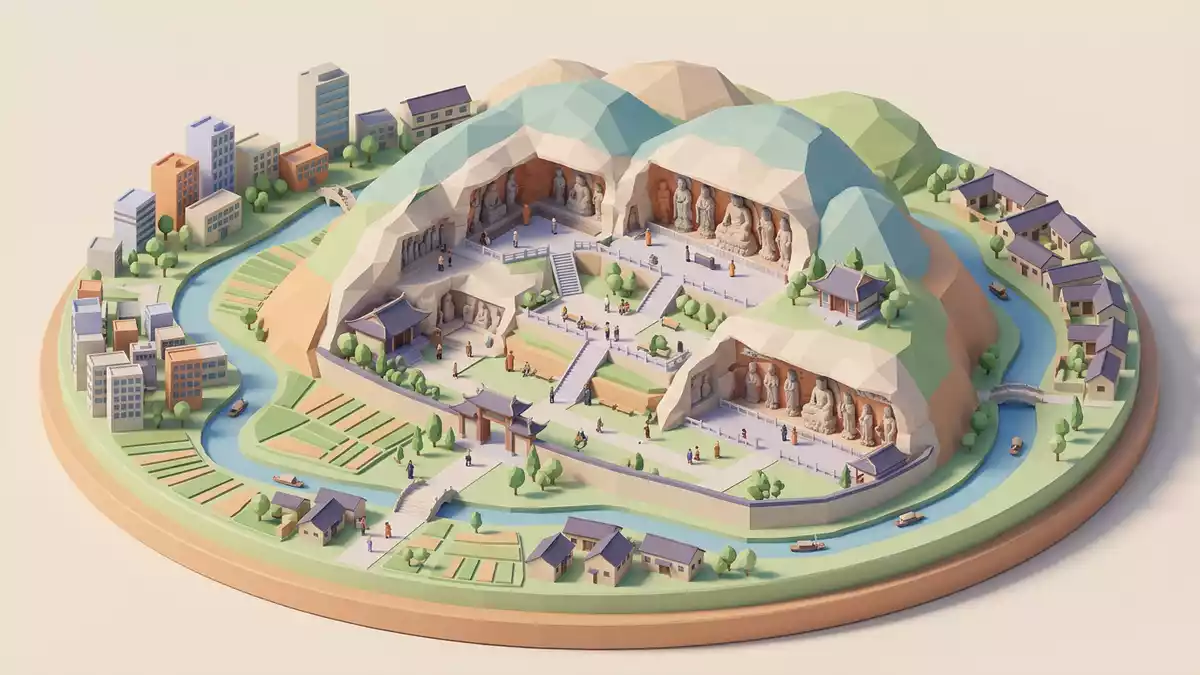
Dazu Shike in Chongqing is a hillside landscape of carved stone, where tens of thousands of figures and inscriptions turn bare rock into a record of Chinese religious life between the ninth and thirteenth centuries. The carvings form part of the Dazu Rock Carvings, a UNESCO World Heritage Site in the Dazu District of Chongqing, and are renowned for the way Buddhist, Taoist and Confucian imagery appears side by side on the same cliffs.
Cliffside scriptures in the Dazu District
Dazu Shike refers to the rock carvings spread across the steep hillsides of the Dazu District, west of Chongqing’s urban core, where sculpted panels and grottoes line the faces of sandstone cliffs. The wider ensemble of Dazu Rock Carvings was inscribed on the UNESCO World Heritage List in 1999 as an “exceptional series of rock carvings” that document religious and secular life over several centuries, with the official listing recognising five principal clusters in the district.UNESCO World Heritage listing The carvings occupy numerous sites in the countryside around Dazu town, and together they comprise a vast collection of sculptures, reliefs and carved texts cut directly into the rock.
Many sources describe more than 50,000 sculpted figures and over 100,000 carved Chinese characters distributed among dozens of protected cliff sites, making Dazu Shike one of the most extensive concentrations of grotto art in China.scale of the carvings The carvings appear in different formats: full sculptures projecting from the cliff, half-reliefs emerging from the rock face, and flatter reliefs that read almost like monumental drawings. Around them, cliff surfaces carry inscriptions and epigraphs that identify donors, record doctrinal points or describe scenes of daily life in medieval China.
Five main hillsides: Beishan, Baodingshan and their companions
Within the wider Dazu Shike ensemble, five named hillsides are consistently recognised as the core locations: Beishan (North Mountain), Baodingshan (Baoding Mountain), Nanshan (South Mountain), Shizhuanshan and Shimenshan.five core locations Each occupies a different slope or valley, and each preserves its own sequence of panels and grottoes, so a visit to Dazu Rock Carvings becomes a circuit through several discrete cliffside sanctuaries rather than a single compact site. Beishan lies close to Dazu town and is associated with early phases of carving, while Baodingshan, a prominent hill in the area, is known for an especially dense concentration of figures arranged along a curving cliff.
UNESCO’s description notes that the carvings are “remarkable for their aesthetic quality” and for the variety of their subject matter, which ranges from doctrinal tableaux and monumental bodhisattvas to scenes that depict domestic life and moral parables in recognisable settings.aesthetic quality and diversity At Baodingshan in particular, large narrative sequences unfold across the rock face, showing multi-figure compositions such as groups of bodhisattvas, guardians and worshippers arranged in tiers. In contrast, smaller grottoes at Beishan and Nanshan contain more intimate ensembles, with individual statues or compact reliefs framed by carved niches.
Syncretic faith carved in stone
One of the most striking characteristics of Dazu Shike is the way different strands of Chinese religious thought share the same cliffs. The official World Heritage documentation highlights the harmonious synthesis of Buddhism, Taoism and Confucianism, pointing to the coexistence of Buddhist bodhisattvas, Taoist immortals and Confucian themes within a single carved landscape.harmonious synthesis of traditions Panels that show Buddhist hells and paradises may sit beside reliefs illustrating filial piety or Taoist deities, and the inscriptions around them weave doctrinal commentary with moral instruction.
The carvings are traditionally dated to the period between the ninth and thirteenth centuries, with activity linked to the late Tang Dynasty and flourishing in the Song period, although some sites in the wider Dazu area preserve work that began earlier and continued into later dynasties.chronology of the carvings As a result, walking along the cliffs at Dazu Shike brings visitors through a sequence of styles and iconographies that reflect shifting emphases in Chinese grotto art, from earlier emphatic reliefs to later, more narrative compositions crowded with figures and text.
Visiting Dazu Shike: what travellers from Western Europe should know
- Dazu Shike lies in the Dazu District of Chongqing in south-west China, and the carved hillsides are reached from Dazu town by local transport or organised excursions.
- Many of the principal carvings stand on sloping ground or along cliff paths, so a visit involves walking on uneven surfaces and climbing stairways cut into the hillside.
- The carved panels are spread across several hillsides in the countryside around Dazu, and moving between sites such as Baodingshan and Beishan requires short journeys by road or bus.
- The official language is Chinese and the currency is the Chinese yuan.
- Entry requirements depend on your nationality; UK travellers can check the FCDO travel advice at gov.uk/foreign-travel-advice, Irish travellers the Department of Foreign Affairs at ireland.ie.
Searching for Dazu Shike on social platforms
These links open searches for Dazu Shike on each platform.
Frequently asked questions about Dazu Shike
Where is Dazu Shike located?
Dazu Shike forms part of the Dazu Rock Carvings in the Dazu District of Chongqing, in south-west China, on hillsides west of Chongqing’s main urban area.
What can visitors expect when exploring the carvings?
Visitors encounter carved cliffs and grottoes with thousands of figures and inscriptions, reached by paths and stairways that follow the contours of hillsides such as Baodingshan and Beishan.
What makes Dazu Shike distinctive among grotto sites?
Dazu Shike is distinctive for its scale, with tens of thousands of figures, and for the way Buddhist, Taoist and Confucian imagery is carved together on the same sandstone cliffs.


