
Dalt Vila, Ibiza’s walled hilltop old town
Published on 09/10/2026 at 22:52 | Editorial responsibility: Rafael Müller, Editor-in-Chief AD HOC NEWS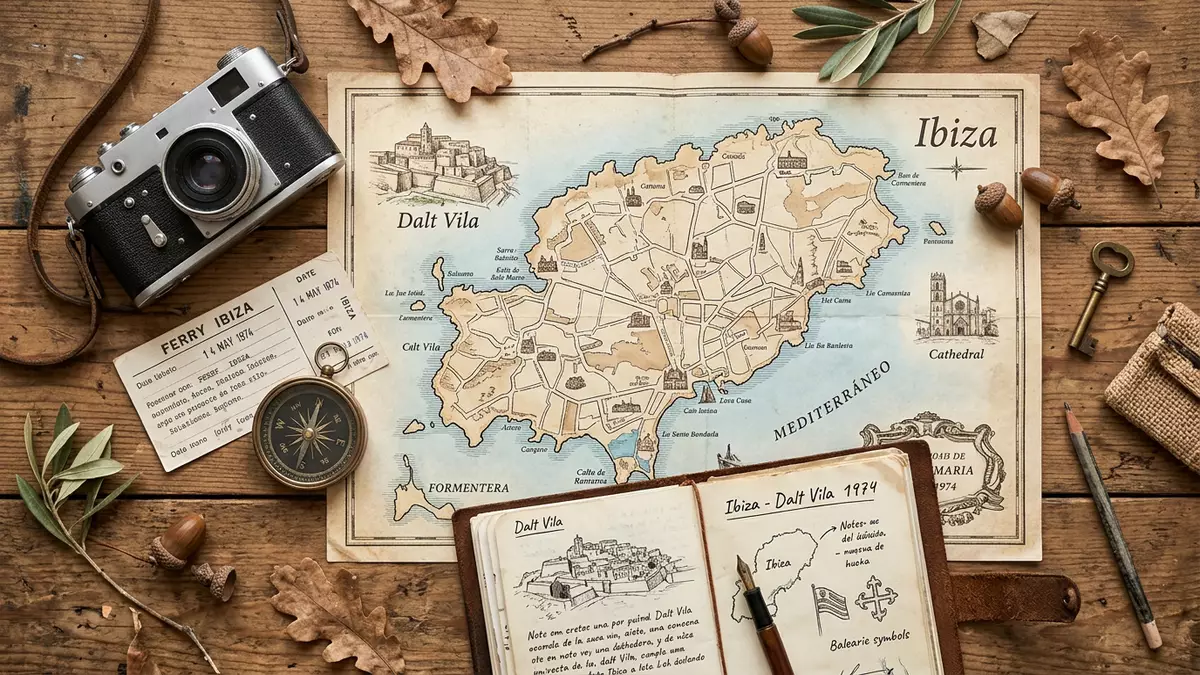
Dalt Vila is the fortified upper town of Ibiza City, rising as a walled acropolis above the harbour on the hill of Puig de Vila and forming the historic core of the island’s capital in Spain. It is enclosed by substantial Renaissance defences and has been part of the UNESCO World Heritage property “Ibiza, Biodiversity and Culture” since 1999.
Stone walls on a Mediterranean hill
The most striking feature of Dalt Vila is the way stone fortifications wrap around a steep hill directly above the working port of Eivissa, creating a compact acropolis that dominates the skyline of Ibiza Town. The name “Dalt Vila” is Catalan for “Upper Town”, fitting a district that occupies the heights while the harbour and newer quarters spread out at the base of the hill.fortified upper quarter The walls form a continuous enclosure with projecting bastions and gates, giving the upper town a clear outline that can be traced from the sea and from the modern promenade along the waterfront.
The present fortification system dates to the Renaissance, when Spanish authorities built new defences around Ibiza’s hilltop town in the sixteenth century in response to changing military technology. Between 1554 and 1585, engineers Giovanni Battista Calvi and Jacobo Paleazzo Fratin oversaw construction of angular bastions and curtain walls that adapted Italian ideas of fortress design to this Mediterranean island hill.sixteenth-century defences The circuit of walls is described in local guides as stretching for around 1,800 m (5,906 ft) and incorporating seven bastions, numbers that give a sense of the scale of stone surrounding the upper town without needing to walk every metre of it.Renaissance wall perimeter
Layers of history behind the ramparts
Beneath the Renaissance walls, Dalt Vila preserves an urban fabric with traces of more than two millennia of Mediterranean history in its street plan and buildings. The site developed from a Phoenician settlement founded in 654 BC, and has seen Carthaginian, Roman, Islamic and Catalan phases, giving the upper town a depth that is unusual for a district of this size.Phoenician foundation in 654 BC UNESCO describes the Upper Town as more than 2,500 years old, reflecting continuous occupation on the hill and the survival of medieval lanes, alleys and passageways inside the fortifications.more than 2,500 years old
Within the walls, prominent landmarks mark successive periods. Near the highest point stands the Cathedral, known locally as Santa Maria or Our Lady of the Snows, whose present form combines Gothic-Catalan elements with later alterations.Cathedral of Our Lady of the Snows Nearby lies the Almudaina Castle area, recalling earlier fortification on the summit, and the former Santo Domingo convent and University building, which speak to Ibiza’s religious and civic history.Almudaina Castle and convent Museums within Dalt Vila, including an archaeological museum and spaces for contemporary art, underline how the fortified hill serves both as a living neighbourhood and as a repository of artefacts from the island’s past.
Gateways, ramparts and everyday streets
For visitors, the experience of Dalt Vila begins with its gateways and continues along its cobbled lanes and ramparts. One of the most notable entrances is the Portal de ses Taules, a sixteen-century gateway reached over a stone drawbridge and flanked by Roman busts, which opens into an inner courtyard and then into Plaza de Vila, a square that gathers houses and restaurants around its edges.Portal de ses Taules gateway Other gates punctuate the wall circuit and once controlled access from different sides of the hill, though everyday movement now focuses more on the set of streets within the walls.
Inside, narrow passageways climb and curve between whitewashed houses and small squares, reflecting a medieval layout that adapted to the slope of Puig de Vila rather than to a rigid grid. Sections of the ramparts are accessible on foot, offering views over the harbour, the districts of La Marina and Sa Penya below, and the broader outline of Ibiza Town.hill above the harbour Bastions project outward from the main line of the walls, creating platforms from which the geometry of the fortress and its relationship to sea and land can be appreciated in three dimensions rather than on a map.
Visiting Dalt Vila: what travellers from Western Europe should know
- Dalt Vila rises above the harbour on the hill of Puig de Vila at the centre of Ibiza Town on the island of Ibiza in Spain, and is reached on foot from the waterfront and surrounding streets.fortified Upper Town above the port
- The terrain within the walls is steep, with cobbled streets and stone steps linking different levels, and sections of the ramparts reached by inclines rather than level pavements.labyrinth of cobbled streets
- Key named areas around Dalt Vila include the harbour district below, the old fisher quarters of La Marina and Sa Penya at the foot of the walls, and the square of Plaza de Vila just inside the main gateway.old fisher quarters below
- The official language on Ibiza is Spanish, and the currency is the euro.
Searching for Dalt Vila on social platforms
These links open searches for Dalt Vila on each platform.
Frequently asked questions about Dalt Vila
Where is Dalt Vila?
Dalt Vila is the historic walled upper town of Ibiza City on the island of Ibiza in Spain, occupying the hill of Puig de Vila above the harbour.
What can visitors expect inside the walls?
Visitors encounter cobbled lanes, bastions, gateways, whitewashed houses, squares such as Plaza de Vila, and landmarks including the Cathedral and castle area.
What makes Dalt Vila distinctive among Mediterranean towns?
Dalt Vila combines a complete sixteenth-century Renaissance fortification system with an urban fabric that retains traces of more than 2,500 years of Mediterranean history.


