
Dalt Vila, Ibiza’s hilltop walled old town
Published on 09/08/2026 at 10:07 | Editorial responsibility: Rafael Müller, Editor-in-Chief AD HOC NEWS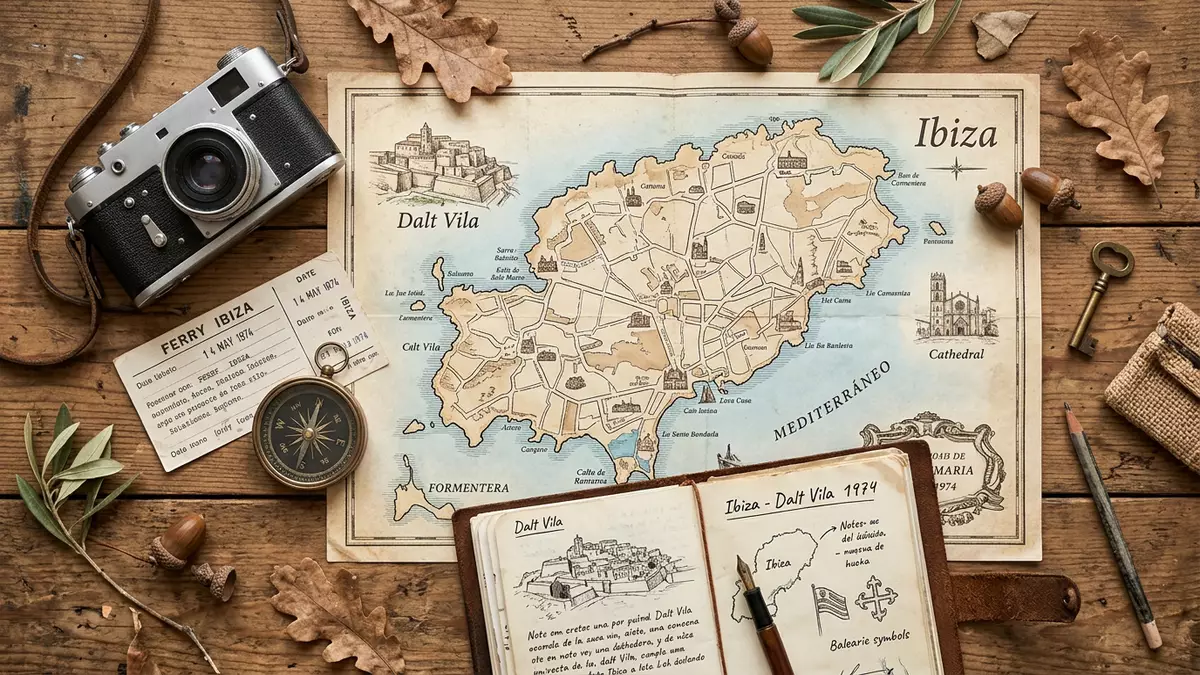
Dalt Vila is the fortified old town that rises above the harbour of Ibiza Town, its stone walls and hilltop cathedral forming a compact acropolis of Mediterranean history.
A hill above the harbour
Dalt Vila occupies the upper part of Ibiza Town on a hill known as Puig de Vila, climbing from sea level streets to a fortified crest with wide views over the port and the island’s coastline.Puig de Vila The district’s name in Catalan translates as “Upper Town”, a simple description that reflects how the old neighbourhood sits above the harbour and the modern extension below.Upper Town
From the quays and waterfront promenades, the profile of Dalt Vila is easy to pick out: a line of high fortifications encloses a dense cluster of houses, with the Cathedral of Santa Maria and the castle occupying the highest point of the ridge.cathedral and castle The climb into the old town runs along cobbled streets and ramps that pass under gateways and between bastions, connecting everyday residential lanes with terraces that look out towards Formentera and the open sea.harbour and Formentera
Renaissance walls and bastions
The fortified envelope that defines Dalt Vila is a work of sixteenth-century military architecture, built under Philip II of Spain as part of a Mediterranean defence system.Philip II of Spain Italian engineers Giovanni Battista Calvi and Jacobo Paleazzo Fratín designed a circuit of Renaissance walls that forms an irregular heptagon reinforced by bastions, creating a continuous stone perimeter around the upper town.Renaissance military architecture
These fortifications are recognised as an outstanding example of their period and form part of the World Heritage property “Ibiza, biodiversity and culture”, inscribed by UNESCO in 1999.UNESCO World Heritage Site The walls include seven named bastions and several formal entrances, among them the Portal de ses Taules, a ceremonial gateway reached by a stone ramp and flanked by Roman-style statuary and heraldic panels.Portal de ses Taules
Layers of settlement and sacred buildings
The hill of Dalt Vila holds traces of settlement spanning more than two millennia, beginning with Phoenician foundations in 654 BC that later developed through Punic and medieval phases into the present historic district.Phoenician foundation in 654 BC This long continuity is reflected in the concentration of historic structures inside the walls, including civic buildings, religious houses and museums that occupy former bastions and palaces.historic Old Town
At the highest point stands the Cathedral of Santa Maria, also known as the Cathedral of Our Lady of the Snows, which combines Gothic and Catalan influences and has roots in thirteenth-century church building on the site.cathedral at the top Nearby are the castle complex and former university buildings noted in the UNESCO inscription, while museums inside Dalt Vila showcase contemporary art and archaeological finds that relate to Ibiza’s wider cultural landscape.castle and historic buildings
Visiting Dalt Vila: what travellers from Western Europe should know
- Dalt Vila rises directly above the harbour of Ibiza Town on the island of Ibiza in Spain, with approaches from waterfront streets and nearby districts at sea level.
- The ascent into the old town involves steep cobbled streets, ramps and stairways that pass through gateways and around bastions, requiring steady footing on uneven stone surfaces.
- Road vehicles driven by residents have limited access inside the walls, so visitors usually explore Dalt Vila on foot along its lanes and sections of the fortifications.
- The official language is Spanish and the currency is the euro.
Searching for Dalt Vila on social platforms
These links open searches for Dalt Vila on each platform.
Frequently asked questions about Dalt Vila
Where is Dalt Vila located?
Dalt Vila forms the walled upper quarter of Ibiza Town on the island of Ibiza in Spain, rising above the harbour on the hill of Puig de Vila.
What should visitors expect inside the walls?
Visitors encounter steep cobbled streets, historic houses, gateways, bastions and hilltop viewpoints, together with religious buildings and museums housed in older structures.
What makes Dalt Vila distinctive among Mediterranean towns?
Its combination of sixteenth-century Renaissance fortifications, a compact hilltop plan and long continuity of settlement since Phoenician times gives Dalt Vila a dense, layered character.


