
Dalt Vila, Ibiza’s hilltop Renaissance walled town
Published on 09/21/2026 at 07:36 | Editorial responsibility: Rafael Müller, Editor-in-Chief AD HOC NEWS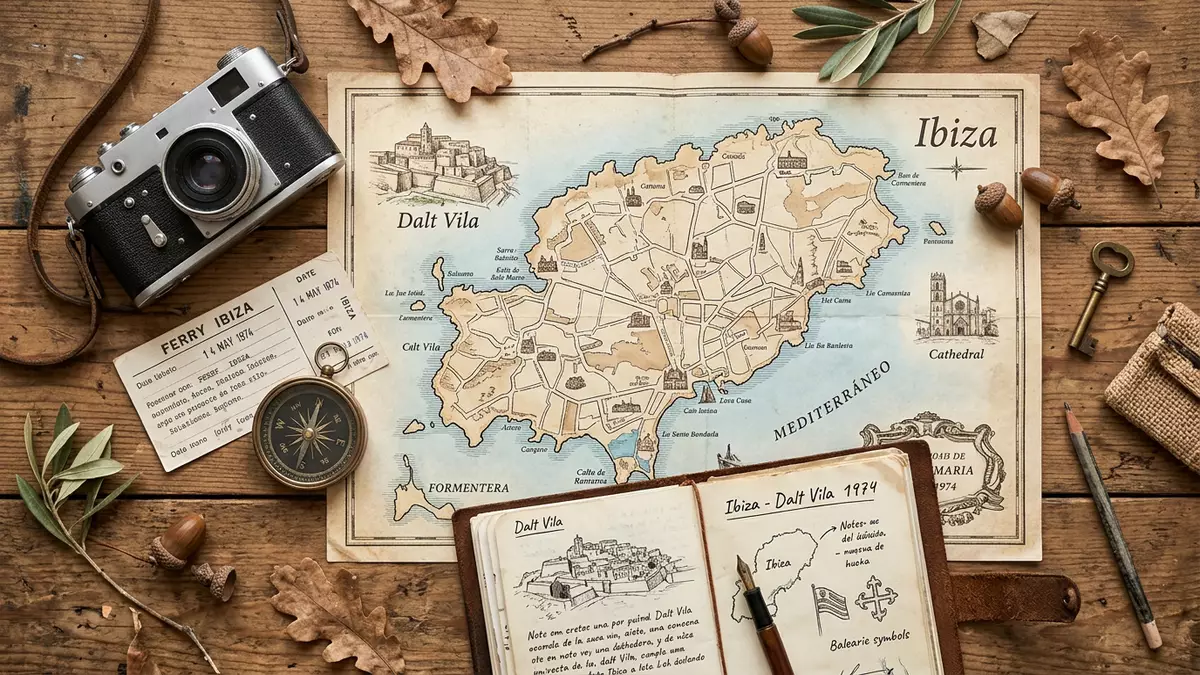
Dalt Vila is the fortified upper town of Ibiza, a hilltop citadel enclosed by sixteenth?century walls and crowned by the Cathedral of Santa María. Rising above the harbour on the hill of Puig de Vila, it forms the historic core of the island’s capital and concentrates more than two millennia of Mediterranean history in a compact urban landscape.
A Renaissance fortress over a Mediterranean harbour
Dalt Vila occupies the hill of Puig de Vila directly above the harbour of Ibiza Town on the island of Ibiza in Spain, its profile defined by continuous stone ramparts and projecting bastions that follow the slope of the hill.Dalt Vila occupies the hill of Puig de Vila above the harbour of Ibiza Town The fortified enclosure corresponds to the upper town, where narrow streets and stairways climb towards the castle and cathedral that occupy the highest ground within the walls.
The enclosing fortifications belong to the Renaissance period and were built between 1554 and 1585 as a coastal defence system, laid out with angular bastions suitable for cannon warfare.Between 1554 and 1585, new fortifications were built by two Italian engineers Italian military engineers such as Giovanni Battista Calvi and Jacobo Paleazzo Fratin contributed to the design of the walls, which became a model for later fortifications in other parts of the Spanish realms.Italian military engineers designed the fortifications using Renaissance techniques The bastioned ring still surrounds the upper town as a largely intact example of Renaissance military architecture facing the Mediterranean.
Layers of settlement and sacred architecture
The hill on which Dalt Vila stands has attracted settlement since ancient times, with Phoenician traders establishing a presence on the site in the seventh century BC and giving the island an early role in maritime exchange.Founded by Phoenician settlers in 654 BC Subsequent periods brought Roman, Islamic and later Aragonese rule, each leaving physical traces in the fabric of the town and its surroundings that can be traced in the street pattern and in nearby archaeological sites.Phoenician traders founded a settlement here in 654 BC, followed by Romans, Moors and the Aragonese Crown
At the summit of Dalt Vila, the Cathedral of Santa María occupies the highest point, rising above the surrounding houses and lanes as the principal religious building of the town.the Cathedral of Santa María crowns the fortified upper town The cathedral’s fabric incorporates Gothic elements and later modifications, reflecting the long history of worship on this site since the thirteenth century, when a church was established following the Christian conquest of the island.the Cathedral of Our Lady of the Snows dominates the highest point, with Gothic structure incorporating elements from the original thirteenth-century church Around it, smaller squares and terraces open towards views over the town, the harbour and the coastline beyond.
UNESCO World Heritage and the wider property
In 1999, Dalt Vila and associated sites were inscribed on the UNESCO World Heritage List under the title “Ibiza, biodiversity and culture”, recognising both the coastal fortifications and the archaeological depth of the island.Ibiza, Biodiversity and Culture was inscribed on the World Heritage List Within this serial property, the fortified upper town forms an outstanding example of a Renaissance coastal fortress, integrated with an historic urban fabric that documents Mediterranean defensive strategies over centuries.the walled enclosure of Dalt Vila crowns the city of Ibiza and is considered a well-preserved coastal fort
The World Heritage inscription also encompasses elements beyond the walls, including the ancient necropolis of Puig des Molins and the Phoenician settlement of Sa Caleta, as well as the Posidonia oceanica seagrass meadows in the surrounding sea.the property Ibiza, biodiversity and culture includes Dalt Vila, Puig des Molins, Sa Caleta and Posidonia meadows In the town itself, districts such as La Marina, Sa Penya and Es Soto lie at the foot of the walls beside the port, forming a network of streets that complement the fortified hill with a lower belt of historic neighbourhoods.ancient districts at the foot of the walls, including La Marina, Sa Penya and Es Soto, form part of the protected area
Visiting Dalt Vila: what travellers from Western Europe should know
- Dalt Vila stands above the harbour of Ibiza Town on the hill of Puig de Vila, reached on foot from the lower districts of the city via historic gateways and rising streets.
- The terrain within the walls is steep, with cobbled lanes, stairways and uneven surfaces, and reaching the summit involves sustained walking over gradients.
- The surrounding area includes the port of Ibiza Town and the lower districts of La Marina and Sa Penya at the foot of the walls, with streets that connect directly to the fortified hill.
- The official language is Spanish and the currency is the euro.
Searching for Dalt Vila on social platforms
These links open searches for Dalt Vila on each platform.Frequently asked questions about Dalt Vila
Where is Dalt Vila located?
Dalt Vila is located on the hill of Puig de Vila above the harbour of Ibiza Town on the island of Ibiza in Spain.
What should visitors expect inside the walls?
Visitors encounter steep cobbled streets, stairways, historic houses and small squares, leading upwards to the castle and the Cathedral of Santa María at the summit.
What makes Dalt Vila distinctive among Mediterranean towns?
Dalt Vila combines an intact ring of sixteenth-century Renaissance fortifications with a long history of settlement and a prominent cathedral crowning its hilltop citadel.


