
Dai Noi Hue, the imperial citadel on the Perfume River
Published on 09/18/2026 at 06:19 | Editorial responsibility: Rafael Müller, Editor-in-Chief AD HOC NEWS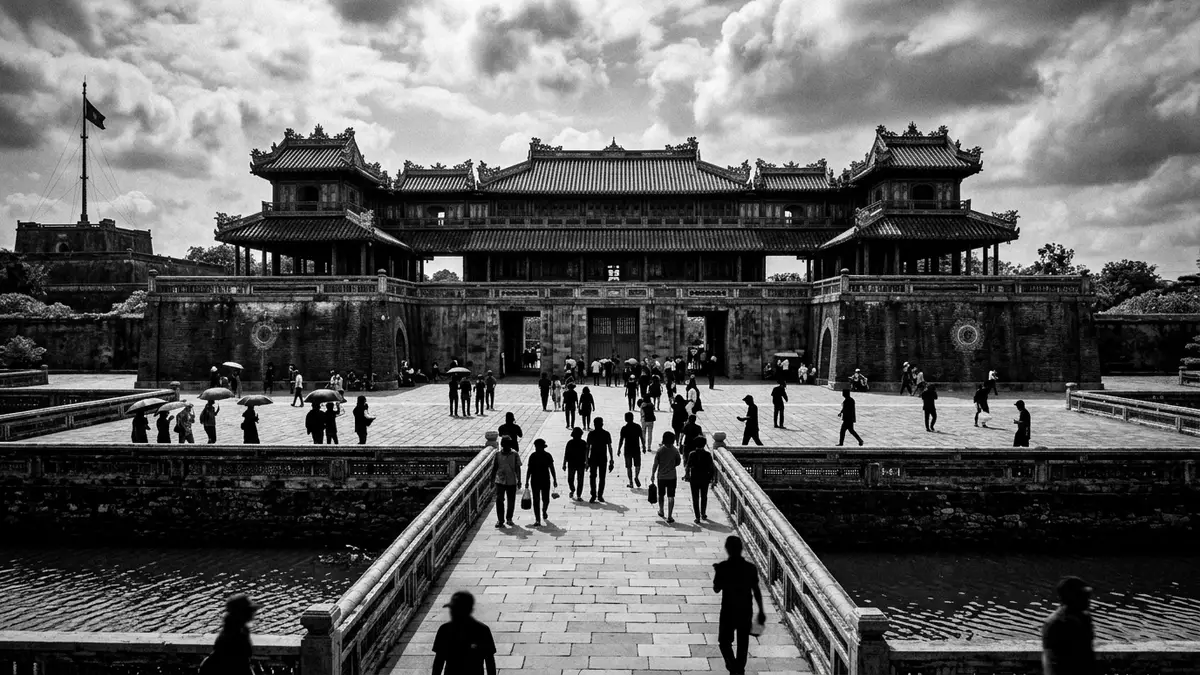
Dai Noi Hue in Hue, central Vietnam, is the royal enclosure within the city’s walled imperial citadel on the north bank of the Perfume River, laid out as the capital of the Nguyen dynasty in the nineteenth century.walled imperial citadel The moated walls, palace courts and axial processional axis still form a self-contained inner city that contrasts with the later commercial districts across the water.
A river citadel shaped as an imperial city
Dai Noi Hue occupies the inner section of Hue’s fortified Kinh Thanh, the walled city established when the Nguyen dynasty made Hue the imperial capital in the early nineteenth century.Imperial City known as Dai Noi The enclosure stands on the river’s north bank, facing the broad, slow course of the Perfume River and the city’s later commercial quarters on the opposite side.north bank of the Perfume River
The overall plan is arranged as a nested sequence of walled rectangles, with the outer moat and ramparts of the Kinh Thanh, the more formal gateway zone of the Imperial City and the innermost palatial compound that once housed the royal family. Brick ramparts ring large open courtyards, ornamental ponds and halls aligned along a main north–south axis, giving Dai Noi Hue the character of an entire city quarter devoted to imperial ceremony and administration.Imperial City enclosure with moat and wall
Nguyen dynasty power and palace landscapes
Construction of the imperial citadel in Hue began in the early nineteenth century under Emperor Gia Long, founder of the Nguyen dynasty, and continued under his successors as the court consolidated its seat beside the Perfume River.construction began in 1804 under Emperor Gia Long Within Dai Noi Hue, successive emperors commissioned palaces, audience halls and temples that reflected Vietnamese interpretations of Chinese imperial city-making while responding to the tropical climate of central Vietnam.
From this walled enclosure the Nguyen rulers governed large parts of Vietnam in the nineteenth and early twentieth centuries, making Hue the political and ceremonial heart of the kingdom.Nguyen family controlled southern and central Vietnam Dai Noi Hue forms a core element of the Complex of Hue Monuments, an ensemble of palaces, tombs and ritual landscapes inscribed as a UNESCO World Heritage Site in 1993 in recognition of the testimony it offers to the last Vietnamese royal dynasty.Complex of Hue Monuments World Heritage
Walking the moats, ramparts and palace courts
Many palace structures inside Dai Noi Hue suffered damage during conflicts in the twentieth century, yet the moats, outer walls and several key halls and gates remain, and restoration has brought back decorative roofs, carved details and gardens in selected areas.restoration and conservation work Visitors walk along broad processional courts, pass through layered gateways and look across ornamental ponds framed by trees and pavilions, gaining a sense of the scale at which the Nguyen court staged imperial ritual.
The contrast between the fortified fabric of Dai Noi Hue and the busy streets beyond the citadel walls is marked, with the Perfume River acting as a visual boundary between the historic imperial quarter and Hue’s later commercial city.citadel at the city’s heart The ensemble of moats, ramparts, palace compounds and axial courtyards turns a visit into a sequence of spatial episodes, from the imposing main gate through more intimate temple precincts and former residential zones of the royal household.
Visiting Dai Noi Hue: what travellers from Western Europe should know
- Dai Noi Hue lies in Hue in central Vietnam, within the historic citadel on the north bank of the Perfume River, opposite the city’s later commercial districts. It is part of the Complex of Hue Monuments that lines the river with imperial sites.
- The imperial citadel is enclosed by large ramparts and a surrounding moat, and visiting involves walking between gates, courtyards and palace zones over level paved surfaces and bridges.
- Hue stands in central Vietnam on the Perfume River, reached from Phu Bai International Airport and by rail services stopping at Hue Railway Station, with local transport continuing across the river to the citadel area.
- The official language is Vietnamese and the currency is the Vietnamese dong.
- Entry requirements depend on your nationality; UK travellers can check the FCDO travel advice at gov.uk/foreign-travel-advice, Irish travellers the Department of Foreign Affairs at ireland.ie.
Searching for Dai Noi Hue on social platforms
These links open searches for Dai Noi Hue on each platform.
Frequently asked questions about Dai Noi Hue
Where is Dai Noi Hue located?
Dai Noi Hue stands within the imperial citadel of Hue in central Vietnam, on the north bank of the Perfume River opposite the city’s later commercial districts.
What can visitors expect inside the citadel?
Visitors encounter walled courtyards, palace halls, ornamental ponds and layered gateways arranged along a main axis, with restored structures alongside ruins and open spaces.
What makes Dai Noi Hue distinctive among historic sites?
Dai Noi Hue combines a riverfront citadel, nested imperial enclosures and a palace landscape tied to the Nguyen dynasty, forming the core of a UNESCO-listed monumental complex.


