
Dai Noi Hue, the imperial citadel on the Perfume River
Published on 09/14/2026 at 12:21 | Editorial responsibility: Rafael Müller, Editor-in-Chief AD HOC NEWS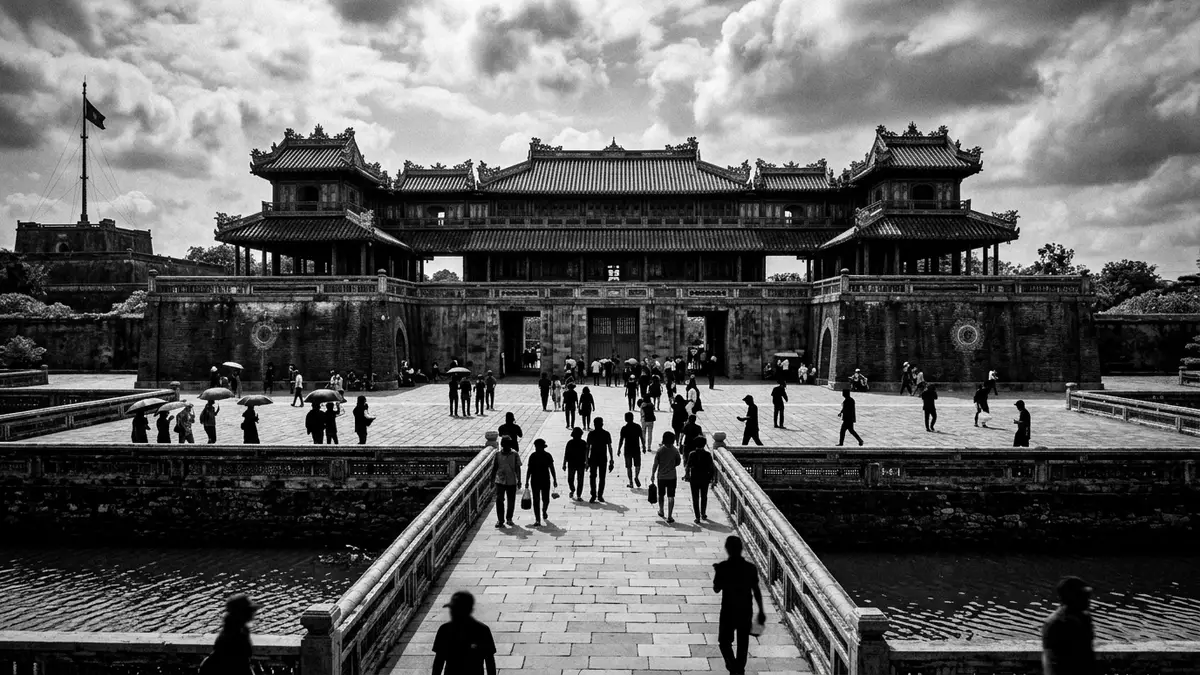
Dai Noi Hue, the Imperial City of Hue, is the innermost royal enclosure of the Nguyen dynasty’s capital on the north bank of the Perfume River in central Vietnam. Laid out in the nineteenth century within the wider Kinh Thanh, or walled city, it formed the ceremonial and residential heart of the imperial citadel that anchored Hue as Vietnam’s royal seat.
Walled imperial geometry beside the Perfume River
Dai Noi Hue stands within Hue’s fortified citadel on the river’s north bank, facing the commercial districts across the broad, slow course of the Perfume River. The Inner City, known locally as Dai Noi, follows a rectangular plan defined by defensive walls and a surrounding moat that set it apart from the street grid outside.The Inner City plan Within this rectangle, successive enclosures organise courtly life along a principal axis running from the main river-facing gate towards the former Forbidden Purple City, which once contained the emperor’s private residences and inner compounds.Imperial Residence and Forbidden Purple City
The wider citadel, of which Dai Noi is the royal core, was conceived as a Chinese-style Vietnamese imperial city, with outer areas devoted to administration and military functions and the inner sections reserved for court ceremony and domestic life.Chinese-style Vietnamese imperial citadel Brick walls and ramparts give the Imperial City a distinctly fortified outline, while the moat and earthworks underline its status as a self-contained royal precinct rather than an ordinary urban quarter.Brick walls and moats
Nguyen dynasty court city and royal residence
Hue became the capital of unified Vietnam under Emperor Gia Long in 1802, and construction of the imperial citadel and Dai Noi began shortly afterwards in the early nineteenth century.Construction under Gia Long and Minh Mang The Imperial City served as the seat of the Nguyen dynasty, which ruled Vietnam from the early 1800s until the abdication of Emperor Bao Dai in 1945, making Dai Noi Hue the backdrop to more than a century of royal ceremony and governance.Nguyen dynasty centre
Within the imperial citadel, Dai Noi functioned as the middle of three concentric layers: the outer Citadel, or Kinh Thanh, for administration and defence; the Imperial City, or Hoang Thanh and Dai Noi, for court rituals; and the Forbidden Purple City, or Tu Cam Thanh, for the emperor’s household.Three concentric wall layers This arrangement reflects the hierarchical structure of the Nguyen court, expressed in stone, brick and timber across a landscape of palaces, shrines and service buildings that once supported imperial ritual, administration and daily life.
Architecture, layout and surviving structures
The Imperial City of Hue showcases Vietnamese royal architecture influenced by classical East Asian planning, combining axial symmetry with courtyards, halls and ornamental gardens.Feudal royal architecture The complex extends over a substantial area on the river’s north bank, with a network of gates leading into successive courtyards and ceremonial spaces that once accommodated audiences, rituals and processions.Three interconnected citadels
War and later neglect damaged many buildings, yet numerous halls, temples and pavilions have been restored or stabilised, and the surviving structures still convey the scale of the royal complex.Surviving royal architecture In 1993 the Complex of Hue Monuments, centred on the Imperial City and its associated tombs and ritual sites, was inscribed as a World Cultural Heritage site, recognising its significance as an ensemble of Nguyen dynasty architecture and landscape design.World Heritage inscription
Visiting Dai Noi Hue: what travellers from Western Europe should know
- Dai Noi Hue lies within the historic citadel of Hue in central Vietnam, on the north bank of the Perfume River opposite the city’s later commercial districts. It is reached across bridges leading from the southern riverfront into the old walled city.
- The imperial precinct includes broad ramparts, moats and large enclosed courtyards, with substantial sections explored on foot over stone surfaces and staircases within various gate towers and palace compounds.
- Hue is served by Phu Bai International Airport to the south and by rail services on the north–south line through central Vietnam, with road connections linking the modern city to the imperial citadel across the Perfume River.
- The official language is Vietnamese and the currency is the Vietnamese dong.
- Entry requirements depend on your nationality; UK travellers can check the FCDO travel advice at gov.uk/foreign-travel-advice, Irish travellers the Department of Foreign Affairs at ireland.ie.
Searching for Dai Noi Hue on social platforms
These links open searches for Dai Noi Hue on each platform.
Frequently asked questions about Dai Noi Hue
Where is Dai Noi Hue located?
Dai Noi Hue forms the inner Imperial City within the historic citadel of Hue in central Vietnam, on the north bank of the Perfume River opposite later commercial districts.
What can visitors expect when exploring Dai Noi Hue?
Visitors encounter a large walled imperial precinct of gates, courtyards, halls and restored royal buildings, linked by stone paths and staircases within a moated citadel landscape.
What makes Dai Noi Hue distinctive among historic sites?
Dai Noi Hue stands out as the royal core of a Nguyen dynasty capital, combining a layered court city layout with surviving palaces and a recognised World Heritage status within the Complex of Hue Monuments.


