
Dai Noi Hue, the imperial citadel on the Perfume River
Published on 08/30/2026 at 12:37 | Editorial responsibility: Rafael Müller, Editor-in-Chief AD HOC NEWS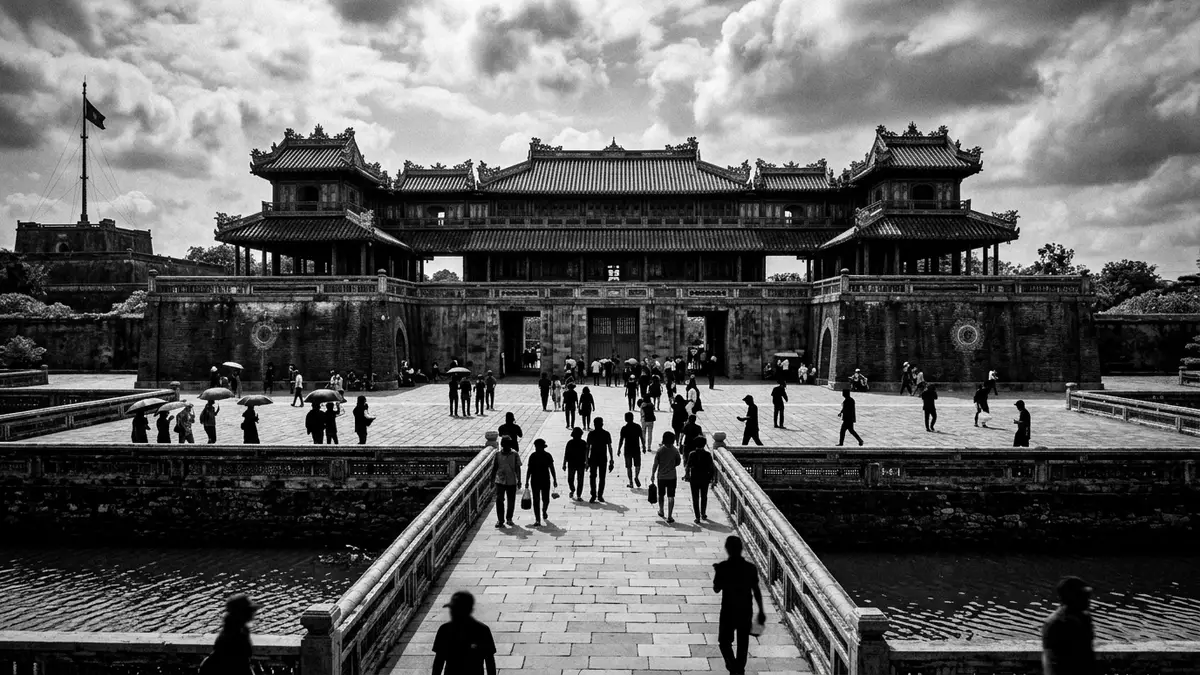
Dai Noi Hue, the Imperial City of Hue, is a walled royal enclosure within Hue’s larger citadel on the north bank of the Perfume River in central Vietnam. Built in the early nineteenth century under the Nguyen dynasty as the ceremonial and administrative heart of the imperial capital, it remains a dense ensemble of walls, moats, gateways and palace courts laid out as a self-contained inner city.
The walled heart of the Nguyen capital
The Imperial City, known in Vietnamese as Hoang Thanh and also called Dai Noi, sits inside the broader Kinh Thanh, the fortified citadel that once defined Hue as Vietnam’s imperial capital under the Nguyen dynasty from 1802 to 1945.Imperial City of Hue The Kinh Thanh forms a square plan on the river’s northern bank, enclosed by long earth and brick ramparts and a moat that together trace a perimeter of around 10 km.citadel perimeter and moat Within this outer defence, Dai Noi occupies the inner core, arranged as a sequence of increasingly restricted precincts leading towards the former residential quarters of the Nguyen emperors.
Construction of the Hue Imperial City began in 1804 under Emperor Gia Long, the first Nguyen ruler, and continued under his successors as halls, temples and service buildings were added.construction began in 1804 under Gia Long The ensemble reflects court architecture shaped by Vietnamese traditions and Chinese models, translated into a vast rectilinear plan aligned with the Perfume River and the surrounding landscape. From the mid-nineteenth century into the early twentieth century, the Nguyen family ruled southern and central Vietnam from this fortified seat, using Dai Noi as both palace complex and ceremonial stage.Nguyen rule from the citadel
Gates, throne halls and palace precincts
Approaching Dai Noi Hue, visitors first encounter the monumental Ngo Mon Gate, the principal southern entrance facing the Perfume River and the former parade grounds outside the citadel walls.Ngo Mon Gate and Thai Hoa Palace Behind this ceremonial gateway lies the Thai Hoa Palace, the throne hall of the Nguyen emperors, set on an elevated terrace and fronted by courtyards that once hosted mandarins arranged by rank. The composition of gate, forecourt and hall is one of the most characteristic sequences within Dai Noi, making the transition from outer administration to inner royal space visible in stone, timber and tile.
Beyond the throne hall, the Imperial City opens into a grid of palace precincts aligned along a main north–south axis, with flanking compounds connected by covered corridors and smaller passages. To the rear stood the Tu Cam Thanh, the Forbidden Purple City, which housed the private residences of the royal family within yet another ring of walls and courtyards.Forbidden Purple City within the Imperial City Many structures suffered heavy damage in twentieth-century conflicts, but key elements such as Thai Hoa Palace, prominent gates and several temples have been repaired or reconstructed, and landscaped courts now mark the footprints of lost buildings while preserving the axial order of the original plan.restoration of halls and courtyards
Dai Noi Hue within the Complex of Hue Monuments
Dai Noi Hue forms a central part of the Complex of Hue Monuments, a cultural ensemble recognised as a UNESCO World Heritage Site in 1993.Complex of Hue Monuments inscription The World Heritage property encompasses the citadel, the Imperial City and Forbidden Purple City, together with associated sites such as royal tombs, temples and educational institutions distributed along the Perfume River in Thua Thien-Hue Province.citadel, Imperial City and Purple Forbidden City Within this wider landscape, Dai Noi stands out as the most concentrated expression of Nguyen court life, combining governance, ritual and residence in a single fortified inner city.
The Imperial City covers an area of roughly 160 ha within the larger buffer zone defined by the citadel ramparts and surrounding waterways.Imperial City area and buffer zone The layout follows geomantic principles that align major axes and gateways with cardinal directions and prominent landscape features, while subsidiary structures cluster in groups according to function. Together with the royal tombs scattered in the countryside and the temples dedicated to the Nguyen lineage, Dai Noi Hue helps to illustrate how Vietnam’s final feudal dynasty embedded its capital in the geography of central Vietnam.Nguyen dynasty monuments along the Perfume River
Visiting Dai Noi Hue: what travellers from Western Europe should know
- Dai Noi Hue lies within the historic citadel on the north bank of the Perfume River in Hue, central Vietnam, opposite the city’s later commercial districts.imperial citadel on the river’s left bank
- The terrain inside the Imperial City consists of broad courtyards, formal gardens and long axial routes, interspersed with stairways leading to terraces and hall platforms.
- Hue Railway Station stands on the southern side of the Perfume River, and bridges link the station district with the citadel and Dai Noi on the northern bank.citadel on the north bank of the Perfume River
- The official language is Vietnamese and the currency is the Vietnamese dong.
- Entry requirements depend on your nationality; UK travellers can check the FCDO travel advice at gov.uk/foreign-travel-advice, Irish travellers the Department of Foreign Affairs at ireland.ie.
Searching for Dai Noi Hue on social platforms
These links open searches for Dai Noi Hue on each platform.
Frequently asked questions about Dai Noi Hue
Where is Dai Noi Hue located within Hue?
Dai Noi Hue stands inside the imperial citadel on the north bank of the Perfume River in Hue, central Vietnam, opposite the city’s later commercial districts.
What can visitors expect when exploring Dai Noi Hue?
Visitors walk through a fortified inner city of moats, ramparts, gates, throne halls and palace courtyards, with restored buildings and landscaped spaces marking the historic plan.
What makes Dai Noi Hue distinctive among Vietnamese heritage sites?
Dai Noi Hue was the imperial enclosure of the Nguyen dynasty, combining governance, ritual and residence, and it forms the core of the UNESCO-listed Complex of Hue Monuments.


