
Dai Noi Hue and the walled imperial citadel of Hue
Published on 08/27/2026 at 13:53 | Editorial responsibility: Rafael Müller, Editor-in-Chief AD HOC NEWS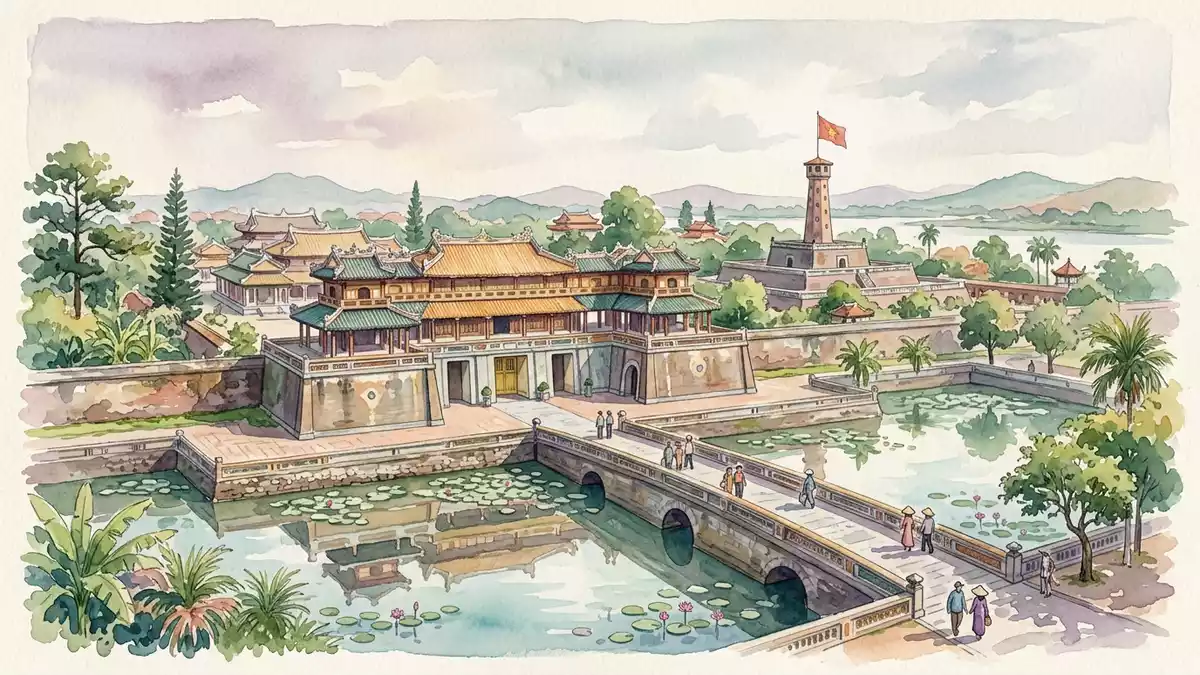
Dai Noi Hue is the royal enclosure at the centre of Hue’s imperial citadel, on the north bank of the Perfume River. It belongs to the Nguy?n dynasty period and the wider Complex of Hue Monuments, a UNESCO World Heritage site since 1993.
Dai Noi Hue inside Hue’s imperial citadel
The place is a walled imperial compound rather than a single palace, with ramparts, gates and successive enclosures. The surviving layout shows the form of a court city shaped around ceremony, administration and residence.
The name Dai Noi identifies the inner citadel, the royal heart of the larger fortified city. That relationship remains the easiest way to read the site, because the monuments are arranged as a sequence rather than as one isolated building.
Nguy?n dynasty walls, gates and courtyards
The citadel is tied to the reigns of Gia Long and Minh M?ng, and the broader court city belongs to the nineteenth century. In Vietnamese history, that period marks the imperial capital at Hu? and the political centre of the Nguy?n dynasty.
Its walls and moats define the plan, while the imperial enclosure contains palaces, ceremonial spaces and the Purple Forbidden City. The ensemble is part masonry stronghold, part royal precinct, and that mixed character is what gives Dai Noi Hue its identity.
A royal landscape on the Perfume River
Dai Noi Hue sits within the historic landscape of Hu?, where the river, moat and fortified walls create a distinct urban setting. The site is linked to the city’s older imperial geography, with the walled citadel on one side of the Perfume River and the later commercial districts beyond it.
The UNESCO inscription also places Dai Noi Hue within a broader heritage group that includes royal tombs, temples and related monuments around Hu?. That wider setting helps explain why the inner citadel reads as part of a larger imperial world rather than a freestanding monument.
Visiting Dai Noi Hue: what travellers from Western Europe should know
- Da Noi Hue lies in Hue, on the north bank of the Perfume River. The site is reached through the city’s imperial quarter, with the moat and walls marking the historic core.
- The place is spread across large enclosures, so the visit involves gates, courtyards and open sections of masonry. Walking means moving through a fortified complex rather than a compact museum building.
- Outside the inner citadel, the wider Complex of Hue Monuments includes royal tombs, temples and other linked sites. That makes Dai Noi Hue part of a broader heritage landscape across Hu?.
- The official language is Vietnamese and the currency is the Vietnamese dong.
Searching for Dai Noi Hue on social platforms
These links open searches for Dai Noi Hue on each platform.
Frequently asked questions about Dai Noi Hue
Where is Dai Noi Hue?
Dai Noi Hue is in Hue, in central Vietnam, on the north bank of the Perfume River. It forms the inner royal enclosure of the city’s imperial citadel.
What does a visit involve?
The site involves walls, gates, courtyards and large open compounds. It is a place of movement through an imperial layout rather than a single hall or gallery.
What makes Dai Noi Hue distinctive?
Its identity comes from the Nguy?n dynasty court city and the UNESCO-listed heritage setting of Hu?. The combination of royal enclosure, fortified walls and linked monuments gives the place its historical weight.


