
Custer State Park where bison share the Black Hills landscape
Published on 09/23/2026 at 22:25 | Editorial responsibility: Rafael Müller, Editor-in-Chief AD HOC NEWS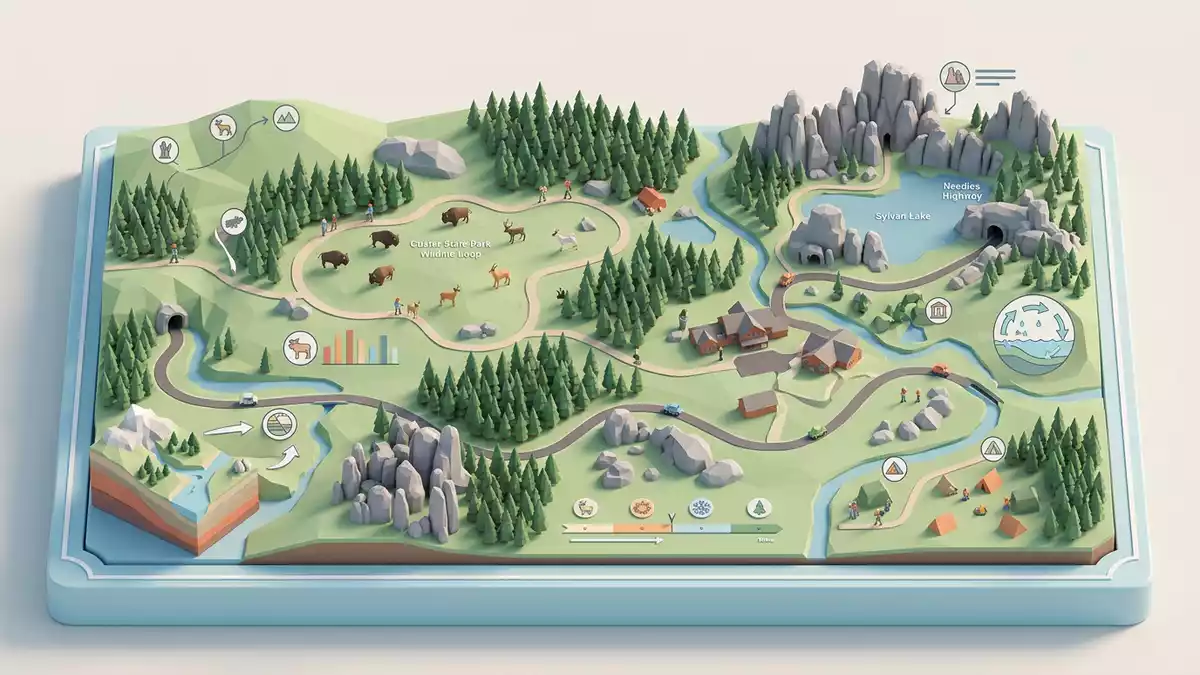
Custer State Park spreads across the southern Black Hills of South Dakota, where open prairie, ponderosa pine forest and granite formations share the landscape with free-roaming bison. Near the town of Custer, the park combines a wildlife reserve, mountain roads, lakes and historic buildings within a broad protected area.
Custer State Park and the Black Hills landscape
The park covers more than 70,000 acres, with rolling grassland opening between forested slopes and rugged granite outcrops. Its terrain includes mountain lakes, streams, pine-covered hills and broad valleys, creating a varied setting within the Black Hills.
The Needles form the park’s most recognisable geological feature. Slender granite pillars rise beside the Needles Highway, where the road passes through narrow rock formations and tunnels. Granite also appears across the wider park, linking the high country with the open prairie.
Bison, pronghorn and a living conservation history
Custer State Park is associated with a large free-roaming bison herd, alongside pronghorn, elk, mule deer, bighorn sheep, mountain goats and other wildlife. Animals occupy grassland, woodland and rocky terrain across the park rather than a separate enclosed display.
The park’s conservation history reaches back to its history from 1897. Thirty-six bison from Scotty Philip’s herd entered the park in 1914, and the first Rocky Mountain bighorn sheep were introduced in 1922. These dates connect the present wildlife landscape with the early development of the reserve.
Peter Norbeck, roads and historic park buildings
Peter Norbeck played a central role in the park’s creation as a South Dakota politician and conservation advocate. Custer State Forest was designated in 1912, and the area became an official state park in 1919. The park’s name refers to Lieutenant Colonel George Armstrong Custer and the nearby town of Custer.
Roads are a major part of the park’s identity. The Needles Highway was completed in 1922, while the Wildlife Loop Road crosses prairie and wooded country. The State Game Lodge opened in 1921, adding a historic lodge to the park’s collection of buildings, roads, lakes and campgrounds.
Visiting Custer State Park: what travellers from Western Europe should know
- Custer State Park lies in the Black Hills of South Dakota, near Custer. US Highway 16A crosses the park, and Rapid City is the nearest major city.
- The landscape combines paved scenic roads with granite formations, forested slopes, prairie and lakes. The Needles Highway includes narrow passages and rock tunnels.
- Wildlife shares the park’s roads and grassland. Bison, pronghorn and deer can appear beside routes through the open country.
- The official language is English and the currency is the United States dollar.
- Entry requirements depend on your nationality; UK travellers can check the FCDO travel advice at gov.uk/foreign-travel-advice, Irish travellers the Department of Foreign Affairs at ireland.ie.
Searching for Custer State Park on social platforms
These links open searches for Custer State Park on each platform.Frequently asked questions about Custer State Park
Where is Custer State Park?
Custer State Park is in the southern Black Hills of South Dakota, near the town of Custer and south-west of Rapid City.
What can travellers expect there?
The park contains prairie, pine forest, granite formations, lakes, historic buildings and scenic roads, with bison and other wildlife across the landscape.
What makes Custer State Park distinctive?
Its distinctive character comes from the visible meeting of free-roaming bison, open prairie and granite formations such as the Needles within one large Black Hills park.


