
Cueva de Nerja and its vast underground chambers beneath Maro
Published on 08/27/2026 at 18:21 | Editorial responsibility: Rafael Müller, Editor-in-Chief AD HOC NEWS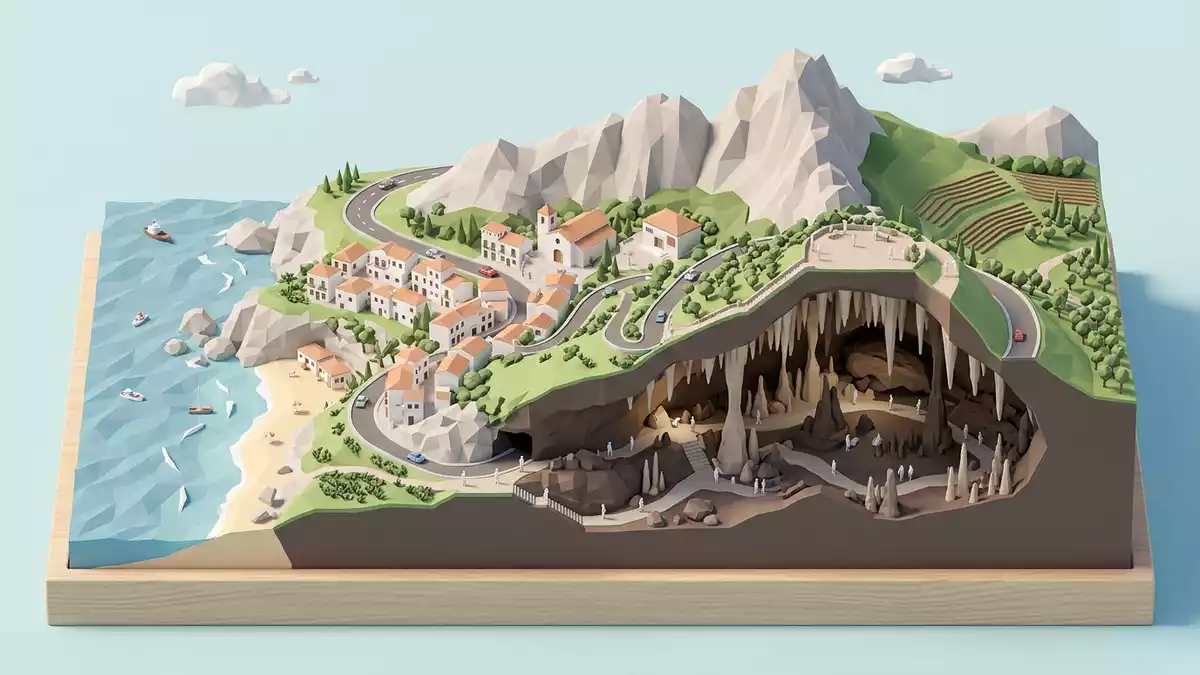
Cueva de Nerja is a vast limestone cave system beneath the hamlet of Maro near Nerja on Spain’s Costa del Sol, a subterranean landscape of towering chambers and dense mineral formations that turns a hillside above the Mediterranean into an underground world of stone.
An underground world beneath the Sierra Almijara
Cueva de Nerja lies on the southern flank of the Sierra Almijara, in the province of Málaga in Andalusia, with its main entrance set above the coastal village of Maro and within reach of Nerja’s seafront. The cave extends for almost 5 km (3.1 mi) through the rock, making it one of the most extensive mapped caverns in Andalusia and a major site on Spain’s southern coast.almost 5 km The show galleries open to visitors occupy only part of this network, with further upper galleries reserved for research and delicate archaeological material.Upper Galleries
The cavity developed in Triassic dolomitic marble within the Alpujárride complex of the Internal Zone of the Betic Cordillera, a belt of mountains running behind the Costa del Sol.Triassic dolomitic marble Rainwater enriched with carbon dioxide has percolated through fractures in these marbles over millions of years, dissolving the rock and opening voids that coalesced into the present cave. Geological studies estimate that water infiltration in the Sierra Almijara marbles began over five million years ago and that some speleothems in the cave are over 800,000 years old, giving the site a deep-time dimension that reaches back long before human presence in the area.over five million years
Discovery, layout and monumental formations
The cave was brought to wider attention on 12 January 1959 when a group of local boys from Maro entered a small opening while searching for bats and encountered large underground chambers.12 January 1959 In the year following this discovery, a new entrance was opened to facilitate controlled visitor access, separate from the natural sinkholes. The present system has three known entrances, two of them subcircular sinkholes used historically, and a third, purpose-made entry that leads directly into the show galleries.three entrances
Inside, Cueva de Nerja divides into areas including the Show Galleries for the public and Upper Galleries for researchers, with a sequence of halls and corridors marked by dense speleothem growth.Show Galleries Stalactites descend from the ceilings and stalagmites rise from the floors, in many places merging into pillars that reach from chamber floor to roof. One of these formations in the central hall is among the largest known cave columns, occupying a striking position in the main route and emphasising the vertical scale of the interior.large cave column
Archaeological traces and cultural setting
Beyond geology, Cueva de Nerja preserves traces of human activity that contribute to its archaeological significance. Excavations have revealed remains from different prehistoric periods, with material spanning tens of thousands of years of occupation in and around the cave.prehistoric remains Among the finds are cave paintings, including depictions of marine animals that have drawn interest for their possible antiquity and the insight they give into communities linked to both inland hills and the nearby Mediterranean coast.cave paintings
The cave lies just inland from the Costa del Sol, close to Nerja’s beaches and whitewashed streets, and forms part of a wider landscape where the Betic mountains meet the sea. It stands within the municipality of Nerja, in the district of Maro, and is reached via the Mediterranean Highway A-7, leaving at exit 295 signposted for the cave and climbing towards the hillside entrance above the village.exit 295 signposted The combination of coastal setting and mountainous geology makes Cueva de Nerja a point where visitors can move directly from sea level views to an interior shaped by water far below the surface.
Visiting Cueva de Nerja: what travellers from Western Europe should know
- Cueva de Nerja stands just outside Maro in the municipality of Nerja in southern Spain, reached from Málaga along the A-7 motorway and signed at exit 295 toward the cave.
- The cave interior involves walking on hard surfaces with significant staircases between levels inside the show galleries, so a visit includes sustained movement on steps in a dimly lit underground environment.
- The surrounding terrain rises above the coastal plain, and the main entrance sits on a hillside above Maro, with outdoor paths and approach areas that reflect this moderate slope between parking areas and the building.
- The official language is Spanish and the currency is the euro.
Searching for Cueva de Nerja on social platforms
These links open searches for Cueva de Nerja on each platform.
Frequently asked questions about Cueva de Nerja
Where is Cueva de Nerja located?
Cueva de Nerja is in the district of Maro in the municipality of Nerja in Málaga province, Andalusia, just inland from Spain’s Mediterranean coast.
What should visitors expect inside the cave?
Visitors follow a marked route through large chambers filled with stalactites, stalagmites and pillars, moving along constructed paths and staircases in a dim underground setting.
What makes Cueva de Nerja distinctive among caves?
Its combination of extensive mapped galleries, very large speleothem columns and prehistoric archaeological remains within a coastal mountain setting gives Cueva de Nerja a distinctive character.


