
Cueva de las Manos and the painted hands of Patagonia
Published on 09/03/2026 at 06:02 | Editorial responsibility: Rafael Müller, Editor-in-Chief AD HOC NEWS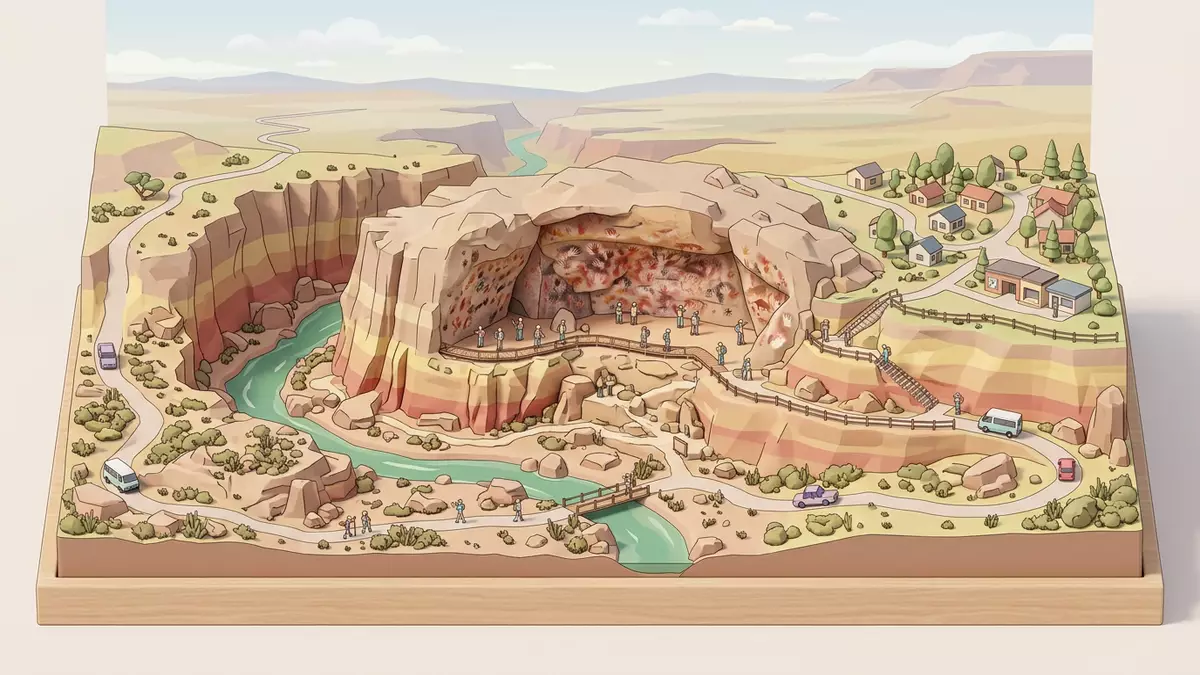
Cueva de las Manos near Perito Moreno in southern Argentina is an archaeological site where ancient hand stencils and animal figures cover the walls of rock shelters above the Río Pinturas canyon. Set in the province of Santa Cruz in Patagonia, the site brings together striking cliff scenery and one of South America’s most important concentrations of prehistoric rock art dating back many thousands of years.
Handprints on a Patagonian cliff
The name Cueva de las Manos, “Cave of the Hands”, refers to the dense clusters of human hand silhouettes that line the rock faces of the Pinturas River canyon. The art appears on the walls of a cave and nearby rock shelters, forming panels where hands overlap in layers, framed by animals, human figures and abstract motifs.The cave lies in the Río Pinturas canyon in Santa Cruz province and the wider archaeological corridor follows the course of the river through a deep gorge in north-west Santa Cruz.Rock shelters line both sides of the canyon.
Archaeological research has identified several phases of painting at the site, spanning a long period of human occupation. The oldest imagery belongs to the early Holocene, and some panels with animals and hunting scenes are linked to later stylistic groups reaching into the first millennium AD.Work by archaeologist Carlos Gradin and colleagues distinguished three main stylistic groups from around 7,300 BCE onwards, while excavations on the plateau above show that people last lived in the shelters around AD 700.Archaeological studies place the end of occupation around AD 700.
Ancient art: hands, animals and colours
The panels of Cueva de las Manos combine hundreds of hand stencils with depictions of local fauna and geometric signs. Among the animals, guanacos, rheas and feline shapes appear in scenes that show hunting and movement across the Patagonian steppe.Painted scenes include guanacos, rheas, cats and hunting groups, while some compositions create complex arrangements of figures and zigzag motifs. The hands themselves number in the thousands when all panels are counted, and many are arranged in dense clusters that fill entire sections of wall.The UNESCO description highlights the exceptionally rich assemblage of painted hands.
The colours used across the site come from mineral pigments sourced in the surrounding landscape. Red and purple tones derive from iron oxides, white from kaolin, yellow from natrojarosite and black from manganese oxide.Analyses of the pigments identify iron, kaolin, natrojarosite and manganese compounds. Many of the hand images are negative stencils, produced by placing a hand on the rock and blowing pigment from a tube made from bone so that the colour falls around the fingers and palm.Descriptions of the technique emphasise the use of bone tubes for spraying pigment.
World Heritage in the Río Pinturas canyon
The art of Cueva de las Manos forms part of a broader archaeological landscape along the upper Pinturas River, where several shelters and caves contain related imagery. The main cave and associated panels are protected as a provincial park and are also linked with Perito Moreno National Park in the wider protected area network.The site lies within both Cueva de las Manos Provincial Park and Perito Moreno National Park. Argentina’s National Congress declared the cave a Historic National Monument in 1993, and in 1999 it was added to the UNESCO World Heritage List for its outstanding rock art and its testimony to early hunter-gatherer societies in Patagonia.The property was inscribed on the World Heritage List in 1999 and recognised as a Historic National Monument in 1993.
The canyon setting is central to the character of Cueva de las Manos. The Pinturas River cuts through a plateau to form steep cliffs with terraces and ledges, and the cave opens partway down this escarpment.Descriptions place the cave around 88 m above the valley floor on a cliff within Estancia Cueva de las Manos. Visitors encounter a combination of eroded rock, sparse vegetation and distant views of the Patagonian steppe, with the painted panels set under overhangs that shield them from direct sun and wind.
Visiting Cueva de las Manos: what travellers from Western Europe should know
- Cueva de las Manos lies in Santa Cruz province in Patagonia, in the canyon of the Río Pinturas south of the town of Perito Moreno, reached by road from Ruta Nacional 40.
- The approach to the cave includes an area of rugged terrain above the canyon and a descent towards the river, with paths and stairways on rock and soil surfaces.
- The cave and shelters stand at altitude above the valley floor, and access involves walking on uneven ground near cliffs, requiring steady footing and care on exposed sections.
- The official language is Spanish and the currency is the Argentine peso.
- Entry requirements depend on your nationality; UK travellers can check the FCDO travel advice at gov.uk/foreign-travel-advice, Irish travellers the Department of Foreign Affairs at ireland.ie.
Searching for Cueva de las Manos on social platforms
These links open searches for Cueva de las Manos on each platform.
Frequently asked questions about Cueva de las Manos
Where is Cueva de las Manos located?
Cueva de las Manos stands in the canyon of the Río Pinturas in Santa Cruz province, Patagonia, south of the town of Perito Moreno in Argentina.
What should visitors expect on a visit?
Visitors follow paths along the edge of a deep canyon to reach the cave and nearby shelters, where guided routes lead past panels of hand stencils and animal figures on the rock.
What makes Cueva de las Manos distinctive?
The site combines a dramatic Patagonian gorge landscape with one of the densest known assemblages of prehistoric hand stencils and hunting scenes, preserved on cliffs above the Pinturas River.


