
Cueva de las Manos and the painted canyon walls of Patagonia
Published on 09/01/2026 at 14:22 | Editorial responsibility: Rafael Müller, Editor-in-Chief AD HOC NEWS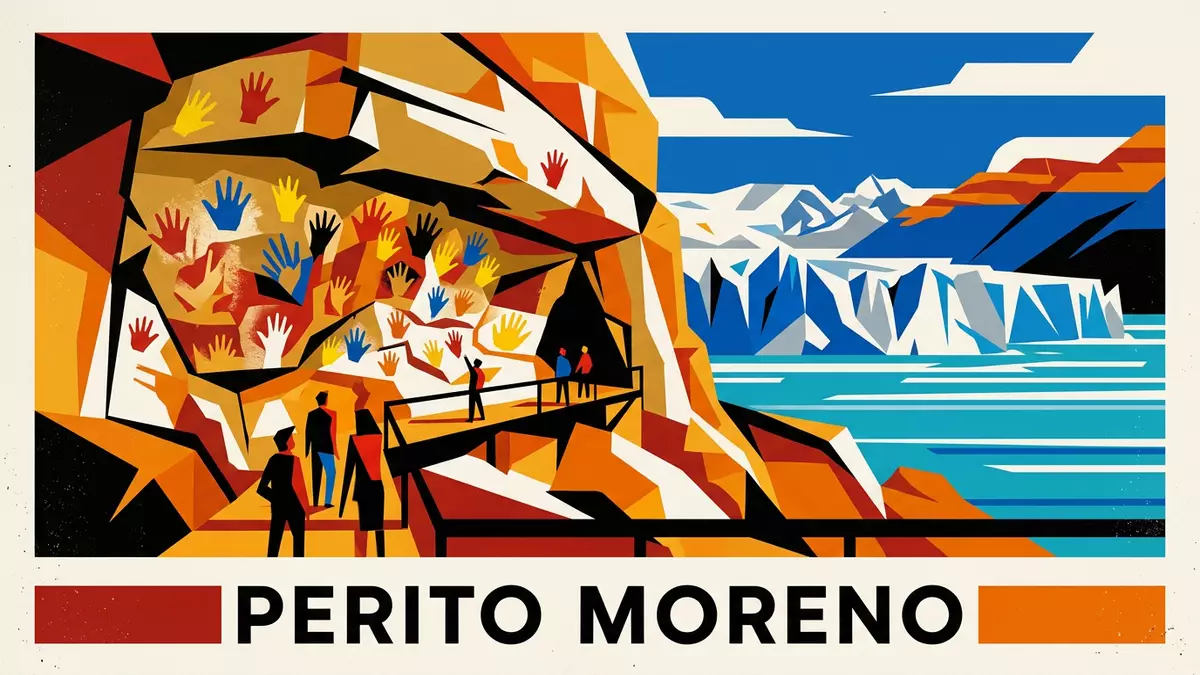
Cueva de las Manos in Argentina’s Santa Cruz Province brings together prehistoric rock art and a dramatic Patagonian canyon, turning a single cliff shelter into a concentrated record of human presence. The site lies between the towns of Perito Moreno and Bajo Caracoles in the basin of the Río Pinturas, and its paintings span much of the early Holocene period.
Ancient hands on a Patagonian cliff
The centrepiece of Cueva de las Manos is a sequence of painted hands that covers sections of the cliff wall like a patterned field of silhouettes. The name of the site translates as “Cave of the Hands”, a literal reference to these stencilled outlines of human hands that give the place its visual identity.Cave of the Hands The shelter sits in the canyon of the Río Pinturas, part of the arid steppe landscape of northern Patagonia, where the river has cut a deep incision into the volcanic plateau.canyon of the Río Pinturas
Archaeological work at Cueva de las Manos has identified rock art phases that reach back to the early Holocene, with some of the oldest motifs dating to more than 9,000 years ago.executed between 9,300 and 1,300 years ago The paintings record hunter?gatherer societies that used this part of Patagonia long before the arrival of European settlers in South America.hunter?gatherer communities For travellers from Western Europe, the timescale alone shifts the perspective, extending human history on the continent into a distant, pre?agricultural past.
Rock art, colours and animals
The hand images at Cueva de las Manos appear mainly as negative stencils, created by placing a hand against the wall and spraying pigment around it. The resulting outlines vary in size and orientation, forming clusters where hands overlap in dense layers. Many are red, ochre or brown, while others use black or lighter tones, building a restrained but clear colour palette against the pale rock.black, white, red, yellow and purple Close by, there are also painted depictions of guanacos and other animals that link the imagery to the fauna of the Patagonian steppe.depictions of animals, such as guanacos
Beyond the cave itself, the surrounding cliff faces carry additional panels and rock overhangs with pictographs, creating a continuous band of imagery along part of the canyon wall.many painted rock shelters, including a cave Stylised hunting scenes, geometric patterns and animal tracks appear among the hand motifs, giving a layered picture of how different groups marked the place over many centuries. The rock art is painted directly onto the natural surface of the volcanic rock, its pigments adhering to the cliff in a way that has proved resilient in the dry Patagonian climate.
A World Heritage site in the Río Pinturas gorge
Cueva de las Manos was designated a National Historic Monument in Argentina in 1993, recognising its importance as an archaeological site of national scale.designated Monumento Histórico Nacional in 1993 In 1999 it was inscribed on the UNESCO World Heritage List under cultural criterion (iii), under the official name “Cueva de las Manos, Río Pinturas”.inscribed on the World Heritage List in 1999 This inscription frames the site as an outstanding example of prehistoric rock art that bears witness to early human societies in South America.outstanding collection of prehistoric rock art
Geographically, the site lies in Santa Cruz Province in southern Argentina, within the wider Patagonian region and south of the town of Perito Moreno.south of the town of Perito Moreno The gorge of the Río Pinturas frames the approach, with the river running far below the level of the painted shelter. From the plateau, the canyon cuts unexpectedly into the steppe, and the rock face that carries the hand stencils stands above a bend in the river, forming a natural balcony over the landscape.
Visiting Cueva de las Manos: what travellers from Western Europe should know
- Cueva de las Manos lies in the canyon of the Río Pinturas in Santa Cruz Province, between Perito Moreno and Bajo Caracoles in northern Patagonia in southern Argentina.
- The rock art site occupies a ledge on a cliff above the Río Pinturas gorge, and access around the shelter involves walking along paths near steep drops on uneven ground.
- The official language is Spanish and the currency is the Argentine peso.
- Entry requirements depend on your nationality; UK travellers can check the FCDO travel advice at gov.uk/foreign-travel-advice, Irish travellers the Department of Foreign Affairs at ireland.ie.
Searching for Cueva de las Manos on social platforms
These links open searches for Cueva de las Manos on each platform.
Frequently asked questions about Cueva de las Manos
Where is Cueva de las Manos?
Cueva de las Manos is in the canyon of the Río Pinturas in Santa Cruz Province, southern Argentina, south of the town of Perito Moreno in northern Patagonia.
What can visitors expect to see?
Visitors encounter a cliff shelter whose walls are covered with negative hand stencils, animal figures and other painted motifs, set above the gorge of the Río Pinturas.
What makes Cueva de las Manos distinctive?
The combination of thousands of prehistoric hand stencils, early Holocene dating and the dramatic Patagonian canyon setting gives Cueva de las Manos a rare concentration of rock art and landscape.


