
Cueva de las Manos and the painted canyon of Río Pinturas
Published on 09/07/2026 at 21:40 | Editorial responsibility: Rafael Müller, Editor-in-Chief AD HOC NEWS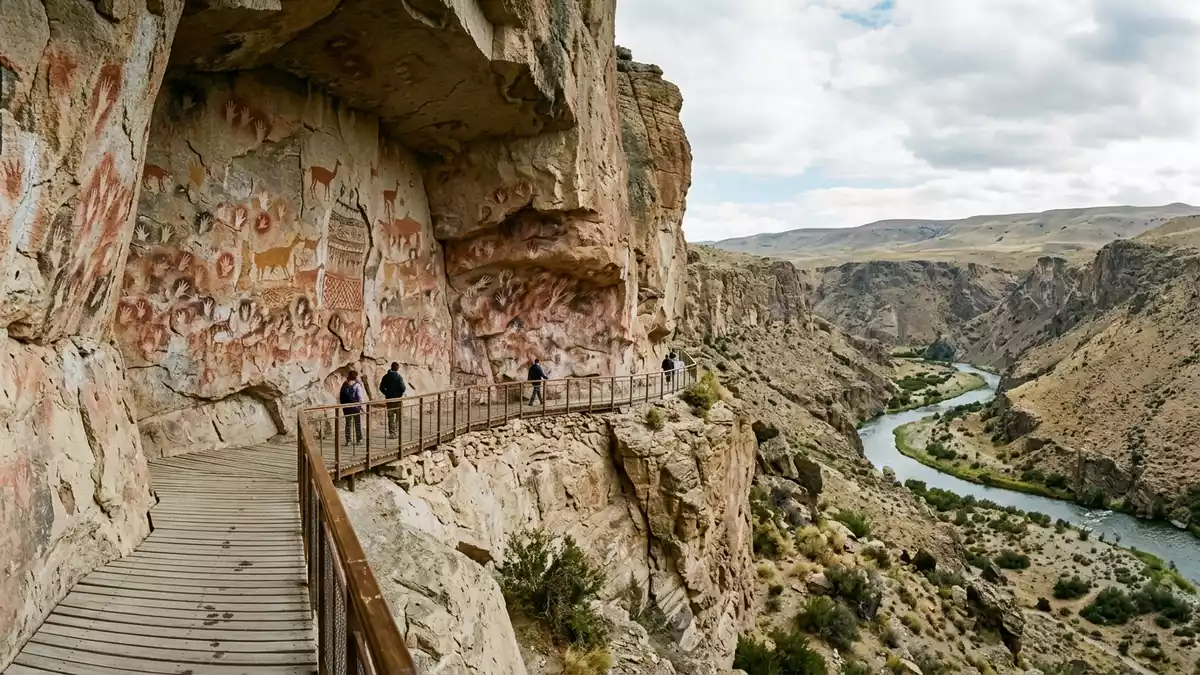
South of Perito Moreno in southern Patagonia, Cueva de las Manos gathers prehistoric images on a cliff high above the Río Pinturas, turning an Andean canyon into an open-air gallery of ancient lives. The rock art here spans millennia in the early Holocene, with successive generations of hunter?gatherers leaving layered hand stencils and hunting scenes on the sandstone walls. In 1999 the site was inscribed on the UNESCO World Heritage List as Cueva de las Manos, Río Pinturas, recognising it as one of South America’s most important records of early human societies.
Rock art on a Patagonian cliff
Cueva de las Manos sits in the province of Santa Cruz, in the canyon of the Río Pinturas between the small settlements of Perito Moreno and Bajo Caracoles. The painted shelters and the main cave occupy ledges on the canyon wall above the river, using natural overhangs as a canvas for images in mineral pigments.The World Heritage listing describes the site in the Pinturas River canyon and emphasises the combination of rock art and dramatic landscape.
The name “Cave of the Hands” comes from the dense fields of hand stencils that line sections of the rock, in black, white, reds and other colours, created by blowing pigment around outstretched palms through pipes made from bone.Descriptions of the site note more than 2,000 stencilled handprints alongside animals and abstract motifs. Many panels show guanacos, a wild camelid still found in Patagonia, as well as stylised human figures and geometric designs.
Layers of time on the canyon wall
The paintings at Cueva de las Manos were created over thousands of years in the early Holocene, with the earliest figures dated by radiocarbon methods to around 9,300 years before present.Nomination documents for the World Heritage inscription describe an exceptional assemblage of cave art produced between roughly 10,000 and 1,000 years ago. Studies of pigment and stratigraphy distinguish several artistic phases, from naturalistic hunting scenes in ochre tones to later bands of negative handprints and abstract motifs extending into the first millennium AD.Analyses of the parietal art place the main sequence between about 7,300 BC and around AD 700.
Archaeological work links the paintings to hunter?gatherer communities ancestral to the Tehuelche people, who occupied this part of Patagonia until the seventeenth century.The UNESCO dossier notes that the site bears witness to some of the earliest human societies in South America, using rock art to express hunting practices and social life. Hunting scenes with guanacos appear among the oldest motifs, while later layers add more stylised figures and denser clusters of overlapping hands, showing how the canyon remained a focal point over generations.
The Río Pinturas canyon landscape
Cueva de las Manos forms part of a wider ensemble of painted shelters along the Río Pinturas, in a rugged stretch of Patagonia where the river has cut a deep gorge into the plateau.Documentation on associated sites in the Pinturas river basin situates the cave on cliffs in the upper Río Pinturas area, in the northeast of Santa Cruz Province. The canyon walls carry bands of sedimentary rock, and the main cave opens partway up the slope on a ledge that looks down onto the river course below.
The surrounding plateau forms a steppe landscape typical of continental Patagonia, with sparse vegetation and wide horizons broken by ravines and mesas. Guanacos and rheas still roam this region, linking the animal figures in the paintings to species that remain part of the local fauna.Accounts of the site highlight the contrast between the dry plateau above and the more sheltered microclimate within the canyon itself, where the river supports pockets of vegetation along its course.
Visiting Cueva de las Manos: what travellers from Western Europe should know
- Cueva de las Manos lies in northwest Santa Cruz Province, in the Río Pinturas canyon south of Perito Moreno, reached from National Route 40 by a side road that descends towards the river.
- The approach to the painted shelters includes stretches on unpaved tracks and paths over uneven ground, and the main viewing areas stand on ledges above the canyon with railings and walkways.
- The terrain involves some climbing on stairs and sloping paths along the cliff, so sturdy footwear is advisable, and winds on the plateau can be strong.
- The official language is Spanish and the currency is the Argentine peso.
- Entry requirements depend on your nationality; UK travellers can check the FCDO travel advice at gov.uk/foreign-travel-advice, Irish travellers the Department of Foreign Affairs at ireland.ie.
Searching for Cueva de las Manos on social platforms
These links open searches for Cueva de las Manos on each platform.
Frequently asked questions about Cueva de las Manos
Where is Cueva de las Manos in relation to Perito Moreno?
Cueva de las Manos is in northwest Santa Cruz Province, in the Río Pinturas canyon south of Perito Moreno, reached via National Route 40 and a side road towards the river.
What should visitors expect when they reach the site?
Visitors encounter painted shelters and the main cave on canyon ledges, with walkways and railings along the cliff and views over the river and Patagonian steppe.
What makes Cueva de las Manos distinctive among rock art sites?
The site combines dense fields of stencilled handprints, detailed hunting scenes and abstract motifs created over several millennia, and it has been recognised as a UNESCO World Heritage Site since 1999.


