
Cueva de las Manos and the painted canyon of Río Pinturas
Published on 08/28/2026 at 15:14 | Editorial responsibility: Rafael Müller, Editor-in-Chief AD HOC NEWS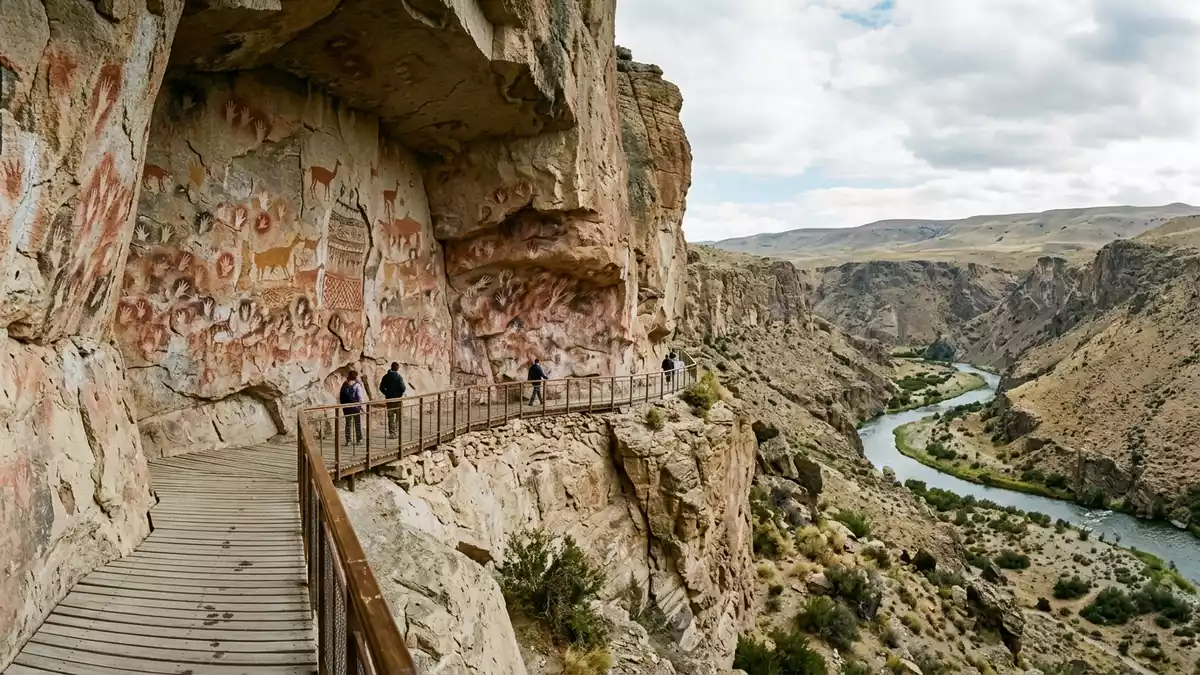
Cueva de las Manos near Perito Moreno in southern Argentina is a rock art site where a Patagonian river canyon carries a long band of painted cliff shelters. The images of hands and hunting scenes place human presence on the walls above the Río Pinturas gorge in the province of Santa Cruz.
A canyon wall turned into a painted shelter
Cueva de las Manos sits in the canyon of the Pinturas River in north-western Santa Cruz, where the river has cut a deep gorge through the Patagonian plateau and exposed stepped rock faces.The cave and rock shelters lie along the canyon, between the towns of Perito Moreno and Bajo Caracoles. The main painted surfaces occupy a section of cliff with an overhanging shelter above the river, with the art concentrated on a stretch of wall rather than in a single enclosed chamber.Travel accounts describe the rock art extending for hundreds of metres along the cliff.
The site lies within both a provincial protected area and a national park, combining archaeological importance with a rugged landscape of canyon rims, eroded slopes and sparse vegetation.It forms part of Cueva de las Manos Provincial Park and Perito Moreno National Park, which help safeguard the cliff shelters and their surroundings. The gorge setting means that visitors approach the painted rock faces along paths and stairways that follow the canyon edge and descend towards the shelter level, seeing the river and the walls together.
Hands, animals and marks from early hunter-gatherers
The name of Cueva de las Manos refers to the dense groups of hand images on the rock, created as negative stencils where pigment was sprayed around the hand so that the outline remains.The panels carry hundreds of these stencilled outlines of human hands, arranged in overlapping clusters. The pigments range across blacks, whites, reds, yellows and purples, forming collages where hands sit in layers, some with clear gaps between the fingers and others partially covered by later additions.Over 2,000 handprints have been recorded, making the hand panels the most immediately recognisable feature of the site.
Among and beside the hands, the walls carry animal figures, geometric motifs and scenes that indicate the broader life of the hunter-gatherer communities who painted them.Guanacos, rheas, felines and stylised human figures appear alongside zigzag patterns, dots and representations of the sun. Some sequences group animals in lines or gatherings that read as hunting scenes, with the guanaco in particular reflecting the importance of this camelid to subsistence in Patagonia. The variation in subject matter and pigment suggests repeated painting episodes over long periods, with later figures superimposed upon earlier ones.
Age, recognition and context in Patagonia
Cueva de las Manos is dated to the early Holocene, with the rock art executed across millennia by hunter-gatherer groups moving through southern Patagonia.Nomination documents describe an exceptional assemblage of cave art produced between roughly 10,000 and 1,000 years ago. The dating places the earliest paintings among the oldest widely recognised rock art panels on the continent, and associates them with some of the earliest human societies known in this part of South America.The site was inscribed on the UNESCO World Heritage List in 1999 under criteria that highlight its prehistoric rock art.
The rock art is linked to hunter-gatherer communities who occupied the region until the arrival of European settlers in the seventeenth century, with the imagery viewed as direct evidence of their practices, beliefs and environment.The documentation notes that the paintings bear witness to the culture of these early societies. Within Patagonia, Cueva de las Manos is regarded as a key rock art site, with its hand panels and hunting scenes often taken as a reference point for other shelters and canyons in the broader Pinturas River basin.Associated sites along the Pinturas River are recognised on Argentina’s tentative World Heritage list, extending the archaeological landscape beyond the best-known shelter.
Visiting Cueva de las Manos: what travellers from Western Europe should know
- Cueva de las Manos lies in the canyon of the Pinturas River in Santa Cruz Province, along the upper course of the Río Pinturas between Perito Moreno and Bajo Caracoles, reached by road across the Patagonian steppe.
Approach routes commonly follow National Route 40 before turning onto tracks that lead towards the gorge and the site entrance. - The terrain around the rock art consists of canyon rims and slopes, with footpaths and stairways connecting the access area to the painted cliff shelters above the river.
Expect uneven ground, exposed sections near the edge and staircases that climb and descend between plateau level and the shelter level. - The surrounding landscape forms part of a wider protected area, with open Patagonian steppe, sparse shrubs and the river corridor combining to create a relatively remote setting.
Travellers encounter gravel roads and wide horizons en route, with the canyon appearing as a marked incision in the plateau. - The official language is Spanish and the currency is the Argentine peso.
- Entry requirements depend on your nationality; UK travellers can check the FCDO travel advice at gov.uk/foreign-travel-advice, Irish travellers the Department of Foreign Affairs at ireland.ie.
Searching for Cueva de las Manos on social platforms
These links open searches for Cueva de las Manos on each platform.
Frequently asked questions about Cueva de las Manos
Where is Cueva de las Manos located in relation to Perito Moreno?
Cueva de las Manos lies in the canyon of the Río Pinturas in Santa Cruz Province, along the upper Pinturas River between Perito Moreno and Bajo Caracoles, on the Patagonian plateau.
What should visitors expect when they reach the rock art site?
Visitors encounter painted cliff shelters with panels of hand stencils, animal figures and abstract motifs on the canyon wall, approached by paths and stairways that follow the gorge rim and slopes.
What makes Cueva de las Manos distinctive among rock art places?
The site combines extensive panels of negative handprints with hunting scenes and other imagery, set on a single canyon wall in a protected Patagonian landscape and recognised as a UNESCO World Heritage Site.


