
Cueva de las Manos and the painted canyon of Patagonia
Published on 09/23/2026 at 15:17 | Editorial responsibility: Rafael Müller, Editor-in-Chief AD HOC NEWS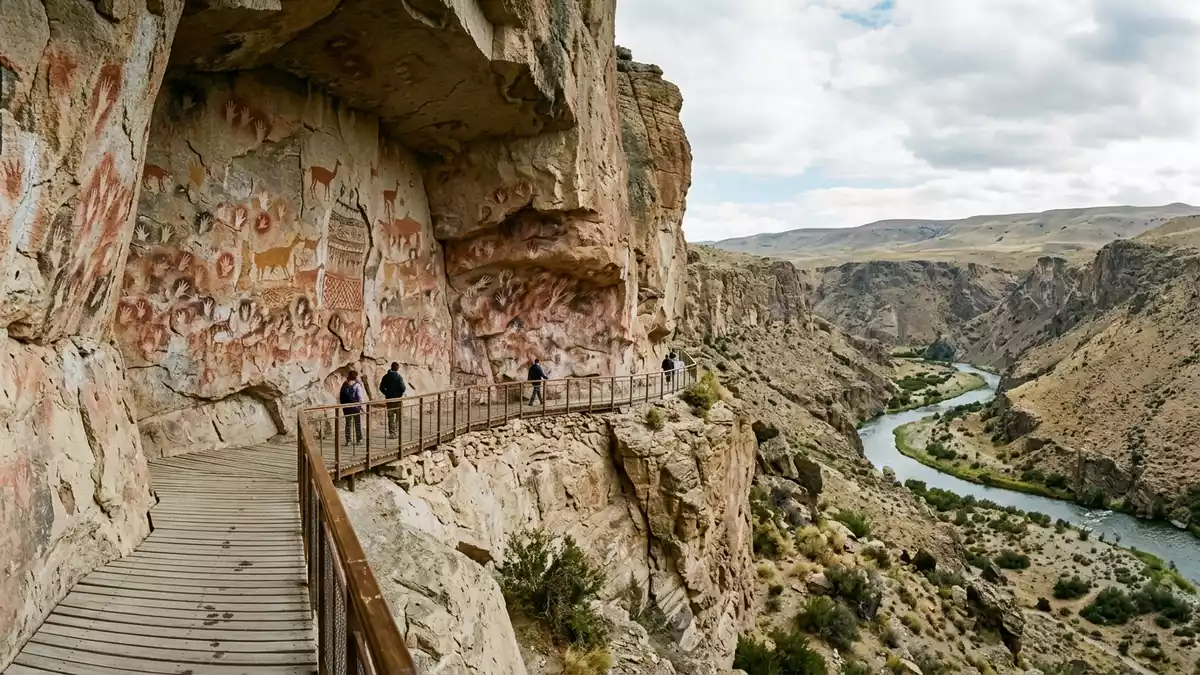
Cueva de las Manos occupies a rock shelter in the canyon of the Río Pinturas, in Santa Cruz province, Argentina. Its walls carry overlapping hand stencils, animals and hunting scenes made across thousands of years, turning the shelter into a visual record of early Patagonian life.
The hand stencils of Río Pinturas
The site takes its name from the painted outlines of human hands covering parts of the rock. Many were made by placing a hand against the wall and applying mineral pigment around it, leaving the surface of the hand unpainted.
Red and purple pigments came from iron oxides. White was produced from kaolin, yellow from natrojarosite and black from manganese oxide. These colours remain visible across the shelter, where hand stencils overlap in dense groups.
The hand motif is only one part of the site. The rock art also includes guanacos, rheas, felines, geometric marks, dots and zigzag patterns. Some images occupy natural features in the rock, while others appear across broad painted surfaces. The result is not a single scene, but a sequence of works made by different communities.
Animals, hunters and an ancient artistic sequence
Cueva de las Manos rock art is dated across a long period. UNESCO records paintings from about 13,000 to 9,500 years ago, while the wider artistic sequence at the shelter extends from around 9,300 to 1,300 years ago.
The earliest major group includes hunting scenes with human figures and guanacos. The animals remain associated with the Patagonian landscape, linking the painted subjects with fauna found in the region. Later works include dense hand stencils, static animal forms and more schematic figures.
Archaeologist Carlos Gradin and his team studied the art during a 30-year investigation between 1964 and 1994. Their work identified three principal stylistic groups, beginning with a group dated to about 7,300 BC, followed by later phases and a final group beginning around AD 700.
The shelter was last inhabited around AD 700. The people who created the paintings belonged to hunter-gatherer communities of Patagonia, and they left evidence of artistic practice, hunting and life beside the Río Pinturas.
A World Heritage site in a Patagonian canyon
The painted shelter lies above the Río Pinturas, whose course runs through a deep canyon in the Patagonian steppe. Rock walls, open ground and the narrow shelter form a setting that is inseparable from the archaeological site.
The protected property covers 600 hectares, with an additional buffer zone around it. The rock shelter contains several concentrations of art, including a cave and painted overhangs. Earlier motifs remain visible beneath later figures in places where the images overlap.
more than 2,000 handprints are associated with the site, appearing in black, white, red, yellow and purple. The number gives the hand motif its visual force, but the surrounding hunting scenes and animal figures provide the wider cultural context.
Cueva de las Manos became a National Historic Monument in Argentina in 1993. It entered the UNESCO World Heritage List in 1999 under the cultural criterion for exceptional evidence of an early South American tradition.
The designation covers both the painted shelter and its surrounding landscape. The site is therefore read as an archaeological place within the Río Pinturas basin, not as an isolated gallery detached from its terrain.
Visiting Cueva de las Manos: what travellers from Western Europe should know
- Cueva de las Manos lies in the Río Pinturas canyon between Perito Moreno and Bajo Caracoles, in Santa Cruz province. Road access from Perito Moreno uses National Route 40 and Provincial Route 97.
- The approach reaches a rock shelter above the canyon. The visit involves uneven ground, exposed terrain and a route through a landscape shaped by cliffs and the Río Pinturas.
- The surrounding area is part of Patagonia’s open steppe, with guanacos among the animals represented in the paintings and present in the regional landscape.
- The official language is Spanish and the currency is the Argentine peso.
- Entry requirements depend on your nationality; UK travellers can check the FCDO travel advice at gov.uk/foreign-travel-advice, Irish travellers the Department of Foreign Affairs at ireland.ie.
Searching for Cueva de las Manos on social platforms
These links open searches for Cueva de las Manos on each platform.
Frequently asked questions about Cueva de las Manos
Where is Cueva de las Manos?
The archaeological site is in the canyon of the Río Pinturas, in Santa Cruz province, between Perito Moreno and Bajo Caracoles in Argentina.
What can visitors expect to see?
The shelter contains hand stencils, guanacos, hunting scenes, geometric motifs and overlapping paintings in mineral colours. The route also includes exposed Patagonian terrain above the river canyon.
What makes the site distinctive?
Its walls preserve a long sequence of rock art, including thousands of painted hand outlines and scenes connected with early hunter-gatherer communities in Patagonia.


