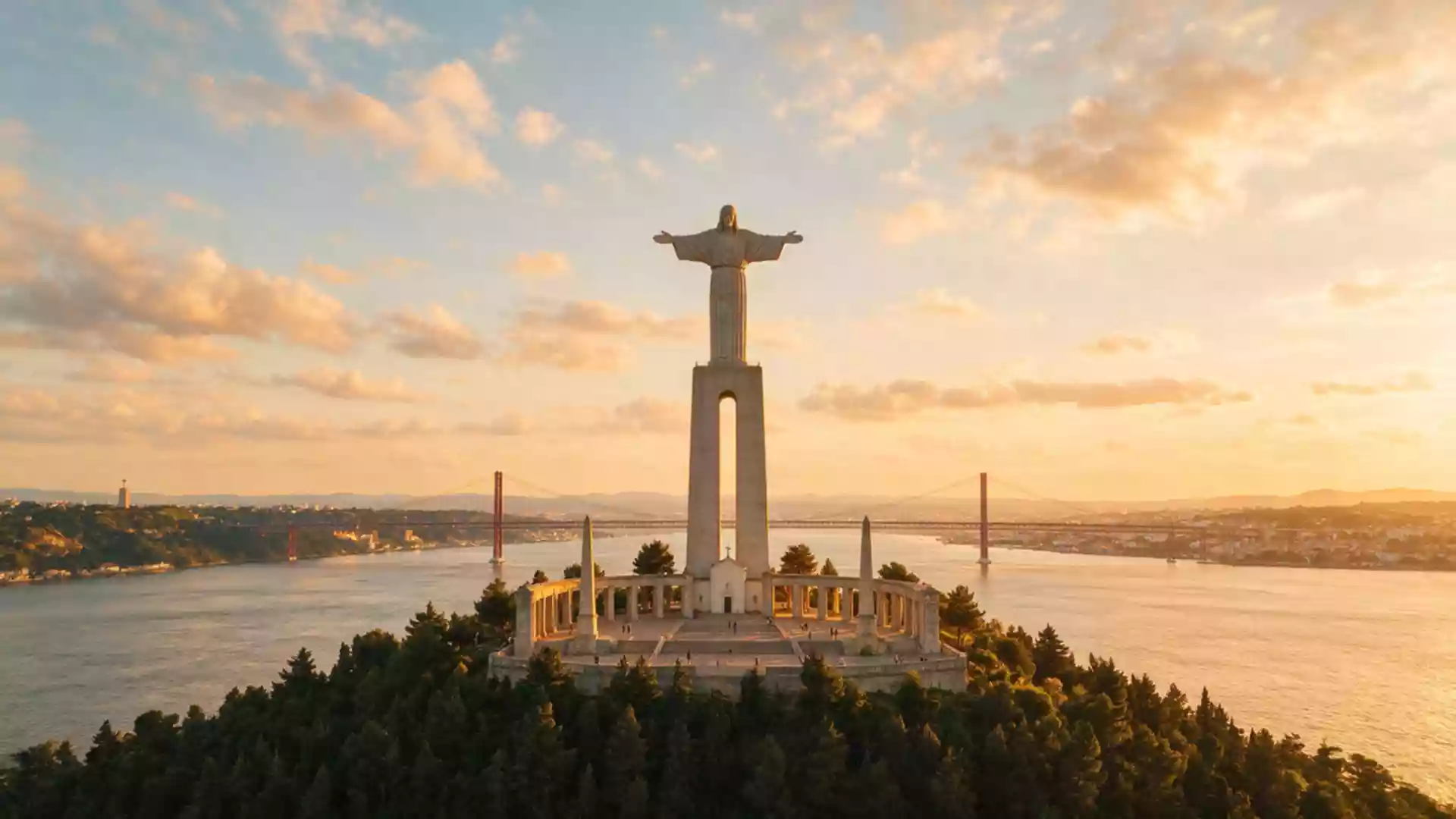
Cristo Rei in Almada and the concrete Christ above the Tagus
Published on 09/12/2026 at 10:21 | Editorial responsibility: Rafael Müller, Editor-in-Chief AD HOC NEWS
Cristo Rei stands on the high ground of Almada as a tall concrete pedestal topped by a statue of Christ the King, facing Lisbon across the broad mouth of the Tagus River. Dedicated as the National Sanctuary of Christ the King and inaugurated in 1959, it combines a Catholic shrine with an elevated lookout over river, bridge and city.
A twentieth-century sanctuary facing Lisbon
The full name of the monument is the National Sanctuary of Christ the King, a Catholic shrine dedicated to the Sacred Heart of Jesus and placed on the southern bank of the Tagus opposite Lisbon.National Sanctuary of Christ the King It stands at Alto do Pragal in the municipality of Almada, in the Setúbal District, where the ground drops towards the river and the sanctuary commands wide views of the estuary and the city beyond.Alto do Pragal, Av. do Cristo Rei
The complex was inaugurated on 17 May 1959, in the period after the Second World War when large Catholic monuments were raised in several countries.inaugurated on 17 May 1959 Its siting above the Tagus sets it in direct visual dialogue with Lisbon and the 25 April Bridge, turning the statue and pedestal into a landmark for ships, road traffic and visitors moving between the two banks.
Concrete pedestal and statue of Christ
Cristo Rei is built in reinforced concrete, with a high portal-like pedestal supporting the statue of Christ at the top.pórtico projected by architect António Lino The overall height of monument and statue reaches about 110 m (361 ft), giving the figure a strong presence on the skyline above Almada and the river.Height 110 m The pedestal itself is about 75 m (246 ft) tall, with the statue rising a further 28 m (92 ft), its arms extended outwards in a gesture that faces towards Lisbon.
The architect responsible for the pedestal was António Lino, while the statue was created by the Portuguese sculptor Francisco Franco de Sousa.work of architect António Lino and sculptor Francisco Franco Together they produced a structure whose straight vertical lines contrast with the flowing water of the estuary below, and whose open-armed figure of Christ is visible from many points in Lisbon and Almada when weather conditions permit.
The sanctuary complex and river panorama
At the base of the pedestal, the sanctuary complex includes chapels and spaces for worship within a simple modern architectural frame.sanctuary complex at the base with chapels The approach leads visitors through grounds that open onto terraces, from which the view extends over the Tagus estuary, the 25 April Bridge and the built-up slopes of Lisbon on the northern bank.
Inside the pedestal a lift carries visitors up to a viewing platform beneath the statue, where the height of the structure and its position above the river become fully apparent.reached by an elevator From here the panorama takes in the mouth of the Tagus towards the Atlantic, the roadway and cables of the bridge, and the urban fabric of Almada and Lisbon spreading away on either side.
Visiting Cristo Rei: what travellers from Western Europe should know
- Cristo Rei stands at Alto do Pragal in Almada on the south bank of the Tagus opposite Lisbon, reached from the city by crossing the 25 April Bridge by road or by taking a commuter ferry to Cacilhas followed by local transport.
- The sanctuary occupies a plateau above the river, and the ascent inside the pedestal to the viewing platform involves using a lift and then climbing further steps, so visitors encounter height and enclosed vertical spaces.
- The official language is Portuguese and the currency is the euro.
Searching for Cristo Rei on social platforms
These links open searches for Cristo Rei on each platform.
Frequently asked questions about Cristo Rei
Where is Cristo Rei located?
Cristo Rei stands at Alto do Pragal in Almada on the south bank of the Tagus River, opposite Lisbon in Portugal.
What can visitors expect during a visit?
Visitors encounter a concrete pedestal and statue of Christ, chapel spaces at the base, terraces overlooking the Tagus and, after a lift ride, a high viewing platform.
What makes Cristo Rei distinctive among Lisbon-area landmarks?
Its combination of twentieth-century Catholic sanctuary, tall concrete pedestal and open-armed statue of Christ, placed high above the Tagus facing Lisbon, gives it a distinctive profile.