
Cristo Redentor and the open-armed skyline of Rio
Published on 09/23/2026 at 06:15 | Editorial responsibility: Rafael Müller, Editor-in-Chief AD HOC NEWS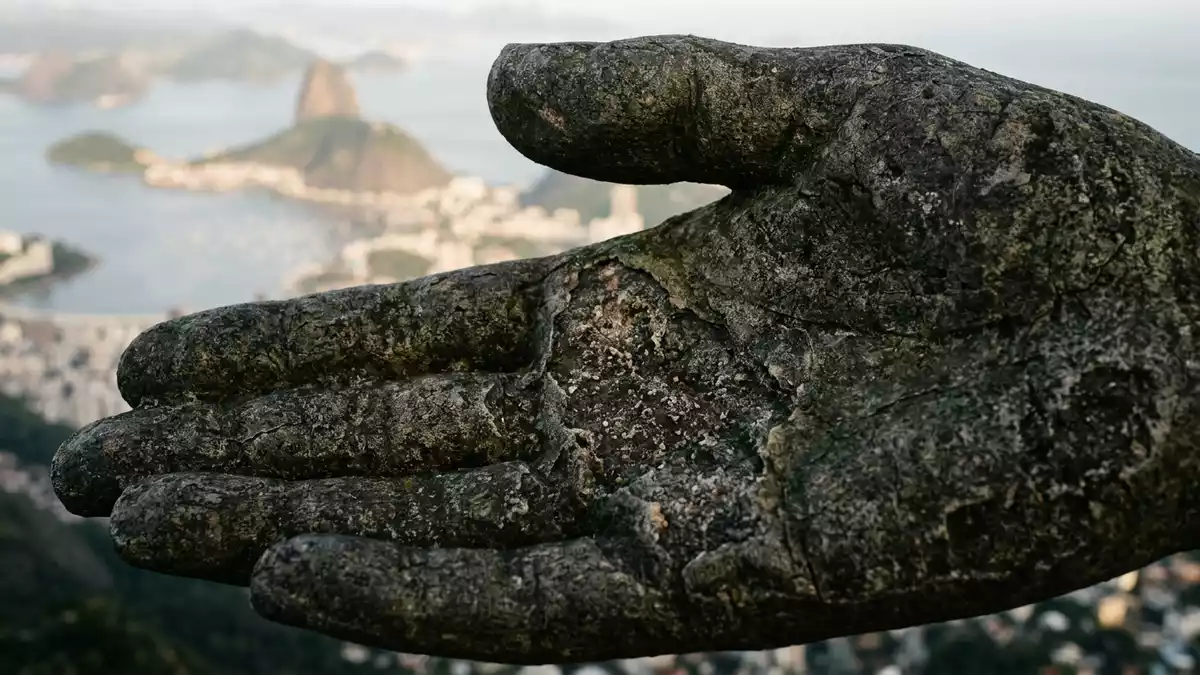
Cristo Redentor rises above Rio de Janeiro with its arms extended across the sky. The 30-metre statue stands on an eight-metre pedestal atop Corcovado, combining reinforced concrete, soapstone and Art Deco geometry with the forested slopes of Tijuca National Park.
Cristo Redentor: a horizontal figure above Corcovado
Seen from Rio de Janeiro, the monument is defined by the breadth of its gesture. Its arms span 28 metres, while the head and hands carry the most detailed sculptural work. The figure faces across the city, with the body formed as a tall, simplified silhouette.
Christo Redentor is 30 metres high without its pedestal and 38 metres high in total. The statue’s mass is carried by reinforced concrete, while a surface of triangular soapstone pieces covers the exterior. This mosaic-like skin gives the monument a patterned texture that differs from the smooth appearance of a cast metal figure.
Heitor da Silva Costa, Paul Landowski and the 1931 monument
The Brazilian engineer Heitor da Silva Costa led the project, with the French-Polish sculptor Paul Landowski responsible for the head and hands. Albert Caquot developed the internal structural work, and the Brazilian artist Carlos Oswald contributed to the design.
Construction began in 1922, and Cristo Redentor was inaugurated on 12 October 1931. The monument belongs to the Art Deco period, when simplified volumes, strong outlines and carefully controlled ornament shaped public architecture and sculpture. Its 1931 inauguration places it within a distinct chapter of twentieth-century Brazilian cultural history.
Concrete, soapstone and the cultural landscape of Rio
Cristo Redentor stands on Corcovado, a granite mountain within Tijuca National Park in the southern part of Rio de Janeiro. The monument is surrounded by Atlantic rainforest, while the city, Guanabara Bay and the coastal mountains extend below it.
The relationship between statue, mountain and urban shoreline forms part of Rio de Janeiro’s cultural landscape. “Carioca Landscapes between the Mountain and the Sea” entered the UNESCO World Heritage List in 2012. The Carioca cultural landscape includes natural and urban elements across Rio, with Corcovado as a prominent high point.
The statue’s visible details also reveal its scale. Each hand measures 3.20 metres in length, and the head rises 3.75 metres above the shoulders. These dimensions remain legible from the viewing terraces, where the open-armed form occupies the centre of the mountain setting.
Visiting Cristo Redentor: what travellers from Western Europe should know
- Cristo Redentor stands on Corcovado in Tijuca National Park, within southern Rio de Janeiro. Access routes include the Corcovado Railway from Cosme Velho and official vans from Paineiras-Corcovado.
- The summit lies at about 710 metres above sea level. The final approach includes stairs, lifts and escalators around the upper station and the monument terrace.
- The Corcovado Railway climbs through Tijuca’s forest from Cosme Velho. Road access reaches the Paineiras area before the upper section of the approach.
- The official language is Portuguese and the national currency is the Brazilian real.
- Entry requirements depend on your nationality; UK travellers can check the FCDO travel advice at gov.uk/foreign-travel-advice, Irish travellers the Department of Foreign Affairs at ireland.ie.
Searching for Cristo Redentor on social platforms
These links open searches for Cristo Redentor on each platform.
Frequently asked questions about Cristo Redentor
Where is Cristo Redentor?
Cristo Redentor stands on Corcovado, a granite mountain within Tijuca National Park in Rio de Janeiro. The monument occupies a high position above the city and Guanabara Bay.
What does a visit involve?
Visitors travel through Tijuca’s forest by railway or road before reaching the upper approach. The monument terrace includes stairs, lifts and escalators.
What makes Cristo Redentor distinctive?
Its reinforced-concrete figure is faced with soapstone and has arms spanning 28 metres. The Art Deco monument combines a precise geometric silhouette with a mountain and rainforest setting.


