
Cristo Redentor and the open-armed skyline of Rio de Janeiro
Published on 09/15/2026 at 19:31 | Editorial responsibility: Rafael Müller, Editor-in-Chief AD HOC NEWS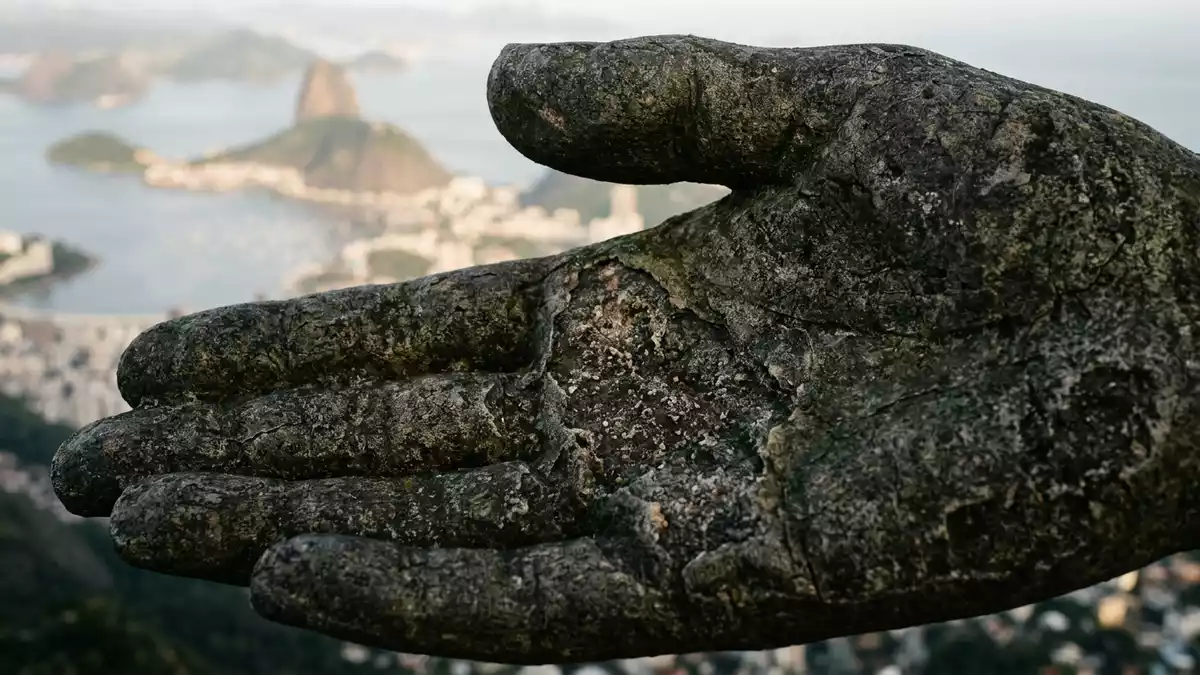
Cristo Redentor, the colossal Art Deco statue of Christ overlooking Rio de Janeiro, stands on Corcovado in Brazil with arms spread wide above forested slopes and ocean bays. Completed in 1931 and made of reinforced concrete clad in soapstone, it has become a fixed point in the city’s skyline and a landmark where landscape, engineering and religious imagery meet.
An Art Deco giant on Corcovado
Cristo Redentor is an Art Deco statue of Jesus Christ that rises from the summit of Corcovado, a granite peak within the Tijuca National Park in the south of Rio de Janeiro. The statue itself stands about 30 m (98 ft) high on an 8 m (26 ft) pedestal, bringing its full height to roughly 38 m (125 ft) above the mountain’s summit, with arms that stretch about 28 m (92 ft) from fingertip to fingertip.stands 30 metres tall The whole figure is set more than 700 m (around 2,300 ft) above sea level, so that its silhouette appears against both Atlantic cloud and city lights.located at the peak of Corcovado
The statue was created by the French-Polish sculptor Paul Landowski and built by the Brazilian engineer Heitor da Silva Costa, working with the French engineer Albert Caquot, while the Romanian sculptor Gheorghe Leonida shaped the face.created by Paul Landowski The project took much of the 1920s to realise and was formally inaugurated on 12 October 1931, a date that anchors the statue in the period between the world wars and in the height of the Art Deco movement.inaugurated in October 1931 Its reinforced concrete core carries a weight measured in hundreds of tonnes, while the outer surface is a mosaic of thousands of small soapstone tiles, hand-set to form the pale, slightly textured skin that visitors recognise.
Form, materials and the surrounding forest
Seen from nearby ridges or from the streets of Rio de Janeiro, Cristo Redentor appears as a single figure, yet the composition rests on careful engineering. The statue stands on a square pedestal, and together they rise above a viewing platform cut into the summit of Corcovado, which itself is part of the granite backbone of the Tijuca range.trinta metros de altura sem contar os oito metros do pedestal The figure faces east over the city, its arms extended horizontally in a broad cross shape, with the load carried down through the torso and into a concrete support hidden inside the pedestal.
Reinforced concrete made it possible to cast the statue in sections and assemble it on the mountain, while the soapstone cladding gives a smooth, light-coloured surface that withstands the humid climate of the Atlantic forest. Each tile is triangular and only a few centimetres across, so up close the statue’s surface reads as dense geometric pattern rather than monolithic stone.clad in a mosaic of triangular soapstone tiles Around it, the Tijuca National Park forms one of the world’s largest urban forests, replanted in the nineteenth century after earlier clearing and now filled with dense vegetation that climbs steep slopes, drops into ravines and frames the views towards Guanabara Bay.Redeemer rises from the tropical foliage of Tijuca National Park
Cristo Redentor in Brazil’s cultural landscape
Cristo Redentor has become a symbol closely linked with both Rio de Janeiro and Brazil as a whole, appearing in film, television and visual culture as shorthand for the city’s mountainous coastline and its mix of dense urban fabric and steep, green peaks.has been a cultural icon of the nation In 2007 it was named among the “New Seven Wonders of the World”, a list assembled through global voting campaigns that placed the statue alongside sites such as the Great Wall of China and Petra.nominated to be one of the New Seven Wonders The Catholic Church has also recognised the statue formally; in 2006 it was declared a sanctuary, with a small chapel at its base where religious ceremonies, including weddings, may take place.declared Redeemer a sanctuary
The statue’s image, particularly the open arms and frontal pose, has been used in a range of cultural contexts, from postage stamps and tourism campaigns to appearances in cinema. It has featured in films such as Alfred Hitchcock’s “Notorious” and has stood as a visual marker in sequences where Rio de Janeiro’s hills and bays form the backdrop to the story.Redeemer has enjoyed cameos in several movies Together with Sugarloaf Mountain and the sweeping curve of beaches such as Copacabana, Cristo Redentor forms part of a group of landscapes and structures that define the city’s profile and continue to anchor its image in the wider world.
Visiting Cristo Redentor: what travellers from Western Europe should know
- Cristo Redentor stands on Corcovado, a peak within the Tijuca National Park in the south of Rio de Janeiro, reached by road and by a mountain railway running up from the urban districts below.
- The summit area includes terraces and stairways; reaching the main viewing level involves climbing flights of steps or using lifts and escalators from the arrival point near the top of Corcovado.
- Nearby viewpoints such as Sugarloaf Mountain and the hills around Santa Teresa are within the same coastal zone and offer additional perspectives on Cristo Redentor and the city’s bays.
- The official language is Portuguese and the currency is the Brazilian real.
- Entry requirements depend on your nationality; UK travellers can check the FCDO travel advice at gov.uk/foreign-travel-advice, Irish travellers the Department of Foreign Affairs at ireland.ie.
Searching for Cristo Redentor on social platforms
These links open searches for Cristo Redentor on each platform.
Frequently asked questions about Cristo Redentor
Where is Cristo Redentor located?
Cristo Redentor stands on the summit of Corcovado, a peak within the Tijuca National Park in the south of Rio de Janeiro in Brazil, rising above Guanabara Bay.
What should visitors expect on a visit to Cristo Redentor?
Visitors encounter a large Art Deco statue on a high mountain terrace, with stairways, viewing platforms and wide views over the forested slopes, the city districts and the bays below.
What makes Cristo Redentor distinctive among world landmarks?
Cristo Redentor combines a monumental twentieth-century statue, an Art Deco design, a high mountain setting in an urban forest and a position above one of the world’s most recognisable coastal cityscapes.


