
Cristo Redentor and the open-armed skyline of Rio de Janeiro
Published on 09/14/2026 at 09:37 | Editorial responsibility: Rafael Müller, Editor-in-Chief AD HOC NEWS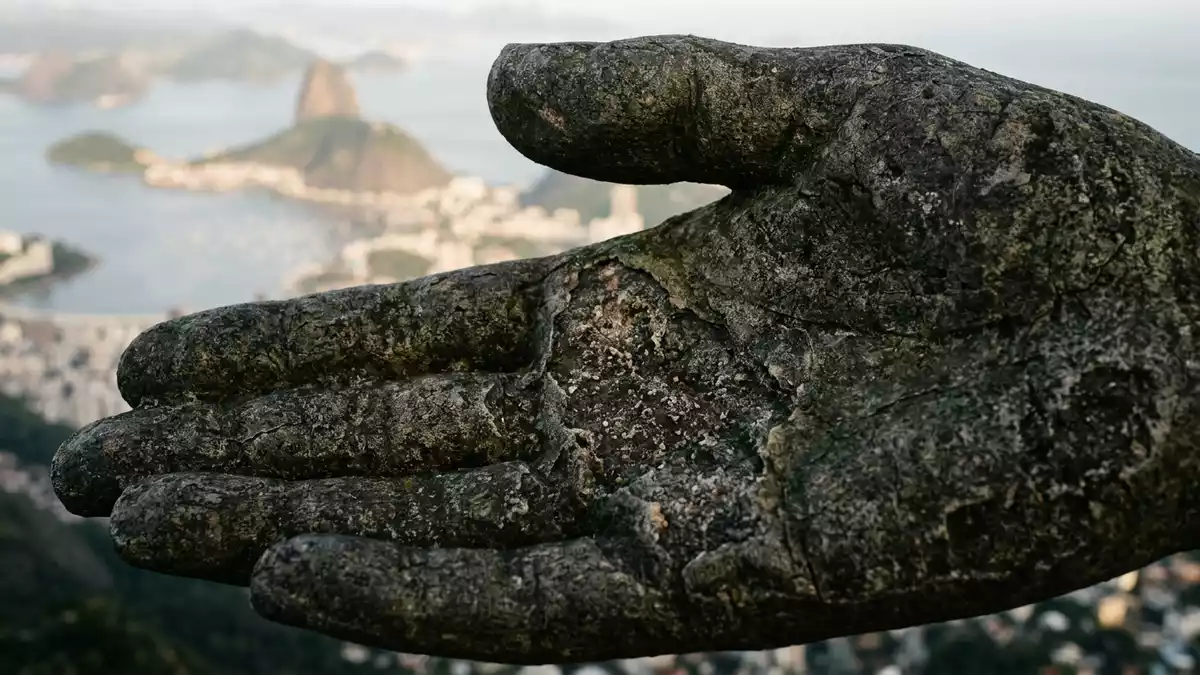
Cristo Redentor rises above Rio de Janeiro on the peak of Corcovado, an Art Deco statue of Jesus Christ that has become a fixed part of the city’s skyline. Completed in 1931 and built from reinforced concrete with a cladding of soapstone, it stands with outstretched arms gazing over the bays, hills and dense neighbourhoods below.
An Art Deco figure on Corcovado
The monument stands on Corcovado, a granite peak within Tijuca National Park in the south of Rio de Janeiro, with the statue itself around 30 m (98 ft) tall and set on a pedestal that raises it further above the forest canopy.The statue of Christ the Redeemer The figure is carved in a stylised Art Deco manner rather than a naturalistic one, with the long robe flowing straight down and the arms projecting to either side in a strict horizontal line.
Cristo Redentor’s arms span about 28 m (92 ft) from fingertip to fingertip, so the silhouette forms a broad cross when seen against the sky.an Art Deco statue of Jesus The reinforced concrete core carries the load of the arms and torso, while the outer surface is clad in small soapstone tiles that give the monument its pale, slightly matte skin when seen at close range.Feito de concreto armado e pedra-sabão
From idea to completed monument
The idea of placing a Christian monument on Corcovado dates back to proposals in the nineteenth century, when the peak was already recognised as a vantage point over Rio and the bay.The idea of placing a large Christian monument The present project belongs to the early twentieth century, when the Catholic Circle of Rio and the archdiocese supported the construction of a large statue to mark the centenary of Brazil’s independence.
Brazilian engineer Heitor da Silva Costa provided the engineering design, with sculptor Paul Landowski responsible for the figure and Gheorghe Leonida credited with carving the face.created by French-Polish sculptor Paul Landowski Construction ran through the 1920s, and the statue was inaugurated on 12 October 1931 with a religious ceremony at the summit that marked its formal opening as a national symbol.the completed monument was inaugurated on 12 October 1931
Cristo Redentor as landscape and sanctuary
Cristo Redentor stands within Tijuca National Park, a reforested tropical landscape that forms one of the largest continuous green areas inside any major city, so visitors pass from dense urban streets into dense Atlantic forest as they ascend Corcovado.Tijuca National Park At the summit, a paved terrace wraps around the pedestal, framing views towards Guanabara Bay, the sweep of the Atlantic coast and other landmarks including the Sugarloaf and the beaches of the southern districts.
A small chapel sits in the base of the monument, used for religious services and weddings since the statue was granted sanctuary status by the Catholic Church.In 2006 the Catholic Church declared Redeemer a sanctuary In 2007 Cristo Redentor was inscribed on the list of the New Seven Wonders of the World, a designation that placed it alongside other globally recognised monuments and reinforced its role as a symbol of Brazil.Christ the Redeemer - 7 Wonders
Visiting Cristo Redentor: what travellers from Western Europe should know
- Cristo Redentor stands on Corcovado in the south of Rio de Janeiro, reached from the city by road or by the Corcovado rack railway that climbs through Tijuca National Park.
- The monument terrace is set on a high mountain summit, with stairways and level changes around the pedestal that require walking on slopes and steps.
- Tijuca National Park is a tropical forest environment, so conditions on the paths and viewing terrace can vary with rainfall and cloud, and the summit is exposed to wind.
- The official language is Portuguese and the currency is the Brazilian real.
- Entry requirements depend on your nationality; UK travellers can check the FCDO travel advice at gov.uk/foreign-travel-advice, Irish travellers the Department of Foreign Affairs at ireland.ie.
Searching for Cristo Redentor on social platforms
These links open searches for Cristo Redentor on each platform.
Frequently asked questions about Cristo Redentor
Where is Cristo Redentor located in Rio de Janeiro?
Cristo Redentor stands on the summit of Corcovado, a mountain within Tijuca National Park in the southern part of Rio de Janeiro, overlooking the city and its bays.
What should visitors expect on a visit to Cristo Redentor?
Visitors reach a high terrace around the monument with extensive views and a close view of the Art Deco statue, moving between levels on stairways and paved ramps.
What makes Cristo Redentor distinctive among large statues?
The statue combines a stylised Art Deco depiction of Christ with open horizontal arms, reinforced concrete construction and soapstone cladding on a mountain summit inside an urban national park.


