
Cristo Redentor: an open?armed landmark above Rio de Janeiro
Published on 08/20/2026 at 17:24 | Editorial responsibility: Rafael Müller, Editor-in-Chief AD HOC NEWS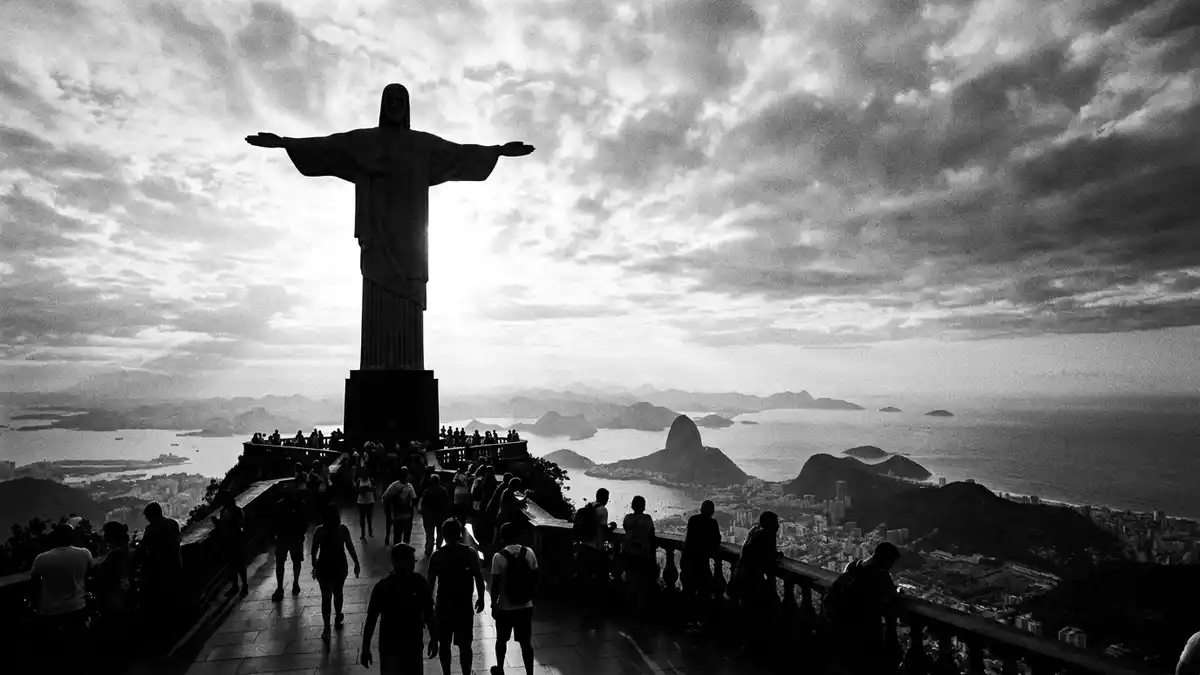
Cristo Redentor, known in English as Christ the Redeemer, stands with outstretched arms above Rio de Janeiro on the summit of Corcovado, bringing sculpture, mountain and city into one panorama. Completed in 1931 in an Art Deco style and rising high above the Atlantic forest of Tijuca, it has become the defining silhouette on the skyline of this part of Brazil.
An Art Deco statue with a distinct profile
Cristo Redentor is an Art Deco statue of Jesus Christ, set on a stone pedestal and facing across the bay and the city below. The sculptural figure itself stands about 30 m (98 ft) high, with the monument reaching roughly 38 m (125 ft) when the pedestal is included, giving the statue a scale that is immediately apparent from the viewing platforms and approaches.30 metres high The arms extend horizontally from the body, forming a broad cross?like outline that is visible from many districts of Rio de Janeiro and is reinforced by the uncluttered pedestal beneath the figure.
The statue was conceived and realised by a team that brought together Brazilian and European expertise. The Brazilian engineer Heitor da Silva Costa directed the project and is credited with designing the overall structure, while the French?Polish sculptor Paul Landowski created the sculptural model and Romanian sculptor Gheorghe Leonida shaped the face of Christ.Heitor da Silva Costa and Paul Landowski French engineer Albert Caquot contributed to the structural design, helping to translate the sculptural concept into a robust monument capable of standing on a mountain summit.Albert Caquot
From early twentieth?century project to completed monument
The idea of a large religious statue on Corcovado dates back to the early twentieth century, and construction of Cristo Redentor began in the 1920s. Work on the base commenced in 1922, during the centenary of Brazil’s independence, and the main phase of construction ran between 1926 and 1931.construction between 1922 and 1931 The monument was formally dedicated on 12 October 1931, a date that has entered Brazilian cultural history as the moment when the statue first opened to visitors on the mountaintop.inaugurated on 12 October 1931
The structure combines reinforced concrete with an outer layer of soapstone, chosen for its durability and the soft texture it gives to the monumental surfaces.soapstone cladding The outer skin consists of small soapstone panels fixed to the concrete body, creating a fine mosaic effect when viewed at close range. From further away, the material reads as a continuous pale surface, catching light and shadow along the folds of the robe, the hands and the expressive face shaped by Gheorghe Leonida.
Corcovado, Tijuca Forest and the views over Rio de Janeiro
Cristo Redentor stands on the summit of Corcovado, a granite peak rising to about 710 m (2,329 ft) above sea level inside the Tijuca National Park, an expanse of Atlantic rainforest within the urban area of Rio de Janeiro.Corcovado at 710 metres The sanctuary that surrounds the statue forms part of this protected landscape, with forested slopes dropping away from the platforms and the city’s bays, lagoons and beaches spreading out below.
From the terraces around the monument, visitors see Rio de Janeiro laid out in multiple directions. Guanabara Bay opens towards the Atlantic Ocean, Sugarloaf Mountain rises on its own rocky promontory, and the Rodrigo de Freitas lagoon lies between the forested hills and the urban districts of the South Zone.views over lagoon and South Zone The combination of high granite summit, dense tropical vegetation and dense cityscape below gives Cristo Redentor a setting that is as distinctive as the statue itself.
Visiting Cristo Redentor: what travellers from Western Europe should know
- Cristo Redentor stands on Corcovado in the Tijuca National Park, above central and southern districts of Rio de Janeiro. The peak lies inland from Guanabara Bay and the Atlantic beaches.
- The summit area is reached by transport routes that climb the mountain, including a railway running from the Cosme Velho district through the forest to the upper station near the statue.
- The terraces and platforms around the monument are paved and stepped, with stairways between levels and some areas reached by lifts and escalators inside the base structure.
- The official language is Portuguese and the currency is the Brazilian real.
- Entry requirements depend on your nationality; UK travellers can check the FCDO travel advice at gov.uk/foreign-travel-advice, Irish travellers the Department of Foreign Affairs at ireland.ie.
Searching for Cristo Redentor on social platforms
These links open searches for Cristo Redentor on each platform.
Frequently asked questions about Cristo Redentor
Where is Cristo Redentor located in Rio de Janeiro?
Cristo Redentor stands on the summit of Corcovado, a peak inside Tijuca National Park in Rio de Janeiro, Brazil, overlooking Guanabara Bay and urban districts.
What should visitors expect at the monument itself?
Visitors find a large Art Deco statue on a pedestal, terraces with panoramic views, paved platforms connected by steps, and facilities integrated into the base structure.
What makes Cristo Redentor distinctive among city landmarks?
Its combination of a 30 m high open?armed statue, soapstone cladding, and a position on a 710 m granite summit within a tropical forest above a major city makes it distinctive.


