
Cradle Mountain’s jagged skyline over Tasmania’s high country
Published on 08/27/2026 at 22:26 | Editorial responsibility: Rafael Müller, Editor-in-Chief AD HOC NEWS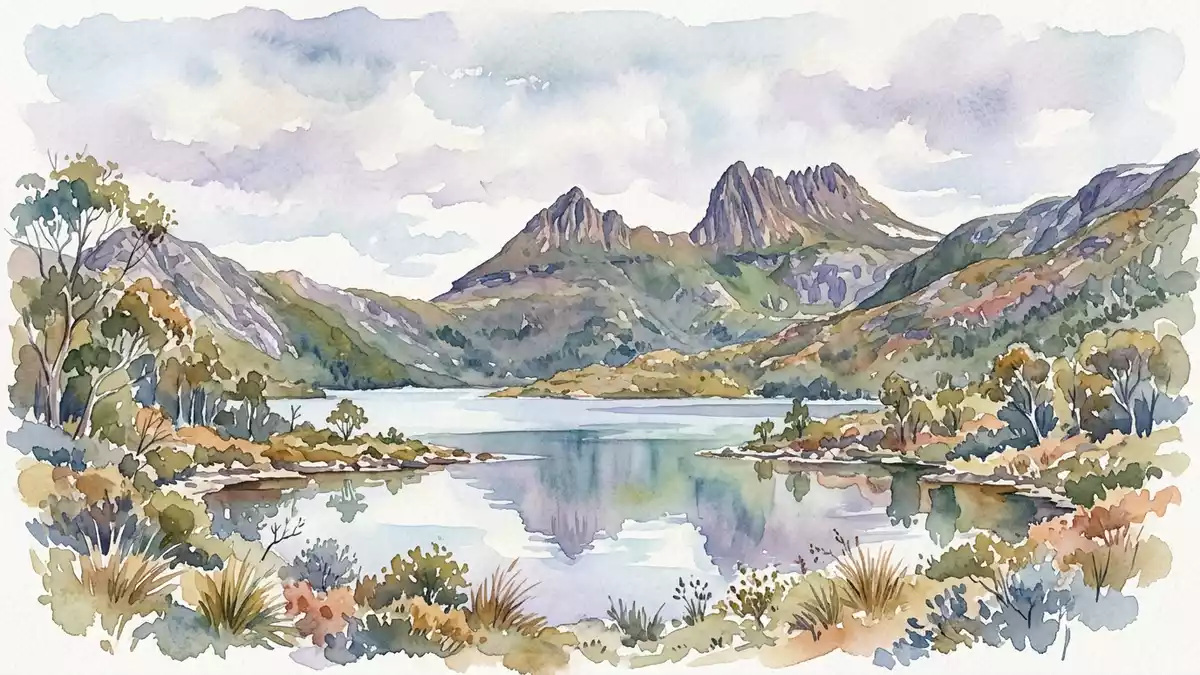
Cradle Mountain is a jagged dolerite peak in the Central Highlands of Tasmania, forming the northern landmark of Cradle Mountain–Lake St Clair National Park in Australia. Rising to 1,545 m (5,069 ft), it stands on the island’s central plateau within the broader Tasmanian Wilderness World Heritage Area, where steep ridges, glacial lakes and subalpine vegetation come together in a compact high-country setting.Cradle Mountain–Lake St Clair National Park
A dolerite summit above glacial lakes
Seen from the shore of Dove Lake, Cradle Mountain presents a broken skyline of narrow ridges and towers that rise sharply above the surrounding plateau. The summit ridge carries several high points, including Smithies Peak and Weindorfers Tower, with steep faces dropping toward a scatter of cirques and basins carved by ice.jagged dolerite peak The underlying rock is dominated by Jurassic dolerite, part of a wider system of dolerite-capped mountains that runs across Tasmania’s interior.Jurassic dolerite
Glacial erosion has left a ring of lakes and tarns around the base of the mountain, the most prominent being Dove Lake directly beneath the northern slopes.Dove Lake The wider national park contains higher peaks such as Barn Bluff and Mount Ossa and stretches south toward Lake St Clair, the deepest lake in Australia, but Cradle Mountain remains the focal point of the northern half of this landscape.Lake St Clair
Tasmanian Wilderness World Heritage landscape
Cradle Mountain lies within Cradle Mountain–Lake St Clair National Park, a protected area of more than 1,600 square kilometres (around 620 square miles) that forms part of the Tasmanian Wilderness World Heritage Area.Tasmanian Wilderness World Heritage Area The park’s central plateau is an elevated tableland where mountain ranges, valleys and lakes reflect the work of large Pleistocene glaciers over hundreds of thousands of years.Pleistocene glaciers
Within this setting, vegetation shifts with altitude from forests on the lower slopes through subalpine heath and buttongrass moorland to sparse alpine communities around the summit ridges.alpine grasslands and rocky outcrops Around Dove Lake and the lower valleys, visitors encounter a mosaic of rainforest species such as myrtle and sassafras alongside King Billy pines and open moorland, creating strong contrasts between dense canopy and exposed shorelines.Tasmania's special vegetation
Walking the lakes and high country
Cradle Mountain has become closely associated with walking and long-distance trekking, with trails ranging from short lake circuits to multi-day journeys across the plateau. The Overland Track, a multi-day route of around 80 km, begins near Cradle Valley and crosses the national park southward to finish near Lake St Clair, linking a chain of peaks, moorlands and forests along the way.Overland Track
Closer to the mountain itself, the Dove Lake Circuit offers an accessible loop that traces the lake’s edge beneath the northern slopes, combining boardwalk sections with gravel paths and occasional steps.Dove Lake Circuit More demanding summit routes climb from the lake and surrounding valleys to the high ridge, where the broken skyline and wide views over the Tasmanian high country give a clear sense of the plateau’s scale.Cradle Mountain Summit Track
Visiting Cradle Mountain: what travellers from Western Europe should know
- Cradle Mountain lies in northwest-central Tasmania on the island’s central plateau, with access routes by road from regional centres such as Launceston and Devonport.
- The terrain around the mountain includes uneven tracks, boardwalks, steps and exposed sections near lakes and higher ridges, so walks require steady footing and appropriate outdoor clothing.
- Dove Lake sits directly beneath the northern slopes of Cradle Mountain, and several signposted walking tracks begin near the lake shore and the visitor facilities in Cradle Valley.
- The official language is English and the currency is the Australian dollar.
- Entry requirements depend on your nationality; UK travellers can check the FCDO travel advice at gov.uk/foreign-travel-advice, Irish travellers the Department of Foreign Affairs at ireland.ie.
Searching for Cradle Mountain on social platforms
These links open searches for Cradle Mountain on each platform.Frequently asked questions about Cradle Mountain
Where is Cradle Mountain located in Australia?
Cradle Mountain is in the Central Highlands of Tasmania, in northwest-central Australia, forming the northern landmark of Cradle Mountain–Lake St Clair National Park.
What should visitors expect on a trip to Cradle Mountain?
Visitors encounter a high-country landscape of dolerite ridges, glacial lakes such as Dove Lake, and walking tracks that cross forests, heath and alpine terrain.
What makes Cradle Mountain distinctive among Tasmanian peaks?
The mountain’s jagged dolerite skyline, reflected in nearby lakes and set within a World Heritage national park, gives this part of Tasmania a compact alpine character.


