
Cradle Mountain’s jagged skyline over Tasmania’s alpine heart
Published on 08/18/2026 at 14:22 | Editorial responsibility: Rafael Müller, Editor-in-Chief AD HOC NEWS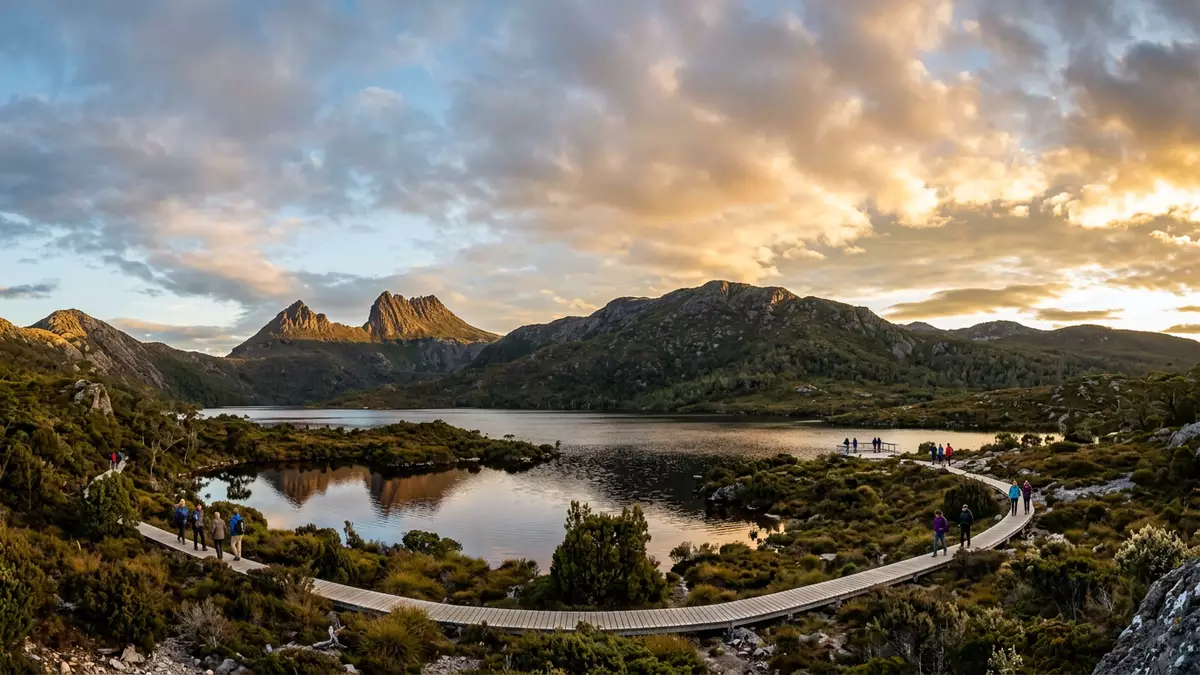
Cradle Mountain in Tasmania rises in a jagged line above a basin of lakes, forests and moorland, giving one of Australia’s most recognisable mountain skylines inside a compact alpine valley. Set within the Cradle Mountain-Lake St Clair National Park in the Central Highlands of Tasmania, this peak anchors a protected landscape that forms part of the broader Tasmanian Wilderness World Heritage Area.
An alpine stronghold in Tasmania’s Central Highlands
Cradle Mountain lies in northwest-central Tasmania, on the central plateau that runs across the island’s interior. The mountain stands within the northern half of Cradle Mountain-Lake St Clair National Park, which extends between Cradle Valley in the north and Lake St Clair in the south as part of the Tasmanian Wilderness World Heritage Area.Tasmanian Wilderness World Heritage Area The wider park contains several of Tasmania’s highest summits, from Barn Bluff near Cradle Mountain to Mount Ossa further south, and a network of glacial lakes and tarns scattered across the plateau.Cradle Mountain-Lake St Clair National Park
The mountain itself rises to 1,545 m (5,069 ft), its summit forming a narrow ridge that has given the peak its cradle-like profile.lava basalt peak rises to 5,069 feet The ridge carries several named points, including Smithies Peak and Weindorfers Tower, but Cradle Mountain is the dominant high point above Cradle Valley.Cradle Mountain summit and neighbouring peaks Much of the surrounding terrain sits above 700 m (2,297 ft), giving the valley a distinctly alpine character with buttongrass moorland, stands of rainforest and exposed dolerite and basalt outcrops.dramatic peaks and glacial-carved lakes
Dove Lake and the valley around Cradle Mountain
The most familiar view of Cradle Mountain is from the shores of Dove Lake, a large glacial lake at the northern end of the national park, where the peak rises steeply behind the water and low heathland. This setting places the mountain immediately above an accessible lakeshore, making it possible to see the serrated skyline and lake basin together on short walks from the lakeside circuit.Cradle Mountain above Dove Lake Around the lake, walking tracks pass through a mixture of scrub, open moor and pockets of temperate rainforest, where myrtle beech and other native species grow close to the water.
Beyond Dove Lake, Cradle Valley opens out into a wider basin with smaller lakes, tarns and forested slopes. The valley forms the northern gateway to the Cradle Mountain-Lake St Clair National Park and the start of the Overland Track, the multi-day alpine route that crosses the plateau towards Lake St Clair.home of the Overland Track Within a relatively short distance, the landscape shifts from visitor facilities near the park boundary to open high country with extensive views towards Barn Bluff and the central mountains, giving Cradle Mountain a role as both landmark and starting point for longer traverses.
History of protection and naming
The landscape around Cradle Mountain has been formally protected for over a century. The area was declared a scenic reserve in 1922 and then a wildlife reserve in 1927, before gaining national park status in 1947 as Cradle Mountain-Lake St Clair National Park.scenic reserve in 1922 and national park from 1947 In 1982 the broader Tasmanian Wilderness, including the park, was inscribed on the UNESCO World Heritage List for its natural and cultural values, giving the mountain and its surroundings international recognition as part of a linked protected area.part of the Tasmanian Wilderness UNESCO World Heritage site
The name Cradle Mountain reflects the shape of the summit ridge, which forms an arête – a narrow, steep-sided ridge – that resembles a cradle when viewed from certain angles in Cradle Valley.arête that resembles a cradle In the early nineteenth century the surveyor Henry Hellyer made an ascent of the mountain; his exploration work in 1831 is recorded as the first known European climb of the peak.Hellyer ascended in 1831 Since that period, Cradle Mountain has become a central reference point in descriptions of Tasmania’s interior, appearing in maps, walking guides and park literature as the northern anchor of the Cradle Mountain-Lake St Clair corridor.
Visiting Cradle Mountain: what travellers from Western Europe should know
- Cradle Mountain is in Tasmania’s Central Highlands, at the northern end of Cradle Mountain-Lake St Clair National Park. Road access from the north commonly approaches via towns such as Sheffield and Mole Creek before reaching Cradle Valley.
- The terrain around Cradle Mountain includes alpine moorland and glacial valleys at elevations above 700 m (2,297 ft), with formed walking tracks that can involve uneven surfaces, boardwalks and extended sections on foot.
- Dove Lake sits directly beneath Cradle Mountain and is reached from the park’s northern entrance; from its shore, short circuits provide close views of the lake basin and the serrated summit skyline.
- The official language is English and the currency is the Australian dollar.
- Entry requirements depend on your nationality; UK travellers can check the FCDO travel advice at gov.uk/foreign-travel-advice, Irish travellers the Department of Foreign Affairs at ireland.ie.
Searching for Cradle Mountain on social platforms
These links open searches for Cradle Mountain on each platform.
Frequently asked questions about Cradle Mountain
Where is Cradle Mountain?
Cradle Mountain is in northwest-central Tasmania, Australia, at the northern boundary of Cradle Mountain-Lake St Clair National Park in the Central Highlands.
What can visitors expect at Cradle Mountain?
Visitors encounter an alpine landscape of serrated peaks, lakes such as Dove Lake, buttongrass moorland and sections of temperate rainforest, all connected by established walking tracks.
What makes Cradle Mountain distinctive?
The mountain’s narrow summit ridge and cradle-like profile rising directly above Dove Lake, combined with its position within a World Heritage-listed alpine national park, make it distinctive in Tasmania.


