
Cradle Mountain’s jagged skyline above Tasmania’s alpine lakes
Published on 08/26/2026 at 09:36 | Editorial responsibility: Rafael Müller, Editor-in-Chief AD HOC NEWS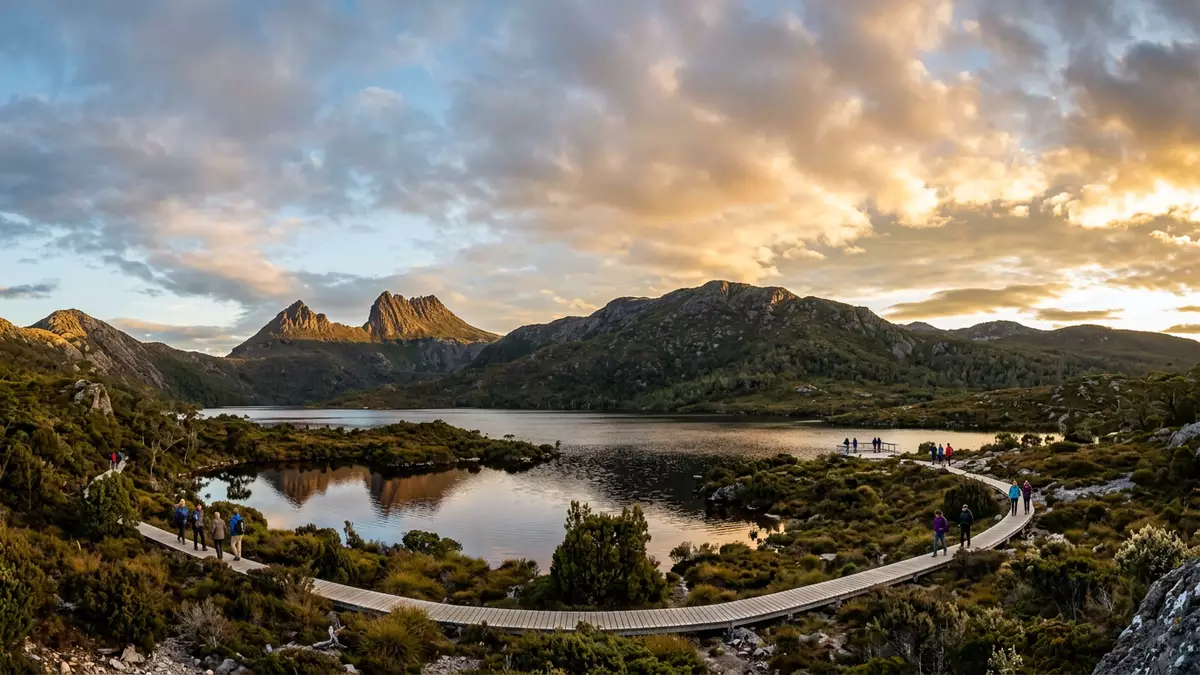
Cradle Mountain rises from the central plateau of Tasmania in Australia, its jagged profile reflected in dark glacial lakes and surrounded by alpine heath and ancient rainforest. Set within the Cradle Mountain-Lake St Clair National Park, part of the Tasmanian Wilderness World Heritage Area, it brings together steep dolerite cliffs, rolling moorland and dense forest in one compact landscape.
Cradle Mountain in its Tasmanian setting
Cradle Mountain stands on Tasmania’s central plateau, in the Central Highlands region of the island state. The mountain forms the northern focus of Cradle Mountain-Lake St Clair National Park, a protected area recognised as part of the Tasmanian Wilderness World Heritage Area for its combination of geology, vegetation and wildlife.Cradle Mountain–Lake St Clair National Park The park stretches between Cradle Mountain in the north and Lake St Clair in the south, with a mosaic of valleys, peaks and plateaus between them.Cradle Mountain-Lake St Clair National Park
The mountain itself is composed largely of dolerite, a rock that forms steep columns and cliffs along the summit ridge. Its highest point reaches about 1,545 m (5,069 ft) above sea level, making it one of the more prominent peaks in Tasmania’s high country.lava basalt peak rises to 5,069 feet Around the base of the mountain, tarns and larger lakes occupy hollows carved by glaciers, while patches of rainforest cling to the valleys, giving the area a striking combination of rock, water and deep green vegetation.glacial-carved lakes and ancient rainforest
A national park shaped by walking tracks and wilderness
Cradle Mountain lies within Cradle Mountain-Lake St Clair National Park, a protected landscape established in stages across the twentieth century as attention grew around the central Tasmanian highlands.declared a scenic reserve in 1922 The park later became part of the wider Tasmanian Wilderness World Heritage Area, a recognition that covers a broad sweep of western and central Tasmania and highlights both natural and cultural values.part of the Tasmanian Wilderness World Heritage Area The mountain sits near the northern boundary of this national park, forming a gateway into the plateau.
The park is crossed by a network of walking tracks, from shorter circuits around lakes near the mountain to longer routes that traverse the high country. The Overland Track, a multi-day walk, begins near Cradle Mountain and follows a route south through valleys and over saddles towards Lake St Clair, linking a series of peaks, plains and forests on its way.Cradle Mountain, Tasmania elevation Along these routes, walkers cross areas of alpine heath, open moorland and pockets of rainforest, meeting streams and tarns fed by the plateau’s high rainfall.towering rainforests and impressive alpine heaths
Wildlife, vegetation and the character of the plateau
Cradle Mountain’s surroundings support a range of Tasmanian wildlife that reflects the mix of habitats in the park. In the forests and heath, visitors can encounter species such as Tasmanian devils, quolls and echidnas, while streams and lakes provide habitat for platypus and frogs.Tasmanian devils, quolls, echidnas and platypus The plateau also supports a wide range of birds and smaller animals, many adapted to the cooler conditions and varied vegetation zones.
The plant life around Cradle Mountain ranges from dense rainforest in sheltered valleys to open grasslands and alpine moorland on higher ground.unique grasslands and ancient rainforest define the park Mosses and lichens cover rocks near streams and lakes, while hardy shrubs and low trees cling to exposed slopes. Against this background, the dolerite columns of Cradle Mountain form a stark outline, and the combination of rock, water and vegetation gives the area a distinctive highland atmosphere.
Visiting Cradle Mountain: what travellers from Western Europe should know
- Cradle Mountain stands in Tasmania’s Central Highlands, at the northern end of Cradle Mountain-Lake St Clair National Park, with access roads approaching from towns such as Sheffield and Mole Creek.
- The terrain around the mountain ranges from boardwalks and formed tracks near the visitor centre to rocky paths and steeper sections closer to the summit, where weather can change rapidly.
- The national park forms part of the Tasmanian Wilderness World Heritage Area, and walkers share the area with native wildlife, glacial lakes and areas of rainforest that require care and respect.
- The official language is English and the currency is the Australian dollar.
- Entry requirements depend on your nationality; UK travellers can check the FCDO travel advice at gov.uk/foreign-travel-advice, Irish travellers the Department of Foreign Affairs at ireland.ie.
Searching for Cradle Mountain on social platforms
These links open searches for Cradle Mountain on each platform.
Frequently asked questions about Cradle Mountain
Where is Cradle Mountain?
Cradle Mountain is in the Central Highlands of Tasmania, Australia, forming the northern focus of Cradle Mountain-Lake St Clair National Park on the island’s central plateau.
What can visitors expect on a visit?
Visitors encounter a mix of jagged dolerite cliffs, glacial lakes, alpine heath and rainforest, with walking tracks ranging from shorter lake circuits to multi-day routes across the plateau.
What makes Cradle Mountain distinctive?
Cradle Mountain stands out for its serrated skyline above a chain of glacial lakes, its elevation of about 1,545 m (5,069 ft) and its setting within the Tasmanian Wilderness World Heritage Area.


