
Cradle Mountain, Australia’s sculpted peak above alpine lakes
Published on 09/19/2026 at 11:08 | Editorial responsibility: Rafael Müller, Editor-in-Chief AD HOC NEWS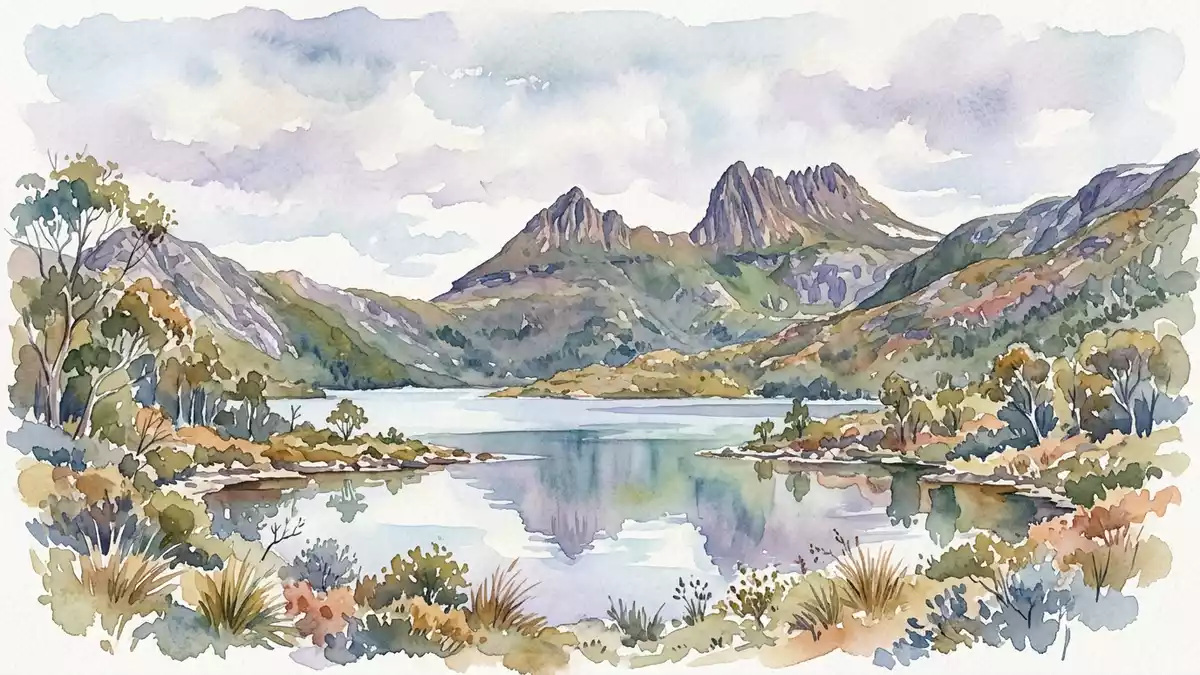
Cradle Mountain in Tasmania’s Central Highlands is a jagged dolerite summit rising above a basin of glacial lakes, moorland and temperate rainforest in southern Australia. It anchors the northern end of Cradle Mountain–Lake St Clair National Park, which forms part of the Tasmanian Wilderness World Heritage Area recognised in 1982 for its wild landscapes and ecology.
The mountain and its glacial setting
The peak of Cradle Mountain reaches 1,545 m (5,069 ft) above sea level, making it one of Tasmania’s highest summits and a prominent feature on the island’s central plateau.Its lava basalt peak rises as an arête, a narrow ridge whose broken spires give the mountain its distinctive, cradle-like profile. The surrounding landscape is a classic glacial amphitheatre: cirque walls and moraines frame lakes and tarns, and ice-scoured rock gives way to peaty moorland and pockets of ancient forest.
The mountain stands at the northern boundary of Cradle Mountain–Lake St Clair National Park, a protected area that extends southwards to Lake St Clair and spans several of Tasmania’s highest peaks.The park covers hundreds of square miles and forms one component of the wider Tasmanian Wilderness World Heritage Area, a group of reserves recognised by UNESCO for their geological and ecological importance.The mountain itself is part of this World Heritage landscape and shares its characteristic mix of alpine and rainforest environments.
Cradle Mountain–Lake St Clair National Park
Cradle Mountain is the signature summit of Cradle Mountain–Lake St Clair National Park, a large protected area in the Central Highlands of Tasmania.The park stretches between Cradle Mountain in the north and Lake St Clair in the south, taking in other peaks such as Barn Bluff and Mount Ossa. Within this landscape, glacial lakes collect in high basins, river valleys cut through rainforest and pencil pines dot the moorland.
The park is well known among walkers for the Overland Track, a long-distance route that begins near Cradle Mountain and runs south towards Lake St Clair.The Overland Track is a multi-day walk across the park, passing beneath high summits and along valleys shaped by ice. Shorter trails radiate from the northern section of the park around Cradle Mountain, reaching viewpoints over lakes and through stands of native forest.
Highland climate, vegetation and wildlife
Cradle Mountain sits within a cool, mountainous climate where conditions can change quickly, even in the milder months. The terrain around the peak includes open alpine heath, buttongrass moorland, stands of endemic conifers and tracts of temperate rainforest strung along riverbanks and lower slopes.The area’s wilderness experiences range from alpine lakes to rainforest riverbanks, all within the bounds of the national park.
Native animals adapted to this highland setting are a central part of Cradle Mountain’s character. On the open slopes and around the lakes, it is possible to see wallabies and wombats feeding, while nocturnal species such as Tasmanian devils keep largely out of sight. Birdlife reflects the mix of habitats, with alpine species using the high ground and forest birds favouring the sheltered valleys. The combination of geology, vegetation and wildlife is one reason the Tasmanian Wilderness area received World Heritage recognition in the twentieth century.UNESCO status for Tasmanian Wilderness dates from 1982.
Visiting Cradle Mountain: what travellers from Western Europe should know
- Cradle Mountain rises in central-north Tasmania at the northern end of Cradle Mountain–Lake St Clair National Park, with road access to the Cradle Valley area via routes inland from the island’s northern coast.
- The terrain around the mountain includes boardwalks across moorland, formed paths beside lakes and steeper, rocky tracks on higher slopes, with some routes involving extended ascents on uneven ground.
- Nearby features include Dove Lake beneath the northern face of the mountain and the wider Cradle Mountain–Lake St Clair National Park, which extends south towards Lake St Clair and other high summits.
- The official language is English and the currency is the Australian dollar.
- Entry requirements depend on your nationality; UK travellers can check the FCDO travel advice at gov.uk/foreign-travel-advice, Irish travellers the Department of Foreign Affairs at ireland.ie.
Searching for Cradle Mountain on social platforms
These links open searches for Cradle Mountain on each platform.
Frequently asked questions about Cradle Mountain
Where is Cradle Mountain?
Cradle Mountain is in the Central Highlands region of Tasmania in southern Australia, forming the northern landmark of Cradle Mountain–Lake St Clair National Park.
What should visitors expect on a trip to Cradle Mountain?
Visitors encounter a highland landscape of glacial lakes, moorland and rainforest beneath a jagged dolerite summit, with walking tracks ranging from short lakeside loops to longer alpine routes.
What makes Cradle Mountain distinctive?
The mountain’s sharp arête profile, its elevation of 1,545 m (5,069 ft) and its position within the Tasmanian Wilderness World Heritage Area give Cradle Mountain a combination of dramatic form and protected wild setting.


