
Coyoacan’s plazas and blue house in Mexiko-Stadt
Published on 09/16/2026 at 10:31 | Editorial responsibility: Rafael Müller, Editor-in-Chief AD HOC NEWS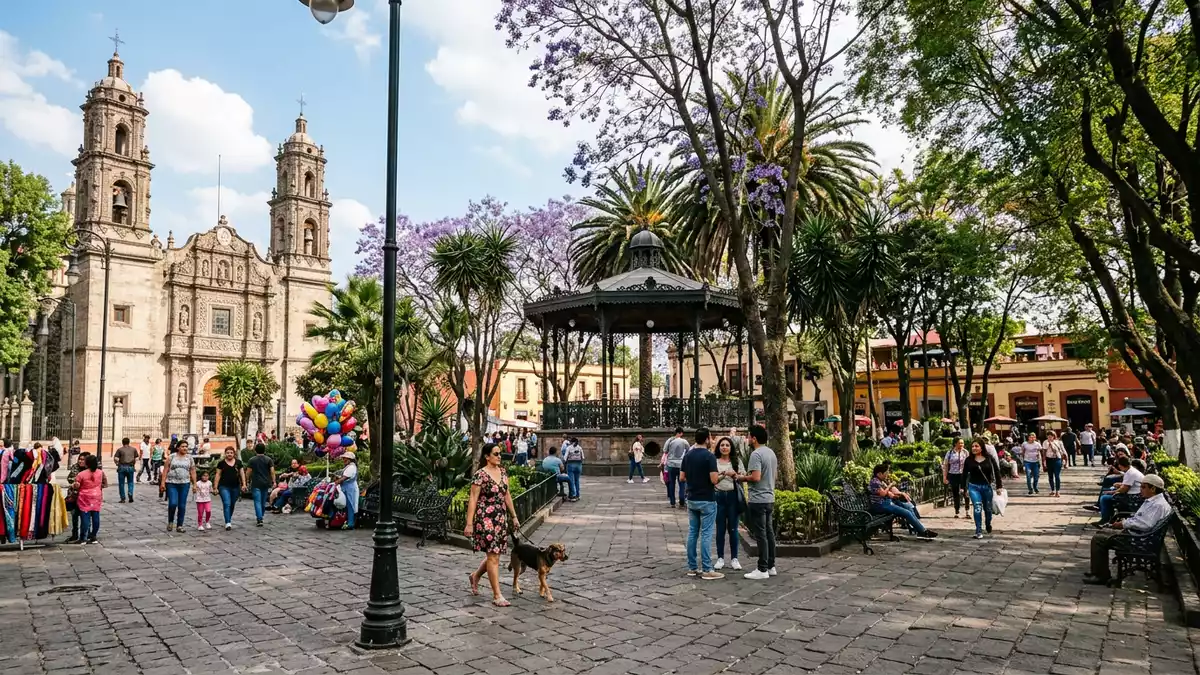
Coyoacan in Mexiko-Stadt is a neighbourhood of plazas, churches and narrow streets, with Frida Kahlo’s blue house as its best-known address. Its centre combines colonial fabric and a strong artistic legacy in a compact, walkable district.
Coyoacan’s colonial centre and civic core
The historic centre revolves around Plaza Hidalgo and the Jardín Centenario, two adjoining public spaces that form the district’s main gathering point. Nearby stands the Parroquia de San Juan Bautista, a church whose origins reach into the sixteenth century.
Coyoacan served as the first capital of the viceroyalty after the Spanish conquest, and that long role still shapes its sense of place. The area later became a borough of Mexiko-Stadt in 1928, bringing an older townscape into the modern metropolis. The name comes from Nahuatl and means “place of coyotes”, an origin that survives in the district’s identity.
Frida Kahlo’s blue house and artistic memory
The district is closely tied to Frida Kahlo, Diego Rivera and the house museum at Londres 247. Known as Casa Azul, the building was the family home where Kahlo was born in 1907 and where she lived for much of her life.
The museum gives Coyoacan a second centre of gravity beyond its plazas. Its cobalt-blue walls, enclosed garden and domestic scale make it a very different presence from the parish church nearby. The wider district also appears in the city’s cultural map as a place of writers, artists and political exiles, which has kept its image distinct from the surrounding capital.
Streets, gardens and an older urban texture
Coyoacan is not a monumental district in the style of a formal palace quarter. It is a neighbourhood of smaller streets, leafy squares and low buildings, where the walk from one landmark to another passes ordinary houses as well as historic institutions.
That texture gives the place its interest. The church front, the gardened plazas and the blue house each show a different layer of the same district, from colonial religious architecture to twentieth-century domestic life.
Visiting Coyoacan: what travellers from Western Europe should know
- Coyoacan lies south of the centre of Mexiko-Stadt, reached through the city’s road and metro network. The district is centred on Plaza Hidalgo and the surrounding streets.
- The streets around the historic core are best treated as a walking area. The main landmarks sit close together, but the pavements, tree-lined squares and church frontage create an urban rather than monumental setting.
- The official language is Spanish and the currency is the Mexican peso.
- Entry requirements depend on your nationality; UK travellers can check the FCDO travel advice at gov.uk/foreign-travel-advice, Irish travellers the Department of Foreign Affairs at ireland.ie.
Searching for Coyoacan on social platforms
These links open searches for Coyoacan on each platform.
Frequently asked questions about Coyoacan
Where is Coyoacan?
It is a district in the southern part of Mexiko-Stadt, centred on Plaza Hidalgo and the streets around it. Its historic core sits within the modern borough of the same name.
What does a visit feel like?
The place combines a church square, gardened public spaces and residential streets with a major house museum. That mix makes the district feel urban, historical and lived-in at once.
What makes Coyoacan distinctive?
The combination of the sixteenth-century parish church, the colonial centre and Casa Azul gives it a layered identity. Frida Kahlo’s home adds a strong artistic focus to an older neighbourhood framework.


