
Copan’s carved stone history in western Honduras
Published on 09/18/2026 at 22:45 | Editorial responsibility: Rafael Müller, Editor-in-Chief AD HOC NEWS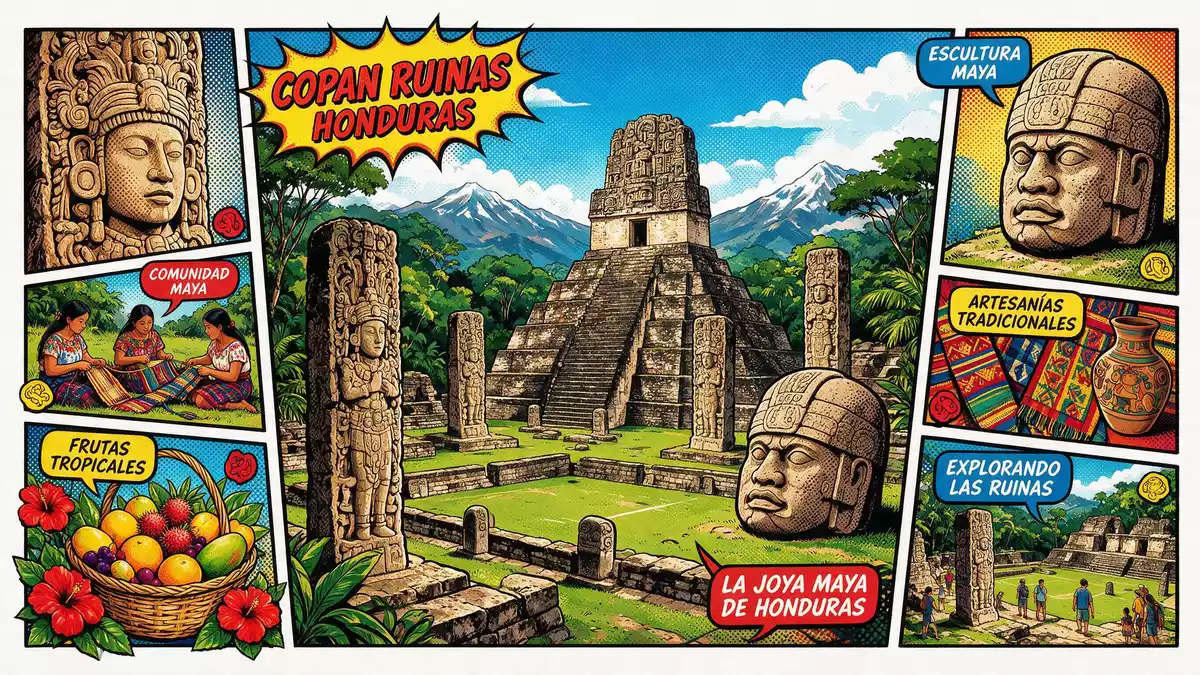
Copan, just outside Copan Ruinas in western Honduras, is an ancient Maya city where stone temples, plazas and terraces form a compact archaeological landscape anchored by hieroglyphic sculpture and carved stelae. The site flourished during the Classic period of Maya civilisation and today its ruins sit in a fertile valley among low hills, within easy reach of the small town that has taken its name.ancient Maya city
Copan in the Classic Maya world
Copan lies in western Honduras, within the municipality of Copan Ruinas in the Copan Department, close to the border with Guatemala and the course of the Copan River.western Honduras location The city formed a political, civil and religious centre for the Copan Valley and for a wider region in the south-eastern Maya area, its influence extending across surrounding settlements that shared its cultural orbit.political and religious centre
The site was occupied from the Early Preclassic period into the Postclassic, with Copan emerging as a major centre during the Classic period between about the fifth and ninth centuries CE, before the city was abandoned in the early tenth century.Classic period occupation Copan was inscribed on the UNESCO World Heritage List in 1980 as the Maya Site of Copan, recognised for its architecture and hieroglyphic texts, and declared a cultural monument by Honduras in 1982 to protect the valley and its pre-Hispanic remains.World Heritage inscription in 1980
Temples, plazas and the Hieroglyphic Stairway
The core of Copan consists of an Acropolis complex with temples and several plazas arranged on and around raised platforms, linked by stairways and flanked by pyramidal structures.central district with temples and plazas Stone courts for the Maya ball game sit among these buildings, while carved altars and monuments line the open spaces, giving the site a dense concentration of sculpted stone within a relatively compact area.ball courts and altars
Copan is renowned for its stelae and sculptures, whose carved surfaces carry portraits of rulers and complex iconography, and for the Hieroglyphic Stairway, a monumental flight of steps inscribed with the longest known Maya hieroglyphic text.Hieroglyphic Stairway inscription The stairway forms part of a wider ensemble of terraces and platforms, where decorative reliefs and hieroglyphic panels record dynastic history and religious narratives across different phases of construction.
Landscape setting and Copan Ruinas today
Copan stands in a fertile valley among foothills at roughly 700 m (2,300 ft) above sea level, its ruins grouped on the river’s west bank with surrounding residential sectors extending across a wider area of about 100 ha.fertile valley location The officially defined Copan Archaeological Park encompasses tens of hectares and contains the principal monumental complexes that visitors encounter as they move from open plazas into more enclosed architectural spaces.Copan Archaeological Park area
The ruins lie just outside Copan Ruinas, a small town that serves as a base for travellers, with roads linking the valley to other parts of Honduras and onward routes to Guatemala.outskirts of Copan Ruinas Copan’s enduring carved stone and its relatively gentle valley setting make it an accessible archaeological site where monumental architecture sits within walking distance of present-day streets and houses.
Visiting Copan: what travellers from Western Europe should know
- Copan is located just outside Copan Ruinas in western Honduras, reached by road links from larger Honduran towns and border crossings with Guatemala.
- The archaeological core consists of terraces, stairways and temple platforms, with walking routes across uneven stone surfaces and earth paths that may require sturdy footwear.
- The ruins stand at a moderate altitude in a valley, where exposure to sun in the open plazas contrasts with shade under nearby trees and structures.
- The official language is Spanish and the currency is the Honduran lempira, though other currencies may be encountered in services catering to international travellers.
- Entry requirements depend on your nationality; UK travellers can check the FCDO travel advice at gov.uk/foreign-travel-advice, Irish travellers the Department of Foreign Affairs at ireland.ie.
Searching for Copan on social platforms
These links open searches for Copan on each platform.Frequently asked questions about Copan
Where is Copan and what is nearby?
Copan is an archaeological site in western Honduras near the Guatemalan border, on the edge of the town of Copan Ruinas in the Copan Valley.
What does a visit to Copan involve?
A visit centres on walking among temples, plazas and sculpted monuments on stone platforms and earth paths, with routes that include stairways and terraced levels.
What makes Copan distinctive among Maya sites?
Copan stands out for its concentration of carved stelae, sculpted altars and the long hieroglyphic text on the Hieroglyphic Stairway, all set within a compact valley setting.


