
Copan’s carved stone city in the hills of Honduras
Published on 08/26/2026 at 21:56 | Editorial responsibility: Rafael Müller, Editor-in-Chief AD HOC NEWS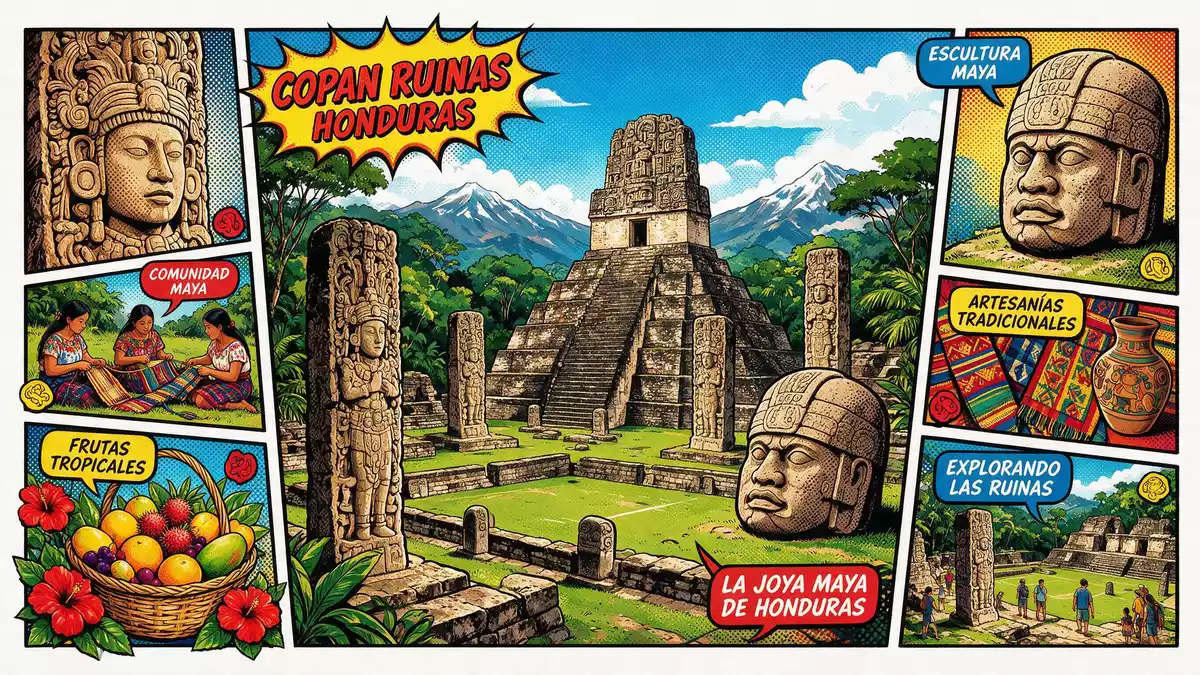
Copan in western Honduras is an ancient Maya city whose carved stone temples and plazas rise from a fertile valley near the town of Copan Ruinas. Set in low hills close to the Guatemalan border, the site preserves a dense ceremonial centre where sculpted facades and inscribed stairways still carry the names and images of its rulers.
A royal city of the Classic Maya
Copan lies in the Copan Valley of western Honduras, within the municipality of Copan Ruinas and not far from the border with Guatemala, in terrain shaped by the Copan River and surrounding hills.extreme western Honduras The ruins form the heart of a former royal city that was a major centre of the Classic-period Maya, with a central district of temples, pyramids, plazas and a ball court spread across several dozen hectares.central district of stone temples Around this core, residential compounds and lesser structures extend across a wider area of valley floor and lower slopes.
Archaeological and historical sources date the foundation of Copan’s ruling dynasty to 426 AD, under the king K’inich Yax K’uk’ Mo’, whose name appears on monuments and is linked to the city’s early political rise.foundation in 426 AD Over the following centuries Copan became a capital whose monuments record a succession of kings, with stelae and altars carved in high relief portraying rulers in elaborate costume. The city continued to flourish into the eighth and ninth centuries before being abandoned in the early tenth century, leaving its citadel and public squares as a standing record of three main stages of development.abandoned in the early tenth century
Carved stone, stelae and the hieroglyphic stairway
The artistic character of Copan is defined by stone carving in deep relief across building facades, stairways and freestanding monuments. Builders here worked extensively in soft volcanic tuff, a rock that allowed sculptors to cut three-dimensional forms and fine detail directly into architectural surfaces, giving many structures a sculptural presence.soft volcanic tuff Portrait stelae stand in plazas and on terraces, their surfaces covered with hieroglyphic text and intricate representations of kings framed by ornamental borders.
One of Copan’s most studied features is the hieroglyphic stairway, a broad flight of steps whose risers are faced with blocks carved in sequence to form a long inscription. The stairway carries thousands of glyphs, making it one of the most extensive written records of royal history in the ancient Americas, and it rises beside major temple structures within the central group.hieroglyphic stairway inscription Nearby lie the Acropolis, a raised complex of platforms and temples, and the Great Plaza, an open space lined with monuments and used in its time for ceremony and ball games.
Copan as a World Heritage landscape
Copan’s status as a major Maya centre and its concentration of carved monuments led to its inscription as a UNESCO World Heritage Site in 1980.World Heritage Site in 1980 The protected area covers the principal group of monumental architecture as well as associated residential zones such as Las Sepulturas, and sits within a valley where pre-Hispanic settlements formed a single socio-political unit centred on the royal court.Copan River Valley protection The wider archaeological zone occupies dozens of hectares, while the monumental core brings together pyramids, terraces, courtyards and sculpted stairways within a walkable landscape.
The surrounding town of Copan Ruinas serves as the modern gateway to the site, with streets and small squares lying a short distance from the entrance to the ruins.Copan Ruins in western Honduras Visitors move from contemporary buildings into shaded paths that lead through trees towards the ancient plazas, where the contrast between living settlement and long-abandoned stone becomes part of the experience of the valley.
Visiting Copan: what travellers from Western Europe should know
- Copan lies in western Honduras in the Copan Department, near the town of Copan Ruinas and close to the Guatemalan border; the archaeological park sits in the Copan Valley.
The nearest larger urban centres are Santa Rosa de Copan and San Pedro Sula, both reached by road before continuing towards Copan Ruinas. - The core monumental group is arranged around plazas, pyramids and terraces linked by stone stairways and earthen paths, and access involves walking over uneven ground and climbing steps of varying heights.
- The surrounding terrain combines low hills and river valley floor at modest altitude, with trees providing intermittent shade and open spaces where exposure to sun is greater.
- The official language is Spanish and the currency is the Honduran lempira.
- Entry requirements depend on your nationality; UK travellers can check the FCDO travel advice at gov.uk/foreign-travel-advice, Irish travellers the Department of Foreign Affairs at ireland.ie.
Searching for Copan on social platforms
These links open searches for Copan on each platform.
Frequently asked questions about Copan
Where is Copan and what kind of place is it?
Copan is an archaeological site of the ancient Maya civilisation in western Honduras, in the Copan Valley near the town of Copan Ruinas and the Guatemalan border.
What should visitors expect when walking around Copan?
Visitors encounter stone temples, pyramids, plazas, stairways and a ball court set among trees and open spaces, with carved stelae and inscriptions appearing throughout the central group.
What makes Copan distinctive among Maya sites?
Copan is noted for its deep stone carving, portrait stelae and the hieroglyphic stairway, a monumental inscription recording royal history, all concentrated in a compact ceremonial core.


