
Constitution Hill in Johannesburg, from prison complex to Constitutional Court
Published on 09/16/2026 at 12:21 | Editorial responsibility: Rafael Müller, Editor-in-Chief AD HOC NEWS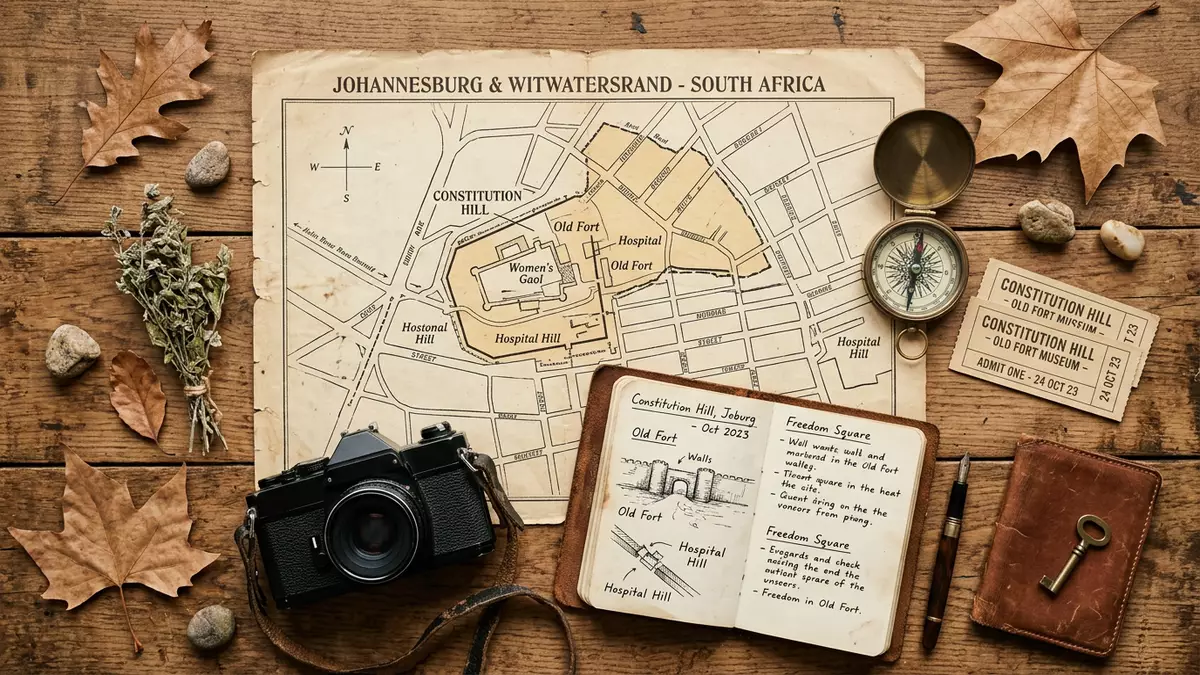
On a ridge above central Johannesburg, Constitution Hill brings together two starkly different faces of South Africa: a former prison and military fort, and the country’s Constitutional Court housed within the same precinct. In the late nineteenth century, a high?security prison complex was established on this Braamfontein ridge, and in the early twenty?first century it became the judicial heart of South Africa’s constitutional democracy.
A hill of prisons above the gold?rush city
Constitution Hill occupies a prominent rise overlooking Johannesburg’s inner city, part of the Braamfontein ridge that framed the young mining settlement in the 1890s. On this ground a high?security Johannesburg Fort prison was established in 1893, at a time when the city was rapidly growing around the goldfields of the Witwatersrand.high?security prison was built in 1893 The complex stood above the city as a physical reminder of state power, its masonry walls and enclosed yards forming a self?contained world of incarceration.
From that initial prison, the site expanded into a cluster of separate institutions. The Old Fort, dating from the 1890s, became associated above all with white male prisoners.Old Fort first opened as a prison for white men Nearby, a section known as Number Four housed black male prisoners, while a Women’s Jail held female detainees in its own buildings.section for black male prisoners, known as Number Four, and a Women's Jail Together, these structures formed a sprawling prison complex that operated through colonial rule and apartheid, holding not only criminal offenders but also political activists, pass?law violators and other people targeted under racial legislation.
From colonial fort to apartheid jail and heritage site
The early phase of Constitution Hill’s history is closely tied to the South African Republic under President Paul Kruger in the 1890s. Around the original prison, Kruger oversaw the construction of an Old Fort between 1896 and 1899, extending the site’s role from a place of detention into a fortified stronghold with military capacity.Old Fort was built around this prison by Paul Kruger from 1896 to 1899 Its walls, ramparts and lookout points gave strategic views across Johannesburg, reflecting the tensions of the Anglo?Boer War era and concern about potential British invasion.
During the twentieth century Constitution Hill gained grim notoriety as one of Johannesburg’s main prison sites. Different sections of the complex were used to detain white political dissidents, black activists resisting apartheid, striking mineworkers, women protesting pass laws and many others caught in the machinery of racial control.prison complex used to detain political dissidents and pass?law offenders Among those held there at different moments were figures such as Nelson Mandela and Mahatma Gandhi, whose periods of imprisonment form part of the broader story of South African and global struggles for rights.leaders of major South African liberation groups, Nelson Mandela and Mahatma Gandhi among them, were detained Over time, the prison buildings came to symbolise the harshness of colonial and apartheid rule.
The Constitutional Court and a living museum of democracy
After South Africa’s transition to democracy in 1994, a decision was taken to transform this former prison into a place that would express constitutional rights rather than their denial. The precinct was renamed Constitution Hill in the mid?1990s, and plans were developed to create a national court building on the historic site.decision was taken in 1995 to locate the Constitutional Court at Johannesburg's oldest prison site The Constitutional Court of South Africa, responsible for interpreting the country’s Constitution and protecting fundamental rights, opened at Constitution Hill in 2004.Constitutional Court opened its doors at Constitution Hill in 2004
Alongside the court, Constitution Hill functions as a living museum that recounts South Africa’s journey from colonialism and apartheid to democracy.living museum that tells the story of South Africa’s journey to democracy Former prison buildings such as the Old Fort, Number Four and the Women’s Jail have been preserved and adapted as exhibition spaces, where displays, cells and courtyards present personal stories and historical documentation. The court building itself incorporates bricks from the old awaiting?trial block, embedding fragments of prison architecture into its contemporary structure.Constitutional Court was opened in 2003 and built using bricks from the old awaiting?trial prison block The result is a precinct where legal work, remembrance and daily city life come together in one place.
Visiting Constitution Hill: what travellers from Western Europe should know
- Constitution Hill stands on the Braamfontein ridge north of Johannesburg’s central business district, reached by road from the inner?city neighbourhoods and nearby suburbs.
- The historic precinct includes multiple levels, courtyards and staircases, and visits often involve walking along paved paths and through former cell blocks.
- Johannesburg lies in South Africa, where the official currency is the South African rand and the official language at national level is English alongside other languages.
- Entry requirements depend on your nationality; UK travellers can check the FCDO travel advice at gov.uk/foreign-travel-advice, Irish travellers the Department of Foreign Affairs at ireland.ie.
Searching for Constitution Hill on social platforms
These links open searches for Constitution Hill on each platform.Frequently asked questions about Constitution Hill
Where is Constitution Hill in Johannesburg?
Constitution Hill stands on the Braamfontein ridge overlooking central Johannesburg, close to the inner?city districts and major transport routes.
What can visitors expect during a visit?
A visit typically includes former prison sections such as the Old Fort, Number Four and the Women’s Jail, as well as the contemporary Constitutional Court building.
What makes Constitution Hill distinctive as a South African landmark?
Constitution Hill is distinctive because it combines preserved prison architecture with the country’s Constitutional Court, presenting South Africa’s journey from incarceration to constitutional democracy.


