
Constitution Hill and Johannesburg’s journey from prison to court
Published on 09/07/2026 at 10:49 | Editorial responsibility: Rafael Müller, Editor-in-Chief AD HOC NEWS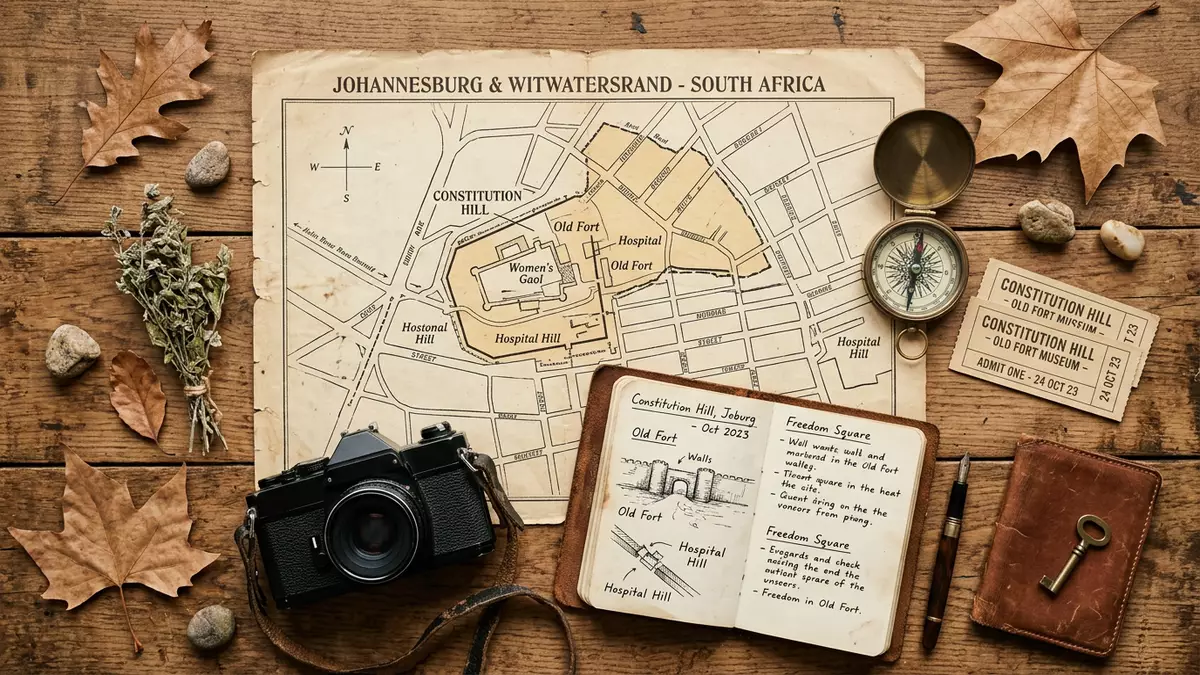
On a ridge above central Johannesburg, Constitution Hill ties together two starkly different chapters of South African history: a notorious prison and the country’s Constitutional Court. The precinct grew out of the Old Fort and related jails, whose origins in the 1890s formed part of the city’s early fabric, and it now houses the highest court established under the 1996 Constitution.
From Old Fort prison to Constitutional Hill precinct
The story of Constitution Hill begins in the late nineteenth century, when a high-security prison was built on the Braamfontein ridge, overlooking Johannesburg’s growing mining settlement.a high-security prison was built In the early 1890s this original jail held white male prisoners and soon became known among residents as the Johannesburg Fort or simply the Fort.the original prison was built
Additional prison sections followed in the early twentieth century, including areas designated for black male prisoners, later infamous as Number Four, and a Women’s Jail added in 1909.sections were added to the site Over decades the hilltop complex expanded into a cluster of separate jails, with the Old Fort at its centre, all enclosed within heavy masonry walls that still frame much of the precinct.
A century of incarceration on the Braamfontein ridge
For more than a hundred years the prisons on this ridge formed one of Johannesburg’s primary sites of incarceration.sites of incarceration The complex held a wide cross-section of society: common-law prisoners, striking mineworkers, activists and those detained under pass laws. Among the best known inmates were Mahatma Gandhi, who was repeatedly arrested for resisting discriminatory legislation, and Nelson Mandela, who experienced the Fort as a lawyer, a prisoner and later revisited it as president.hundreds of thousands of people were jailed there
Conditions in these jails were harsh, with overcrowding and poor sanitation becoming entrenched features as Johannesburg expanded under segregation and apartheid.overcrowding, poor sanitation and disease The separate facilities reflected a racial and gendered order: white male prisoners confined in the Fort, black men in Number Four, and women in the gaol nearby. The prison complex finally ceased operation in the 1980s, leaving behind buildings that carried the physical imprint of the city’s punitive history.the prison was closed in 1983
Home of the Constitutional Court and a living museum
After South Africa’s transition to democracy in 1994, a decision was taken to locate the newly established Constitutional Court at this former prison site in Braamfontein.the site dates back to 1893 An international architectural competition in the late 1990s selected a design that would incorporate remnants of the Old Fort and related jails into a contemporary court building.an intensive, international tendering process The Constitutional Court was inaugurated on 21 March 2004, aligning the opening with Human Rights Day in South Africa.inaugurated on Human Rights Day
Constitution Hill now functions as both a judicial campus and a heritage site. The precinct contains exhibition spaces within the preserved prison blocks, alongside the court chamber and public foyers that draw design cues from South African locations and materials.home to the country’s Constitutional Court It is formally recognised as a national heritage site, and its museums present narratives about political trials, daily life in the jails and the broader struggle that led to the adoption of the Constitution.a National Heritage Site proclaimed
Visiting Constitution Hill: what travellers from Western Europe should know
- Constitution Hill stands on the Braamfontein ridge just north of Johannesburg’s inner city, close to major roads and public transport routes serving the central districts.
- The preserved prison buildings and court precinct are spread across a hilltop site with internal courtyards, stairways and passages, and visitors move between several separate structures.
- English is an official language in South Africa and the national currency is the South African rand.
- Entry requirements depend on your nationality; UK travellers can check the FCDO travel advice at gov.uk/foreign-travel-advice, Irish travellers the Department of Foreign Affairs at ireland.ie.
Searching for Constitution Hill on social platforms
These links open searches for Constitution Hill on each platform.Frequently asked questions about Constitution Hill
Where is Constitution Hill located in Johannesburg?
Constitution Hill occupies a ridge in Braamfontein, just north of Johannesburg’s inner city, within sight of central business district towers.
What should visitors expect when exploring the precinct?
Visitors encounter preserved prison blocks, exhibition spaces and the Constitutional Court building, laid out around courtyards and walkways that link the historic structures.
What makes Constitution Hill distinctive among South African landmarks?
The precinct combines a former prison complex associated with figures such as Nelson Mandela and Mahatma Gandhi with the Constitutional Court, symbolising a shift from repression to rights-based governance.


