
Comuna 13’s hillsides of murals and memory in Medellin
Published on 09/16/2026 at 15:14 | Editorial responsibility: Rafael Müller, Editor-in-Chief AD HOC NEWS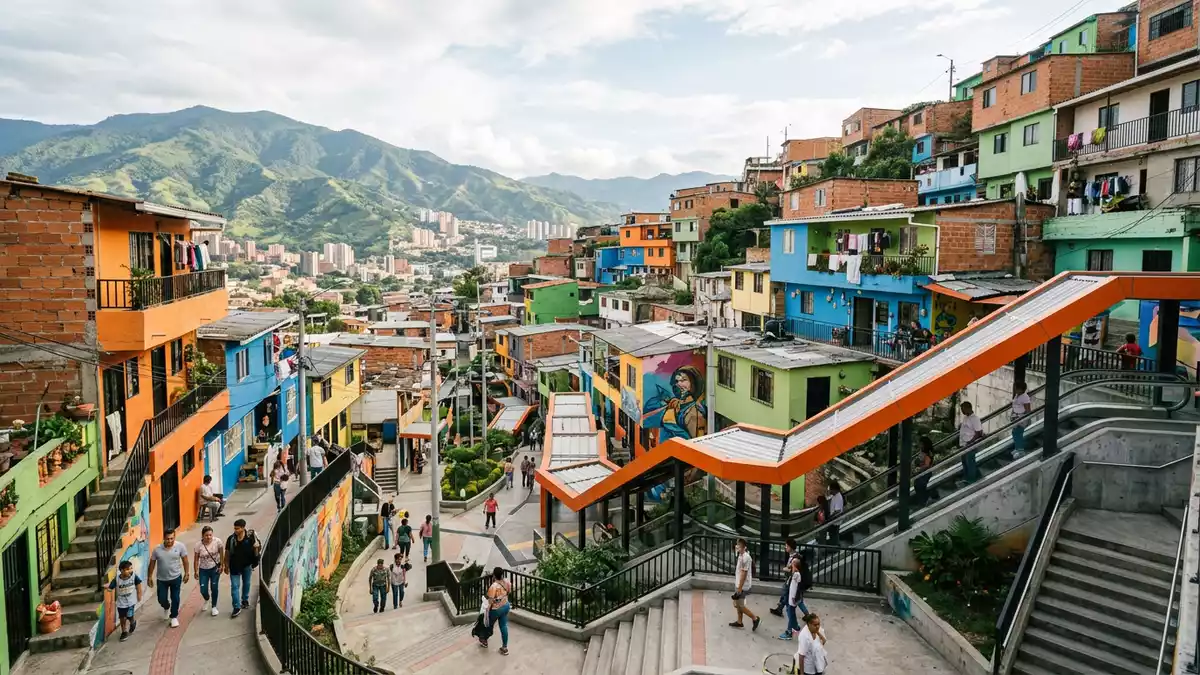
On the western slopes above Medellin, Comuna 13 rises in dense layers of brick, concrete and painted walls, a hillside barrio where steep stairways now share the slope with outdoor escalators and a continuous band of murals. The district forms one of the city’s sixteen comunas, climbing the flanks of the Aburra Valley and carrying visible traces of conflict, displacement and recent community-led art.
From Las Granjas to a sprawling hillside barrio
The area that became Comuna 13 began as agricultural land known as Las Granjas in the nineteenth century, when farmers cultivated plots on the slopes above the growing city.Las Granjas in the nineteenth century Over the twentieth century, informal housing spread across these hillsides, with self-built homes edging along narrow stairways and improvised paths that climbed towards the ridge.informal settlements on the slopes
Comuna 13 owes much of its character to the people who moved here from rural Colombia during periods of conflict, including those escaping La Violencia and later clashes in Antioquia and other regions.farmers fleeing rural violence As Medellin’s urban footprint expanded, the barrio remained physically and socially distinct, perched on steep ground with limited formal infrastructure, which created a landscape of stacked dwellings, concrete landings and tight alleyways.
Conflict, Operation Orion and the scars of the early 2000s
By the 1980s and 1990s, Comuna 13’s position on Medellin’s western edge made it a corridor for armed groups and drug trafficking, and the district became closely associated with violence and territorial control.strategic corridor on the western outskirts Residents lived between the presence of guerrilla organisations such as FARC and ELN, paramilitary forces and criminal gangs, with the hillside layout offering vantage points and escape routes.
A turning point came in October 2002, when military operations including Operation Mariscal and Operation Orion sought to reassert state control over Comuna 13.Operation Orion in 2002 Operation Orion has been described as the largest urban military operation in Colombia’s history, involving thousands of troops supported by helicopters and leaving deep marks on the neighbourhood’s streets and collective memory.largest urban military operation The period around these operations remains central to how many accounts frame Comuna 13’s history and its subsequent changes.
Escalators and murals on the steep hillside
One of the most striking visible changes in Comuna 13 is the network of outdoor electric escalators that climb part of the hillside, linking different residential levels with the streets further down.electric escalators installed in 2011 Installed in 2011, these escalators extend for about 384 m (1,260 ft) in several interconnected sections, replacing a long series of concrete steps with moving platforms that carry residents and visitors up and down the slope.outdoor escalators that extend for 1,260 ft
Alongside these escalators, large-scale murals cover retaining walls, house façades and stairway edges, turning the passage through Comuna 13 into a sequence of painted scenes.murals along the escalator route Community-inspired graffiti and mural projects began to emerge in the early 2010s, with local artists using colour, symbols and portraits to address themes such as memory, resilience and specific events including Operation Orion.murals started in the early 2010s Walking routes near the escalators bring these artworks into close view, with painted stair risers, walls and small plazas forming a continuous gallery embedded in everyday residential space.
Visiting Comuna 13: what travellers from Western Europe should know
- Comuna 13 lies on the western hillsides of Medellin in Colombia, above the Aburra Valley; visits typically begin from the San Javier area, reached by the city’s metro system.
- The main routes climb steep ground, including concrete stairways and stepped paths, although sections of outdoor escalators reduce the need to walk continuously uphill.
- The terrain consists of dense housing, narrow passageways and small terraces, with limited shade along some stairways and exposed viewpoints above the valley.
- Spanish is the official language and the national currency is the Colombian peso.
- Entry requirements depend on your nationality; UK travellers can check the FCDO travel advice at gov.uk/foreign-travel-advice, Irish travellers the Department of Foreign Affairs at ireland.ie.
Searching for Comuna 13 on social platforms
These links open searches for Comuna 13 on each platform.Frequently asked questions about Comuna 13
Where is Comuna 13 in Medellin?
Comuna 13 is a hillside district on the western edge of Medellin in Colombia, overlooking the Aburra Valley and forming part of the city’s network of comunas.
What can visitors expect on a walk through Comuna 13?
Visitors encounter steep stairways, outdoor escalators, dense housing and extensive murals along walls and stair routes, with viewpoints that open towards the valley below.
What makes Comuna 13 distinctive compared with other districts?
The combination of its layered conflict history, the 2002 military operations and the later emergence of escalators and community-led mural projects gives Comuna 13 a particularly visible narrative on its slopes.


