
Colossi of Memnon: twin stone guardians of Luxor’s west bank
Published on 09/07/2026 at 07:56 | Editorial responsibility: Rafael Müller, Editor-in-Chief AD HOC NEWS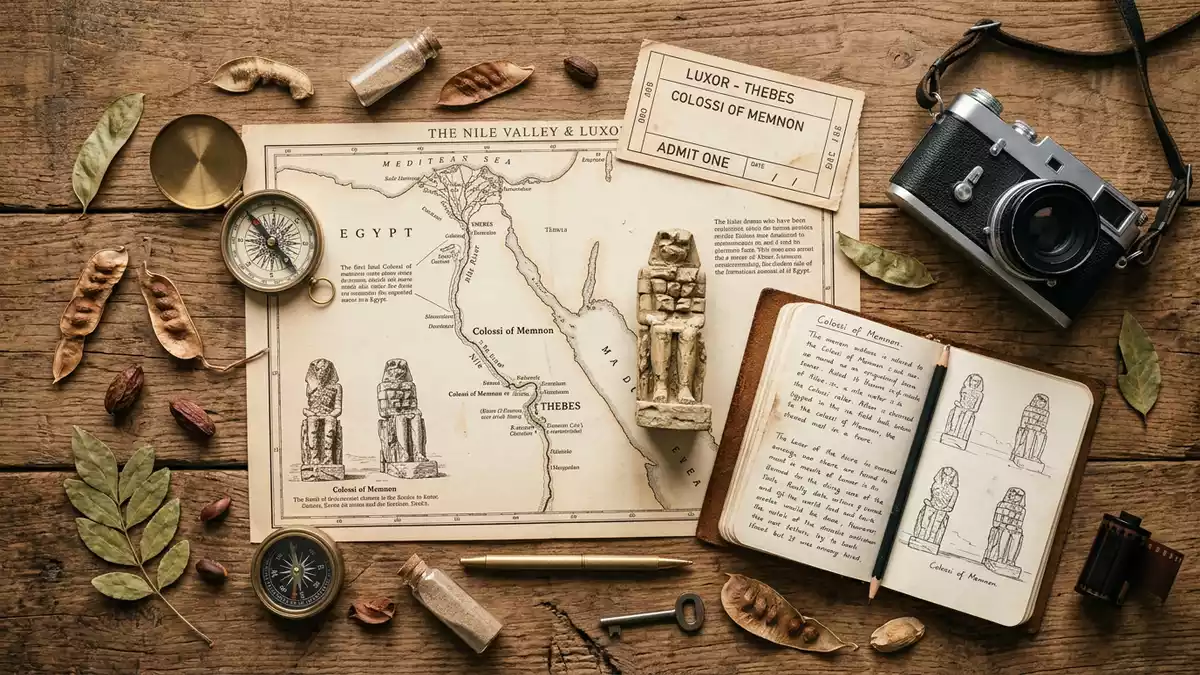
On the west bank of the Nile opposite Luxor, the Colossi of Memnon rise from the plain as two monumental seated statues of the pharaoh Amenhotep III from Egypt’s Eighteenth Dynasty. Their weathered quartzite sandstone surfaces and massive thrones still mark the former entrance to his mortuary temple, a once expansive complex in the Theban necropolis of Upper Egypt.
Amenhotep III and the mortuary temple on the Theban plain
The Colossi of Memnon belong to the funerary landscape of Thebes, the ancient name for the region around modern Luxor in southern Egypt. They stood at the front of the mortuary temple of Amenhotep III, a New Kingdom ruler whose reign in the fourteenth century BC is associated with a period of power and prosperity for the Eighteenth Dynasty.Amenhotep III of the 18th Dynasty That temple once extended far beyond the surviving statues, and has largely disappeared beneath the floodplain and later structures, leaving the colossi as the most visible elements of the original design.front of the ruined Mortuary Temple of Amenhotep III
Each statue represents Amenhotep III seated on a throne, hands resting flat on his knees, facing east towards the river and the rising sun.pharaoh throning with hands on his knees The sides of the thrones carry carved imagery, including figures and symbols associated with the king’s family and the Nile god Hapy. Although the upper parts of both colossi have suffered heavy damage, the basic seated form and the broad mass of the thrones remain clear even at a distance.
Material, scale and the “singing” Memnon
The statues are carved from huge blocks of quartzite sandstone, transported to the Theban west bank and set directly on stone plinths above the plain.each statue is about 18 metres high and made of quartzite Including their bases, the colossi reach around 18 m (about 59 ft) in height, with individual blocks weighing several hundred tonnes.figures rise 60 ft high Their sheer vertical scale, combined with the open surroundings of the necropolis, makes them visible from the approach roads and from parts of the east bank.
In Graeco-Roman times the statues acquired the name “Memnon”, linking them to a legendary Ethiopian king known from Greek myth, and one of the colossi became associated with a mysterious sound reported at dawn. Ancient visitors described a tone or vibration that seemed to come from the damaged northern statue around sunrise.northern statue linked with a famous sound at sunrise Later restorations changed the upper structure, and reports of the sound faded, but the association with Memnon and the idea of a “singing” statue remain part of the site’s historical lore.
Setting among Luxor’s west bank monuments
The Colossi of Memnon stand in the area known as Thebes West, a zone of tombs and temples on the west bank of the Nile opposite the built-up districts of Luxor. They occupy a plot near Kom el-Hettan, alongside the main road that leads towards the necropolis of Deir el-Bahari, the Valley of the Kings and the Valley of the Queens.location near the road to Deir el-Bahari and the Valley of the Queens Travellers approaching the west bank monuments by road encounter the colossi in the open fields before reaching the cliff-side temples and royal burial areas.
The statues stand a short distance west of the present riverbank, on ground that lies slightly above the surrounding cultivation. To the east is the broad sweep of the Nile, while to the west and north the terrain rises towards the limestone cliffs that frame the famous valley cemeteries.near the Valley of the Kings in the Theban necropolis From the base of the statues, the view takes in both the agricultural strip along the river and the desert-edge archaeology that has shaped Luxor’s reputation as one of Egypt’s key ancient centres.
Visiting Colossi of Memnon: what travellers from Western Europe should know
- The Colossi of Memnon stand on the west bank of the Nile opposite Luxor, in the area commonly reached by road routes serving the Valley of the Kings and other Theban west bank sites.
- The statues occupy an open roadside plot on level ground, with firm surfaces underfoot and no enclosing building; visitors walk on packed earth and stone around the bases.
- Luxor lies in Upper Egypt, where the official language is Arabic and the currency is the Egyptian pound.
- Nearby sights include the mortuary temple terraces at Deir el-Bahari and other west bank temples, which share the same general access roads as the Colossi of Memnon.
- Entry requirements depend on your nationality; UK travellers can check the FCDO travel advice at gov.uk/foreign-travel-advice, Irish travellers the Department of Foreign Affairs at ireland.ie.
Searching for Colossi of Memnon on social platforms
These links open searches for Colossi of Memnon on each platform.Frequently asked questions about Colossi of Memnon
Where are the Colossi of Memnon located in relation to Luxor?
The statues stand on the west bank of the Nile in Thebes West, opposite central Luxor, near the road towards the Valley of the Kings and Deir el-Bahari.
What should visitors expect when they arrive at the site?
Visitors find two large seated quartzite statues in an open roadside setting, with room to walk around the bases and views across the fields towards the river and cliffs.
What makes the Colossi of Memnon distinctive among Luxor’s monuments?
Their combination of New Kingdom royal imagery, great height and prominent position at the former entrance to Amenhotep III’s mortuary temple gives them a strong presence on the Theban plain.


