
Colossi of Memnon, stone giants of Amenhotep III in Luxor
Published on 08/31/2026 at 16:21 | Editorial responsibility: Rafael Müller, Editor-in-Chief AD HOC NEWS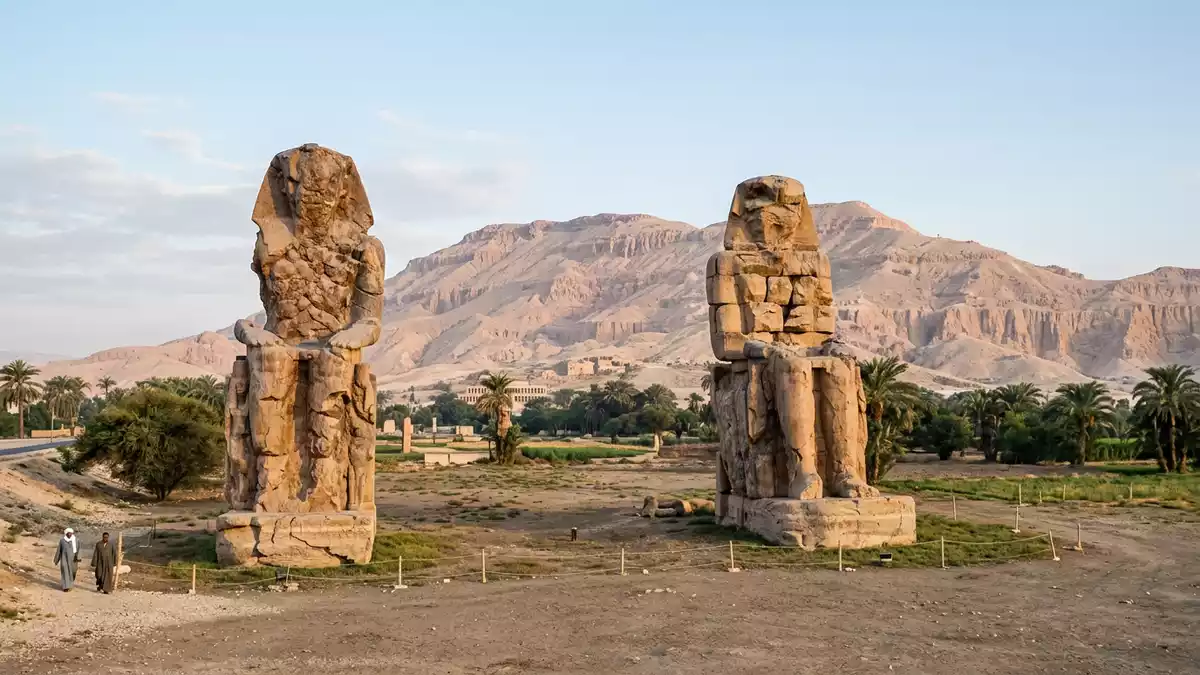
On the west bank of the Nile opposite Luxor, the Colossi of Memnon rise from the plain as two vast seated figures of Pharaoh Amenhotep III, marking the forecourt of his long-vanished mortuary temple from the eighteenth dynasty of ancient Egypt.
Stone guardians of Amenhotep III’s mortuary temple
The Colossi of Memnon represent Amenhotep III of the eighteenth dynasty, who ruled Egypt during the New Kingdom in the fourteenth century BC.Amenhotep III of the 18th Dynasty Each statue shows the king enthroned, hands resting on his knees, facing east towards the river and the rising sun with the formal stillness characteristic of royal sculpture of the period.two enthroned statues facing east They once flanked the main entrance of Amenhotep III’s mortuary temple, a complex that occupied a broad strip of the Theban Necropolis and was renowned for its size in relation to other temples.
Very little remains of the temple itself; its stone was removed over later centuries, leaving the two statues standing almost alone at the edge of the archaeological zone.statues flanking the mortuary temple entrance Each colossus was carved from hard quartzite transported from quarries in the Cairo region to Thebes, then set on a large pedestal that lifts the seated figure well above the surrounding ground.quartzite monoliths from Gebel el-Ahmar Even in their weathered state, the statues still convey the intended monumental scale of the original complex.
Myth, “singing” stone and later repairs
The name “Colossi of Memnon” comes from a Greek reinterpretation of one statue, linked to the mythological hero Memnon rather than to Amenhotep III; the association reflects how travellers from the Hellenistic and Roman worlds encountered the site long after its construction.Greek travellers’ name Memnon In the first century BC an earthquake fractured the northern colossus, and visitors reported that at sunrise the damaged stone produced a faint sound that they interpreted as Memnon calling to his mother, the goddess of the dawn.musical sound at sunrise The “singing” became a noted curiosity of Roman-era travel to Thebes.
In the early second century AD, the Roman emperor Septimius Severus ordered repairs to the fractured statue, adding stone to stabilise the damaged sections.Roman repairs under Septimius Severus After this work, reports of the sunrise sound cease, but the interventions themselves form part of the layered history visible in the surface of the colossus.earthquake damage and Roman rebuilding Between ancient Greek inscriptions, Roman masonry and later archaeological work, the statues record encounters across more than three millennia.
The Colossi within the Theban Necropolis landscape
The Colossi of Memnon stand within the Theban Necropolis on Luxor’s west bank, in the area known as Kom el-Hettan, with the Nile and the modern city across the floodplain to the east and the limestone cliffs of the desert rising behind them to the west.location at Kom el-Hettan west of Luxor The site lies near other major monuments of ancient Thebes, including the Valley of the Kings further into the desert and other mortuary temples scattered along the base of the escarpment.part of the Theban Necropolis near Valley of the Kings In this setting the statues form a clear marker between cultivated land and the belt of tombs and temples.
Each colossus, including its pedestal, rises to a height that modern measurements place around 18 m (about 60 ft), ranking them among the largest ancient statues still standing in Egypt.approximately 18 m high statues The figures sit close to one another on roughly parallel axes, separated by a short stretch of open ground that once formed the temple forecourt.two enthroned statues on pedestals Visitors encounter them as a pair, reading their scale against the relatively flat landscape and the distant cliffs.
Visiting Colossi of Memnon: what travellers from Western Europe should know
- The Colossi of Memnon stand on the west bank of the Nile opposite Luxor, in the Kom el-Hettan area of the Theban Necropolis, reached by road from the city.
- The statues are set on stone pedestals in open ground; approaching them involves walking on firm, generally level terrain with low steps or kerbs around some viewing points.
- The surrounding archaeological zone lies close to cultivated fields and desert slopes, so shade from built structures is limited and the ground can feel exposed in the middle of the day.
- The official language is Arabic and the currency is the Egyptian pound.
- Entry requirements depend on your nationality; UK travellers can check the FCDO travel advice at gov.uk/foreign-travel-advice, Irish travellers the Department of Foreign Affairs at ireland.ie.
Searching for Colossi of Memnon on social platforms
These links open searches for Colossi of Memnon on each platform.
Frequently asked questions about Colossi of Memnon
Where are the Colossi of Memnon located?
The statues stand in the Theban Necropolis at Kom el-Hettan on the west bank of the Nile opposite Luxor, within the wider landscape of ancient Thebes.
What can visitors expect when seeing the Colossi of Memnon?
Visitors encounter two weathered quartzite statues of Amenhotep III seated on tall pedestals in open ground, with the river plain and desert cliffs forming the backdrop.
What makes the Colossi of Memnon distinctive among sites near Luxor?
The Colossi combine great height, a clear link to Amenhotep III’s mortuary temple and the layered history of Greek myth, Roman repair and modern archaeology focused on this pair of statues.


