
Colosseo in Rome and the architecture of a freestanding arena
Published on 09/09/2026 at 15:06 | Editorial responsibility: Rafael Müller, Editor-in-Chief AD HOC NEWS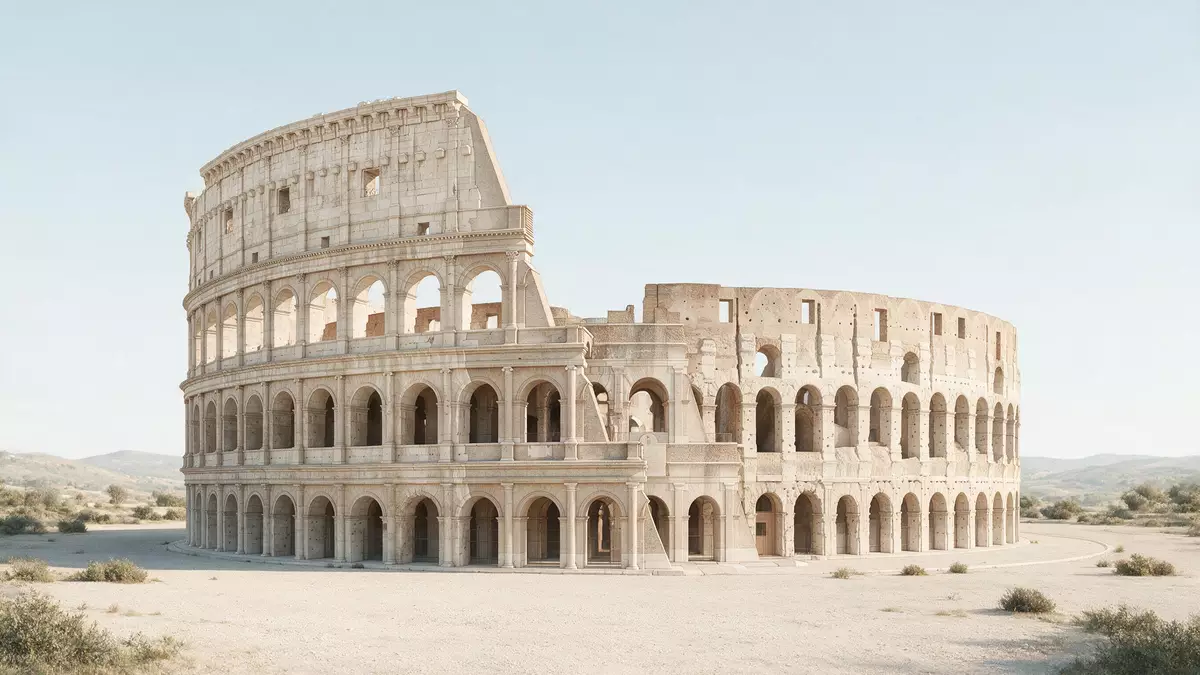
Colosseo, known in English as the Colosseum, is the vast Flavian amphitheatre on the eastern side of Rom’s historic centre, a freestanding stone arena that still frames the city’s ancient core. Built under emperors Vespasian, Titus and Domitian in the first century CE, it combines sheer scale with an ordered façade of arches and columns that has become shorthand for imperial Rome.
A Flavian amphitheatre carved into Rome’s urban fabric
The Italian name Colosseo refers to the ancient Amphitheatrum Flavium, commissioned under Emperor Vespasian of the Flavian dynasty around 70–72 CE and inaugurated in 80 CE under his son Titus.Begun under Vespasian around 70–72 CE and inaugurated by Titus in 80 CE The project continued under Domitian, who completed the upper tiers and underground service areas later in the same century.Domitian added further structures between 81 and 96 CE
Colosseo stands just east of the Roman Forum in Piazza del Colosseo, in the archaeological heart of Rome, occupying a broad oval footprint in the urban fabric.The Flavian Amphitheatre stands in the archaeological heart of Rome The arena formed part of a wider ensemble of imperial monuments in the city centre, but its form is entirely freestanding rather than cut into a hillside, marking a technical and spatial departure from earlier amphitheatres.The Colosseum is a freestanding elliptical amphitheatre built on flat ground
Geometry, dimensions and materials of a giant oval arena
The overall plan of Colosseo is an elongated oval measuring roughly 188–189 m along its major axis and about 156 m across, with the surviving outer wall reaching around 48 m in height.The Colosseum’s oval shape measured 189 m by 156 m with a height of around 48 m Within that envelope lies the arena floor and surrounding tiered seating, creating a steep internal bowl that once accommodated tens of thousands of spectators.
The structure combines travertine limestone for the main frame and façade with volcanic tuff, brick-faced Roman concrete and timber in the interior, using an estimated 100,000 cubic metres of travertine in its construction.The Colosseum was built from an estimated 100,000 cubic metres of travertine stone Barrel vaults and groin vaults support four stacked storeys of arcades, while the arena floor once concealed a hypogeum of corridors and chambers added under Domitian, creating a layered, vertical composition that is as much engineering as architecture.Barrel and groin vaults allowed the Colosseum to rise to four storeys
Façade orders and the amphitheatre’s place in a wider heritage landscape
The exterior of Colosseo is organised into three main tiers of arches framed by engaged columns in the Doric, Ionic and Corinthian orders, crowned by a fourth level with smaller openings set into a solid wall.The outer wall features three tiers of arches in the Doric, Ionic and Corinthian orders This classical layering is legible even where the outer ring has suffered collapse, and it makes the building a textbook case of how Roman architects stacked the canonical orders on large public monuments.
Colosseo forms part of the Historic Centre of Rome, which is inscribed as a UNESCO World Heritage Site, and the amphitheatre itself is frequently cited as the largest Roman amphitheatre constructed.It stands within the UNESCO-listed Historic Centre of Rome The surrounding Parco archeologico del Colosseo links the amphitheatre to neighbouring ruins and green spaces, turning what was once a single arena into a broader archaeological park landscape that extends across about forty hectares in central Rome.The Archaeological Park of the Colosseum extends over more than 40 hectares
Visiting Colosseo: what travellers from Western Europe should know
- Colosseo stands in Piazza del Colosseo on the eastern edge of the Roman Forum, with Metro line B serving a station named “Colosseo” beside the monument.
- The amphitheatre’s interior involves climbing and descending stepped passages and stone ramps, and some areas use narrow stairways between levels.
- Several city bus routes and tram line 3 stop near Piazza del Colosseo, integrating the site into Rome’s wider public transport network.
- The official language is Italian and the currency is the euro.
Searching for Colosseo on social platforms
These links open searches for Colosseo on each platform.Frequently asked questions about Colosseo
Where is Colosseo located in Rome?
Colosseo stands in Piazza del Colosseo on the eastern side of central Rome, immediately beside the Roman Forum and within the city’s archaeological core.
What should visitors expect inside the amphitheatre?
Inside Colosseo, visitors encounter the remains of the tiered seating, the oval arena and traces of the underground hypogeum, linked by stone passages, ramps and stairways.
What makes Colosseo distinctive among ancient Roman monuments?
Colosseo is distinctive for its vast freestanding oval plan, its stacked classical orders and its role as the largest Roman amphitheatre integrated into a wide archaeological park landscape.


