
Colaiste na Trionoide in Dublin: a city campus shaped by centuries
Published on 09/17/2026 at 12:55 | Editorial responsibility: Rafael Müller, Editor-in-Chief AD HOC NEWS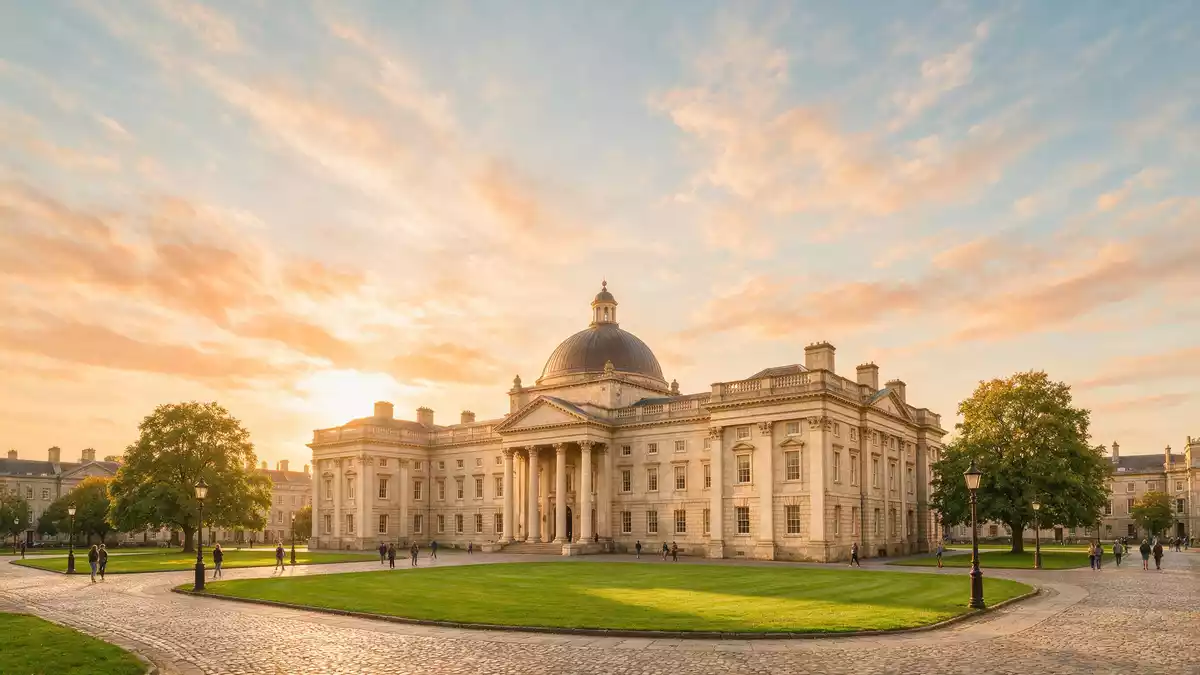
Colaiste na Trionoide in Dublin is Ireland’s oldest university campus, founded as Trinity College in 1592 and now occupying a sizeable rectangle of streets and lawns at the edge of the historic city centre. Behind its formal entrance on College Green, the sequence of squares, classical facades and open grass creates an enclosed world that still reads in layers of seventeenth, eighteenth and nineteenth-century building.
A university founded in the late sixteenth century
Colaiste na Trionoide was established in 1592 under a royal charter granted by Queen Elizabeth I, creating a new college “near Dublin” at the eastern side of the small medieval city.royal charter in 1592 The site provided by Dublin Corporation incorporated the former Priory of All Hallows, then lying just beyond the walls, which gave the young institution more land than it immediately required.grounds of the former Priory of All Hallows In its early period the community of fellows and students occupied only part of what is now Front Square, with brick ranges forming a compact quadrangle around a central court.
The wider history of Colaiste na Trionoide has often been divided into distinct epochs, beginning with this foundation phase, followed by a long eighteenth-century period of expansion and then a modern era of adaptation.three epochs of Trinity College history That sequence is visible in the differing characters of its buildings: early brick residential blocks, grand classical halls and chapel, and later scientific and teaching spaces that extend the campus north and east beyond the original square.
Front Square and the Campanile
Front Square is the ceremonial heart of Colaiste na Trionoide, reached through the main entrance from College Green and framed on all sides by stone-fronted academic buildings and the chapel. At its centre stands the Campanile, a freestanding bell tower completed in the 1850s to a design by the Belfast architect Sir Charles Lanyon.Campanile designed by Sir Charles Lanyon The tower rises from a square base into a two-stage composition with openings at ground level and a belfry above, and has become a visual marker for the axis of the square.
The Campanile was conceived in an Italianate classical style, reflecting nineteenth-century tastes and echoing proposals for an ornamental tower discussed on the campus in the late eighteenth century.Italianate bell tower on Front Square Around it sit some of the principal eighteenth-century buildings of Colaiste na Trionoide, including the Examination Hall and Chapel on the north side and the Dining Hall further west, whose columned fronts and symmetrical plans give the square a strongly ordered character when viewed from the entrance.
The Old Library and academic life on campus
Beyond the Campanile, Library Square is dominated by the Old Library, a long classical building constructed between 1712 and 1732 to designs attributed to Thomas Burgh.Old Library built 1712–1732 Its stone facade and high windows conceal interiors lined with timber shelving and galleries, including the well-known Long Room, which holds large collections of manuscripts and printed volumes associated with the university. Nearby stand the Rubrics, student housing from the early seventeenth century, whose brick construction contrasts with the later stone architecture and forms one of the oldest surviving ranges on the campus.the Rubrics as the oldest surviving structure
The academic life of Colaiste na Trionoide has developed alongside these buildings. The college has moved from a strictly Anglican institution to one that admits students without religious tests, a process accelerated by legislative changes in the nineteenth century.religious requirements removed in the nineteenth century Scholars associated with the campus include mathematician William Rowan Hamilton, who developed quaternion theory there, and physicist Ernest Walton, who shared the Nobel Prize in 1951 for work on splitting the atomic nucleus.William Rowan Hamilton and Ernest Walton Their names, like those of literary alumni, sit alongside the physical fabric as part of the intellectual heritage embedded in the quadrangles.
Visiting Colaiste na Trionoide: what travellers from Western Europe should know
- Colaiste na Trionoide occupies a large campus immediately east of Dublin’s historic core, with its main entrance on College Green opposite the former parliament building.
- The central squares and paths are laid out on level ground, but several interior staircases in the towers and halls are narrow and involve multiple flights.
- The campus is bordered by busy city streets, and once inside the main gateway the environment shifts to enclosed courtyards with lawns, trees and paved routes.
- The official language is English and the currency is the euro.
Searching for Colaiste na Trionoide on social platforms
These links open searches for Colaiste na Trionoide on each platform.
Frequently asked questions about Colaiste na Trionoide
Where is Colaiste na Trionoide located within Dublin?
Colaiste na Trionoide stands on a defined campus east of the old city centre, with its principal gateway opening onto College Green beside central streets and civic buildings.
What can visitors expect when entering the campus?
Visitors pass from traffic-filled streets through the formal entrance into Front Square, where stone-fronted halls, chapel and the Campanile frame lawns, paved paths and views towards the Old Library.
What makes Colaiste na Trionoide distinctive among university campuses?
Its combination of a late sixteenth-century foundation, seventeenth and eighteenth-century quadrangles, the nineteenth-century Campanile and the celebrated Old Library gives the campus a continuous architectural record laid out in the middle of Dublin.


