
Colaiste na Trionoide and the quiet drama of Dublin’s Long Room
Published on 08/27/2026 at 22:05 | Editorial responsibility: Rafael Müller, Editor-in-Chief AD HOC NEWS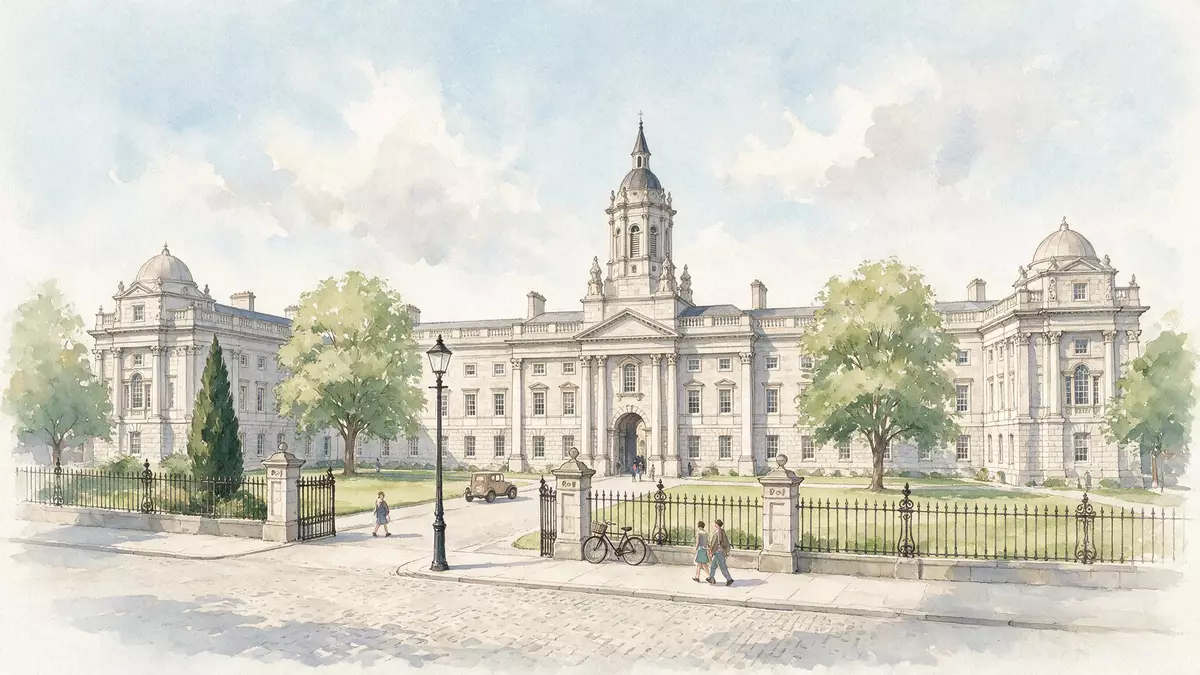
Colaiste na Trionoide in Dublin is a historic university campus whose most striking spaces are shaped around books, stone and quiet courtyards, with the Old Library and its Long Room at the heart of the experience. Established in the late sixteenth century as a college of the University of Dublin, it has grown into a layered ensemble of squares, gardens and academic buildings that chart Ireland’s architectural and intellectual history.
Squares, stone and a campus shaped over centuries
The campus of Colaiste na Trionoide occupies a large block on the south side of the River Liffey, close to Grafton Street and Dublin’s historic core, and is organised around a sequence of formal squares and lawns. Parliament Square and Library Square form the western portion, framed by eighteenth-century buildings such as the Chapel, the Examination Hall and the Old Library, and this side of the campus preserves a classical layout with stone fronts and arcaded ground floors.Parliament Square and Library Square To the east, later buildings for science and engineering extend the grounds towards Pearse Street, demonstrating how the college expanded beyond its original grid into a broader urban campus.buildings mostly for Science
Colaiste na Trionoide was founded in 1592 in the reign of Elizabeth I, and some of its earliest layout can be traced in the position of the Rubrics, a red-brick range regarded as the surviving portion of the original quadrangle.the Rubrics During the eighteenth century the college added what has been described as the largest group of monumental buildings of that period in Ireland, including the Public Theatre and Dining Hall, giving the campus a coherent Georgian character on its western side.largest group of monumental 18th-century buildings Nineteenth-century additions such as the Museum Building, with its richly carved stone inspired by Irish geology, added further depth to the architectural story.
The Campanile and the western profile of Colaiste na Trionoide
The most recognisable vertical accent on the campus is the Campanile, a free-standing bell tower that rises from the centre of the older squares and acts as a stone marker between the Parliament and Library sides.campanile located between the university’s Parliament and Library squares Completed in 1853 to designs by Sir Charles Lanyon, the Campanile stands about 30.5 m (100 ft) high and is built largely of granite with sculptural details in Portland stone.30.5 metres tall and mainly granite Its lower stage is square, with rusticated masonry rising from a pronounced podium, while the upper stages introduce a belfry and lantern that form a distinct profile against the sky.
The Campanile was funded by Lord John George Beresford, then Archbishop of Armagh and Primate of all Ireland, and has long served as a symbolic image for Colaiste na Trionoide in prints and photographs.gift of Lord John George Beresford Around it, the Chapel and Examination Hall, attributed to Sir William Chambers, define the north–south edges of the square and deepen the sense of enclosure.Chapel and Examination Hall Walking across this western part of the campus means moving between stone fronts that span over two centuries, yet share a consistent scale and rhythm, making the Campanile as much a hinge between buildings as an object in its own right.
The Old Library, the Long Room and the Book of Kells
The Old Library of Colaiste na Trionoide forms the southern side of Library Square and contains the Long Room, which is widely recognised as one of Ireland’s defining library interiors.Old Library Designed by Thomas Burgh and built between 1712 and 1732, the Old Library was deliberately oversized for its original needs, reflecting the college’s ambitions for its collections in the eighteenth century.massive new library 1712-32 The Long Room inside stretches almost 65 m (213 ft) and houses around 200,000 of the library’s oldest books in its standard arrangement, creating a dense wall of bindings along both sides.nearly 65 metres in length
The library of Colaiste na Trionoide holds legal deposit status for both Ireland and the United Kingdom, which has made it a major repository for printed material over centuries.legal deposit library Among its most celebrated treasures is the Book of Kells, a richly decorated manuscript of the four Gospels in Latin, based on the Vulgate text completed by St Jerome in 384 AD.Book of Kells contains the four Gospels in Latin Created by Columban monks around 800 AD, the manuscript is now displayed in the Treasury within the Old Library, forming the centrepiece of a curated Book of Kells experience that leads visitors into the Long Room’s main chamber.Book of Kells Experience
Visiting Colaiste na Trionoide: what travellers from Western Europe should know
- Colaiste na Trionoide stands on College Green in central Dublin, a short walk south of the River Liffey, and is reached easily on foot or by city bus.
- The historic squares are laid out with paved surfaces and grassed lawns, while the Campanile and Old Library are approached over level stone, with internal staircases in some academic buildings.
- The Old Library and Long Room form part of a structured visitor route linked to the Book of Kells display, and movement through these interiors is along defined corridors and gallery spaces.
- The wider campus includes teaching and research facilities spread between older stone buildings and more recent structures, so the atmosphere can vary between quiet courtyards and busier academic zones.
- The official language is Irish and English and the currency is the euro (EUR).
Searching for Colaiste na Trionoide on social platforms
These links open searches for Colaiste na Trionoide on each platform.Frequently asked questions about Colaiste na Trionoide
Where is Colaiste na Trionoide located within Dublin?
Colaiste na Trionoide occupies the historic campus on College Green on the south side of central Dublin, close to Grafton Street and the River Liffey.
What can visitors expect on a visit to Colaiste na Trionoide?
A visit centres on stone squares, the Campanile and the Old Library, with the Long Room and Book of Kells providing a focused encounter with Ireland’s scholarly heritage.
What makes Colaiste na Trionoide distinctive among university campuses?
The combination of seventeenth- and eighteenth-century architecture, the nineteenth-century Campanile and the Old Library’s Long Room creates an unusually coherent historic campus around a major library collection.


