
Colaiste na Trionoide and the book-lined heart of Dublin
Published on 09/02/2026 at 21:17 | Editorial responsibility: Rafael Müller, Editor-in-Chief AD HOC NEWS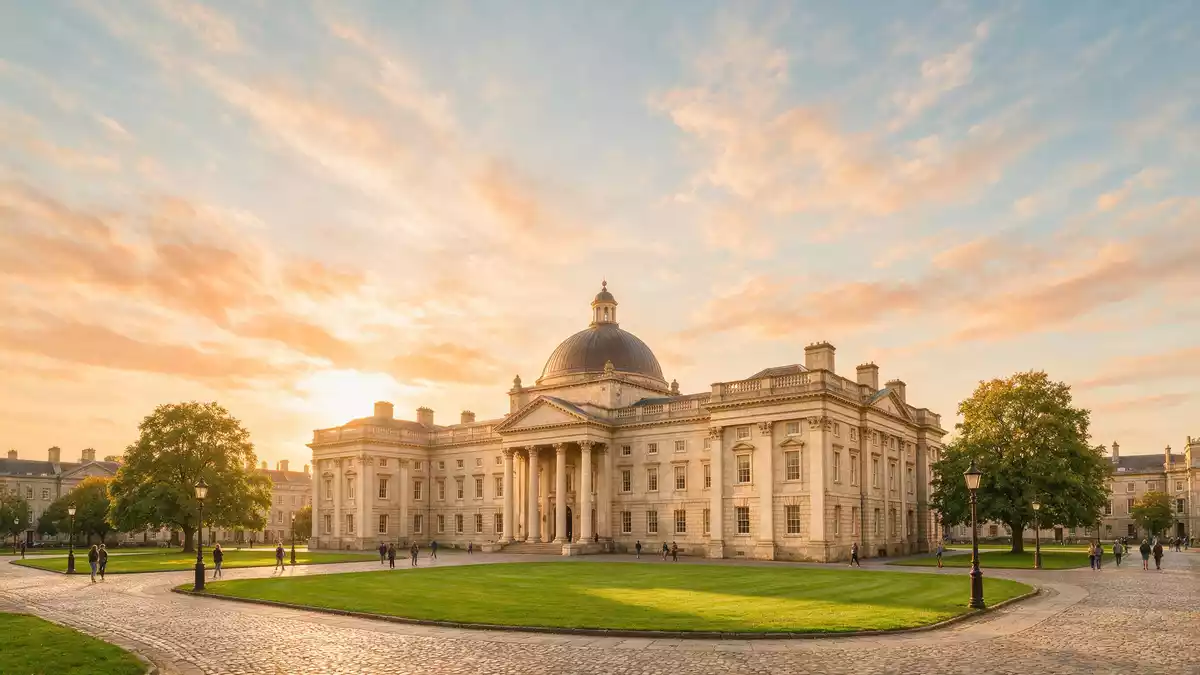
Colaiste na Trionoide is the historic university campus in central Dublin where grand stone squares, neoclassical halls and a remarkable eighteenth-century library sit within one set of walls. Founded in 1592 by Queen Elizabeth I as Ireland’s oldest university, it anchors a district where academic life and city streets meet. Walking through its main gates reveals courtyards, chapels and a celebrated library that together form one of the most extensive ensembles of eighteenth-century architecture in Ireland.
From royal foundation to Georgian quadrangles
Colaiste na Trionoide was established in 1592 through a royal charter granted by Queen Elizabeth I, creating the College of the Holy and Undivided Trinity of Queen Elizabeth near Dublin as the first and only college of the University of Dublin.founded in 1592 by Queen Elizabeth I The site lay just outside the old city walls when Dublin was a compact medieval town, using land that had previously been occupied by the Augustinian Priory of All Hallows.former Priory of All Hallows As the city expanded eastwards, the campus moved from being a separate enclave to forming part of the urban centre.
The college grounds extend across an area that is described as around 47 acres, organised into formal squares framed by stone buildings.the college's main grounds Front Square, sometimes called Parliament Square, is dominated by the West Front and a cluster of eighteenth-century structures that gave the university a classical architectural character.Parliament Square’s neoclassical architecture Buildings such as the Chapel, Examination Hall, Dining Hall and Provost’s House form a coherent neoclassical ensemble, reflecting the ambitions of the eighteenth century to give the university a monumental face towards College Green.
The Campanile and the rhythm of the squares
At the centre of the western side of the campus stands the Campanile, a stone bell tower that has become one of the most recognisable features of Colaiste na Trionoide.the campanile bell tower It rises between Parliament and Library Squares and marks a junction where paths from different parts of the college converge. The tower’s classical detailing and sculpted figures echo the surrounding neoclassical facades, tying together chapels, halls and the Old Library.
Around the Campanile, the squares show layers of building periods. Some of the oldest surviving college fabric can be found in the Rubrics, which preserves parts of the seventeenth-century quadrangle that pre-date the grand Georgian schemes.the Rubrics as seventeenth-century fabric Later additions include the Museum Building from the nineteenth century and more recent academic buildings, which introduce different architectural languages yet remain tied into the grid of courtyards. Crossing from one square to another, the stone underfoot often shifts from older cobbles to smoother paving, but the axes and vistas maintain a consistent organisation around the Campanile and the Old Library.
The Old Library and the Long Room
The Old Library at Colaiste na Trionoide is an eighteenth-century building that has become one of the most visited parts of the campus, both for its architecture and for the treasures it contains.magnificent Old Library building Construction began in 1712 under the architect Thomas Burgh, creating a long, tall structure aligned with Library Square.built between 1712 and 1732 Inside, the main chamber is known as the Long Room, a space that stretches for nearly 65 m (about 213 ft) and is lined with tiers of oak bookcases housing around 200,000 of the library’s oldest volumes.nearly 65 metres in length
Originally, the Long Room had a flat plaster ceiling and a single tier of shelving, but in the nineteenth century the roof was raised and a vaulted profile introduced to accommodate growing collections.roof raised and ceiling altered Marble busts of philosophers, writers and college figures stand between the bays, forming a gallery of stone faces along the central passage.marble busts line the Long Room Among the manuscripts held by the library is the Book of Kells, a richly decorated ninth-century gospel book displayed in a dedicated treasury beneath the Long Room, and the harp often called the Brian Boru harp, regarded as the oldest surviving Irish harp.Book of Kells in the Old Librarythe Brian Boru harp
Visiting Colaiste na Trionoide: what travellers from Western Europe should know
- Colaiste na Trionoide stands on College Green in central Dublin, bounded by streets such as Nassau Street and Pearse Street, with its main entrance facing the city’s historic core.
- The central squares of the campus are paved in cobbles and flagstones, and moving between them involves crossing open courtyards and walking on uneven historic surfaces in places.
- The Old Library building, including the Long Room, is reached via internal stairways and corridors; visitors pass through an entrance shop before entering the exhibition spaces and the main chamber.
- The official language is Irish and English and the currency is the euro.
Searching for Colaiste na Trionoide on social platforms
These links open searches for Colaiste na Trionoide on each platform.
Frequently asked questions about Colaiste na Trionoide
Where is Colaiste na Trionoide located in Dublin?
Colaiste na Trionoide occupies a walled campus off College Green in central Dublin, bordered by city streets and integrated into the historic urban core.
What can visitors expect when entering the campus?
Visitors pass through a formal gateway into cobbled squares framed by neoclassical and later stone buildings, with views of the Campanile, chapels, halls and the Old Library.
What makes the Old Library and Long Room distinctive?
The Long Room’s extended eighteenth-century chamber, lined with oak bookcases, marble busts and historic manuscripts such as the Book of Kells and the Brian Boru harp, gives the library its distinctive character.


