
Ciutat de les Arts i les Ciencies turns Valencia into architecture
Published on 09/24/2026 at 01:21 | Editorial responsibility: Rafael Müller, Editor-in-Chief AD HOC NEWS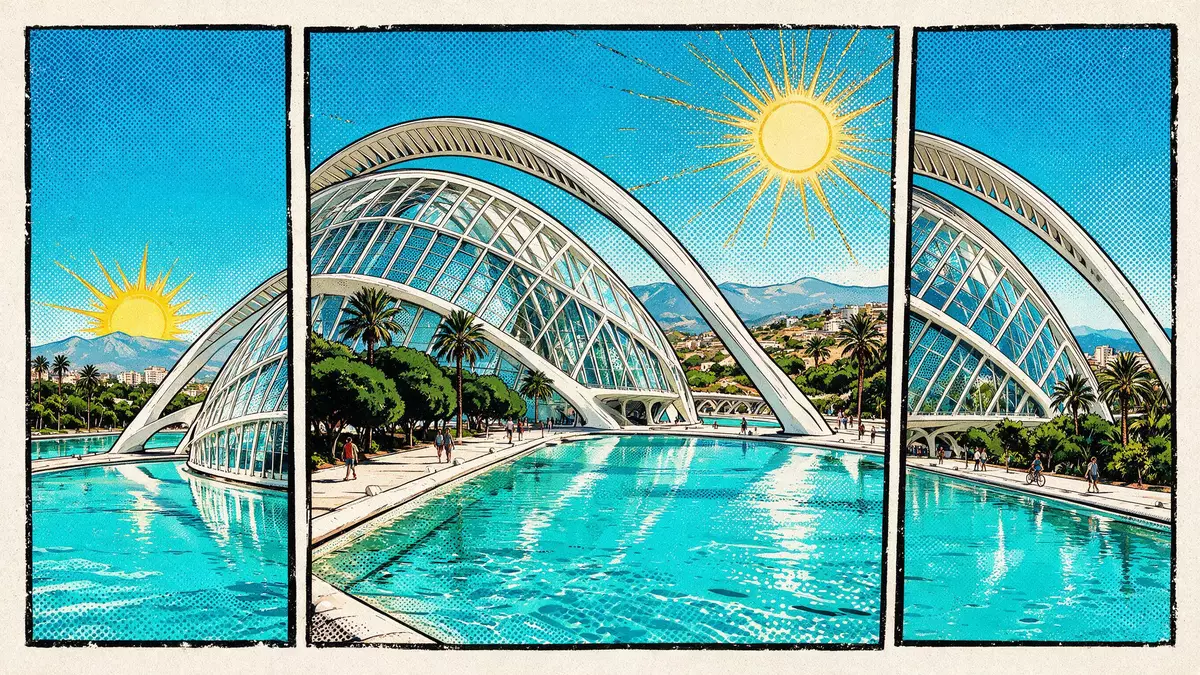
Ciutat de les Arts i les Ciencies stretches through Valencia as a sequence of white structures, reflective water and open public space. Designed chiefly by Santiago Calatrava, with Félix Candela responsible for L’Oceanogràfic, the complex combines science, performance, cinema, planting and marine habitats.
White architecture along the Turia gardens
The complex occupies the former bed of the River Turia, within the long green corridor that crosses Valencia. Its architecture is built from concrete, steel, glass and ceramic surfaces, with large curved forms set against pools and paved terraces. The buildings are separate, but their shared vocabulary creates a continuous architectural landscape.
Calatrava’s principal buildings include L’Hemisfèric, the Museu de les Ciències Príncipe Felipe, L’Umbracle, the Palau de les Arts Reina Sofía and L’Àgora. The official architecture overview identifies Santiago Calatrava’s buildings across the complex, alongside Candela’s work at the aquarium.
From L’Hemisfèric to the Palau de les Arts
The first building opened in 1998, when L’Hemisfèric began the complex’s public life. Its programme includes planetarium presentations, large-format cinema and full-dome screenings. The building’s broad shell surrounds a large opening above the water, giving it a strong presence within the central axis.
The Museu de les Ciències Príncipe Felipe opened in 2000 as an interactive science museum. L’Umbracle followed in 2001 as a landscaped promenade and covered parking structure. L’Oceanogràfic opened in 2003, while the Palau de les Arts Reina Sofía opened in 2005 as a major opera and performing-arts venue. L’Àgora completed the principal sequence in 2009 as a covered civic space. These dates are recorded in the complex’s opening sequence.
Science, performance and marine habitats
Ciutat de les Arts i les Ciencies is not a single museum or monument. It is a group of institutions with distinct functions, joined by a common setting and a consistent architectural language. The science museum presents exhibitions, L’Hemisfèric combines cinema with astronomy, and the Palau de les Arts houses performances.
L’Oceanogràfic forms a separate marine world within the complex. Its buildings use shell-like concrete roofs associated with Félix Candela, whose contribution gives the aquarium a different structural character from Calatrava’s principal volumes. The Palau de les Arts, by contrast, is defined by its long curved roof and layered terraces. Calatrava’s project overview places the ensemble on Avenida del Professor López Piñero in Valencia, beside the Turia gardens.
Visiting Ciutat de les Arts i les Ciencies: what travellers from Western Europe should know
- Ciutat de les Arts i les Ciencies lies in Valencia beside the Turia gardens, on Avenida del Professor López Piñero. Valencia’s urban transport network connects the district with the city centre.
- The site is spread across broad terraces, bridges, pools and separate buildings. Moving between the science museum, L’Hemisfèric, L’Umbracle, the aquarium and the opera house involves outdoor walking.
- The complex is in Spain, where Spanish and Valencian are official languages. The currency is the euro.
Searching for Ciutat de les Arts i les Ciencies on social platforms
These links open searches for Ciutat de les Arts i les Ciencies on each platform.
Frequently asked questions about Ciutat de les Arts i les Ciencies
Where is Ciutat de les Arts i les Ciencies?
It is in Valencia, Spain, beside the Turia gardens on Avenida del Professor López Piñero. The complex occupies the former bed of the River Turia.
What can visitors find there?
The buildings contain a science museum, a planetarium and full-dome cinema, an aquarium, an opera house, a landscaped promenade and a covered civic space.
What makes the complex distinctive?
Its identity comes from the combination of Calatrava’s sweeping white architecture, Candela’s aquarium roofs, reflective pools and several cultural institutions in one setting.


