
Ciutat de les Arts i les Ciencies and the white skyline of Valencia
Published on 09/14/2026 at 15:20 | Editorial responsibility: Rafael Müller, Editor-in-Chief AD HOC NEWS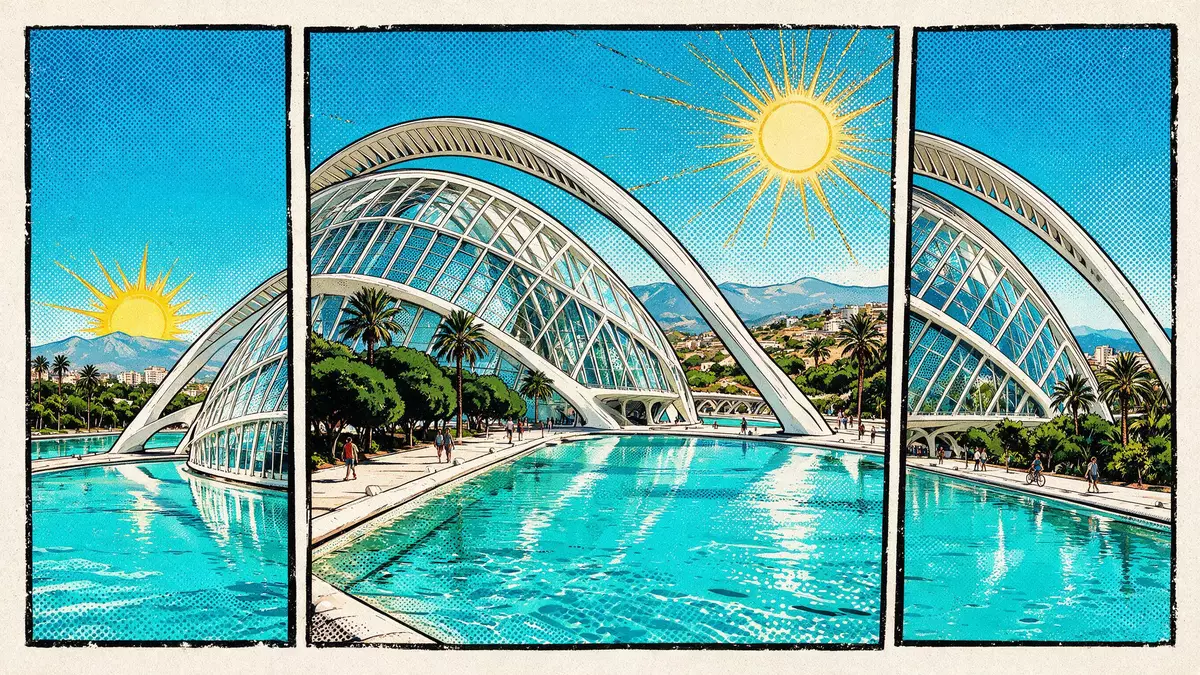
Ciutat de les Arts i les Ciencies in Valencia is a vast cultural and scientific complex where sweeping white architecture runs along the former bed of the Turia river for nearly two kilometres. Framed by shallow water and planted terraces, its buildings form a continuous skyline that has become one of the clearest modern silhouettes of Spain’s Mediterranean coast, bringing together an opera house, an aquarium, a science museum and landscaped promenades in a single ensemble dating from the late twentieth and early twenty-first centuries.
A riverbed turned into a corridor of white structures
Ciutat de les Arts i les Ciencies occupies a long strip in Valencia where the Turia river once flowed towards the sea, a course that was diverted in the twentieth century and later turned into the Jardí del Túria park. The complex stretches for almost two kilometres along this corridor, its buildings aligned between the historic centre and the port and mirrored in pools that reflect their pale concrete and glass surfaces.stretches for almost two kilometres The ensemble occupies more than 350,000 m², a footprint that makes its line of structures a sizeable district rather than a single monument.350,000 m2
The lead architect of Ciutat de les Arts i les Ciencies is Santiago Calatrava, a Valencian engineer and architect known for sculptural bridges and white concrete forms, working alongside Félix Candela on parts of the project.designed by Santiago Calatrava Construction of the complex proceeded in phases from 1998 into the first decade of the twenty-first century, with different elements opening over more than ten years.opened in phases from 1998–2009 This extended timeline gives the site a unified visual language across several structures while still marking it as a product of a particular era of ambitious civic building in Spain.
Six main elements: science, opera, gardens and water
Ciutat de les Arts i les Ciencies is organised into six principal components, each with a distinct role in the complex yet sharing a coherent architectural vocabulary of white surfaces, structural ribs and extensive water features. At one end stands L’Hemisfèric, a planetarium and cinema that combines IMAX projection, 3D screenings and digital shows within a low structure that rises from a surrounding pool.the Hemisfèric Beside it runs L’Umbracle, a landscaped viewpoint with planting and an elevated promenade above parking, offering views along the sequence of buildings.
Further along the axis is the Museu de les Ciències, a large interactive science museum housed in a building defined by exposed structural frames and glazed walls that open long interior galleries to the light. Opposite it lies the Oceanogràfic, an aquarium recognised as the largest in Europe, with a collection running into thousands of creatures across hundreds of species housed in multiple pavilions and outdoor pools.largest aquarium in Europe The Palau de les Arts Reina Sofía provides an opera house and wider performing arts venue under an extensive roof, while the Àgora adds a multifuncional events hall to complete the set of six named elements that define the complex.six major elements
Neo-futurist forms and a new skyline for Valencia
Architecturally, Ciutat de les Arts i les Ciencies stands out for its neo-futurist and structural expressionist approach, seen in the way structural members are expressed as part of the visual language of the buildings. Calatrava’s designs use pale concrete, glass and steel to create long ribs, curved roofs and projecting elements that give each structure a sculptural presence while maintaining a family resemblance across the complex.neo-futurist and structural expressionist The repeated use of reflection pools means that façades are doubled in the water, extending the apparent height and length of the skyline and setting the white forms against blue surfaces.
Many visitors recognise Ciutat de les Arts i les Ciencies from photographs where the complex appears as a continuous sequence of white structures running across the frame, establishing a modern counterpart to the older fabric of Valencia around the cathedral and historic streets. The buildings are aligned along the axis of the former riverbed, producing a visual corridor that frames long views and emphasises the relationship between architecture and the landscaped park that continues beyond the complex.located along the old course of the Turia river This setting makes the ensemble both a destination in itself and a prominent landmark along walking and cycling routes through the Jardí del Túria.
Visiting Ciutat de les Arts i les Ciencies: what travellers from Western Europe should know
- Ciutat de les Arts i les Ciencies lies south-east of Valencia’s historic centre along the Jardí del Túria, reached by city buses, urban tram services and roads such as Avenida del Professor López Piñero.
- The site is spread along a broad, level axis with wide paved promenades, shallow ornamental water basins around several buildings and stairways and ramps connecting different terraces and entrances.
- Ciutat de les Arts i les Ciencies is part of Spain, where the official language is Spanish alongside Valencian, and the national currency is the euro.
- Nearby, the Jardí del Túria continues towards the historic centre, while the port and seafront districts of Valencia lie in the opposite direction along the former river course.
Searching for Ciutat de les Arts i les Ciencies on social platforms
These links open searches for Ciutat de les Arts i les Ciencies on each platform.
Frequently asked questions about Ciutat de les Arts i les Ciencies
Where is Ciutat de les Arts i les Ciencies located in Valencia?
Ciutat de les Arts i les Ciencies stands along the former Turia riverbed between Valencia’s historic centre and its port, within the broader Jardí del Túria corridor.
What can visitors expect from a visit to Ciutat de les Arts i les Ciencies?
Visitors encounter a sequence of white, contemporary buildings housing a science museum, planetarium, aquarium, opera house and events spaces, set among pools, gardens and broad promenades.
What makes Ciutat de les Arts i les Ciencies distinctive among European cultural complexes?
The combination of neo-futurist architecture by Santiago Calatrava, the European-scale aquarium, and the continuous riverside setting gives Ciutat de les Arts i les Ciencies a recognisable modern skyline.


